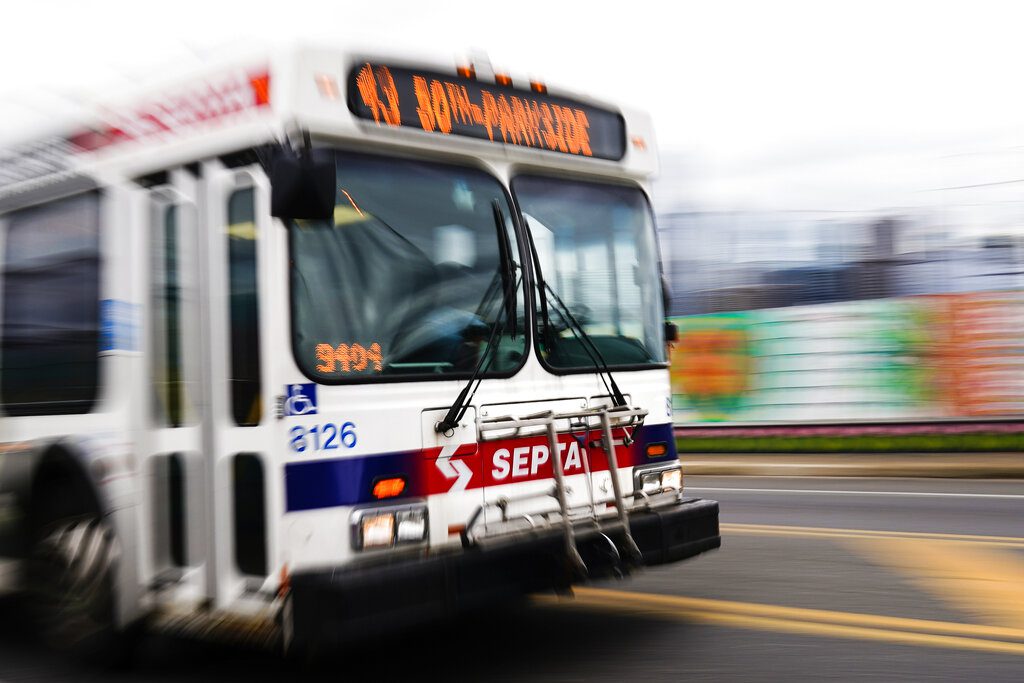
FILE—A Southeastern Pennsylvania Transportation Authority (SEPTA) bus is driven in Philadelphia, in this file photo from, Oct. 27, 2021. Members of Philadelphia's largest transit worker's union announced early Friday, Oct. 29, 2021 they reached a tentative contract agreement. The agreement has averted a possible strike that threatened to bring elevated trains, buses and trolleys to a halt and leave thousands of children and educators without a way to get to school next week. (AP Photo/Matt Rourke, File)
HARRISBURG, Pa. (AP) — Philadelphia’s public transit agency said Friday that it will restore services that it eliminated after a judge ordered it to undo the two-week-old cuts that were challenged in court as discriminatory toward poor and minority communities.
The Southeastern Pennsylvania Transportation Authority said it is working on a plan to restore service, and it moved to divert funding set aside for capital projects to keep those services intact for another two years.
SEPTA — one of the nation’s largest mass transit agencies — had described the cuts as more drastic than any undertaken by a major transit agency in the U.S. but necessary to deal with a deficit of more than $200 million.
At a news conference, SEPTA’s general manager, Scott Sauer, said the solution wasn’t ideal or sustainable, and “over the last two weeks, we’ve seen the devastating effects the service cuts have had on our riders.”
In a letter to the state Department of Transportation, Sauer asked for permission to use up to $394 million in state-provided capital funds to restore services and avoid other planned cuts for the next two years.
That’s about a year’s worth of funding it gets from the state for capital projects, but Sauer wrote that SEPTA believes diverting the cash and deferring capital projects won’t jeopardize the safety of riders. If PennDOT approves the transfer, SEPTA can restore the services Sept. 14, Sauer said.
In a statement, Gov. Josh Shapiro’s office said the administration was “reviewing the request and determining next steps.” The Democratic governor has said he was open to diverting capital funds as part of a broader funding package for struggling transit agencies.
Across the state, Pittsburgh Regional Transit is considering a 35% service reduction to help close what it calls a roughly $100 million deficit this year. That could include eliminating 45 bus routes, reducing 54 others and eliminating one of three light rail lines.
In the state Capitol, Shapiro and Democratic lawmakers have been unable for the past two years to persuade enough Republican lawmakers to approve hundreds of millions more dollars in new transit aid to help fill deficits at SEPTA and other transit agencies around the state.
SEPTA has said its cuts amounted to a 20% across-the-board service reduction. That included eliminating bus routes with lower ridership and reducing the frequency of bus, trolley and rail services across the region.
After the cuts took effect, students and commuters had talked of needing to get up much earlier to make time for longer commutes, unusually crowded buses and skipped stops. Some said they were spending more on ridesharing or worried about losing their job.
SEPTA was leaving many more people behind at bus and trolley stops due to crowded conditions, while the number of bus trips running late rose more than 26%, Sauer said.
The authority still plans to go forward with fare increases of 21.5% on Sept. 14 that it estimated will bring in $31 million a year.
That increase had been set to take effect earlier this week for the system’s approximately 800,000 daily riders before the same judge temporarily halted it. However, the judge lifted her order on the fare increases that will boost a weekday ride from $2.50 to $2.90 on a bus, train or trolley.
The struggles in the nation’s sixth-most populous city reflect similar dilemmas at major transit agencies around the U.S. as they navigate rising costs and lagging ridership after the COVID-19 pandemic disrupted commutes.
All told, SEPTA had warned that it will cut half its services by Jan. 1 and wouldn’t provide enhanced service for major tourist events next year. Those include FIFA World Cup matches in Philadelphia, events surrounding the celebration of the nation’s 250th birthday, Major League Baseball’s All-Star Game, the PGA Championship and NCAA March Madness games.
Author

Pa. lawmakers and doctors push back against RFK Jr.’s vaccine policies
Health and Human Services Secretary Robert F. Kennedy Jr. started the new year changing childhood vaccine schedules despite pushback from the...
ICE pushback in a key Pa. congressional district after unpaid rent allegation
Controller Mark Pinsley said the agency hasn’t paid for space it rents in a Lehigh County government building. A sitting county controller and U.S....
After a year of uncertainty, federal mine safety research employees in Pa. get good news
“This has been a tough battle here. I think we’re finally coming to a true win.” Hundreds of federal employees at the National Institute for...

If you want to start living the van life, here’s what to consider
If you’re thinking about enjoying the van life by traveling and sleeping in a camper van, there are several things you should keep in mind when...

Ben Crump to be featured speaker at Erie MLK awards dinner
Prominent civil rights attorney Ben Crump will be the featured speaker at the 15th annual Dr. King Awards Dinner in Erie on Jan. 17. The theme for...