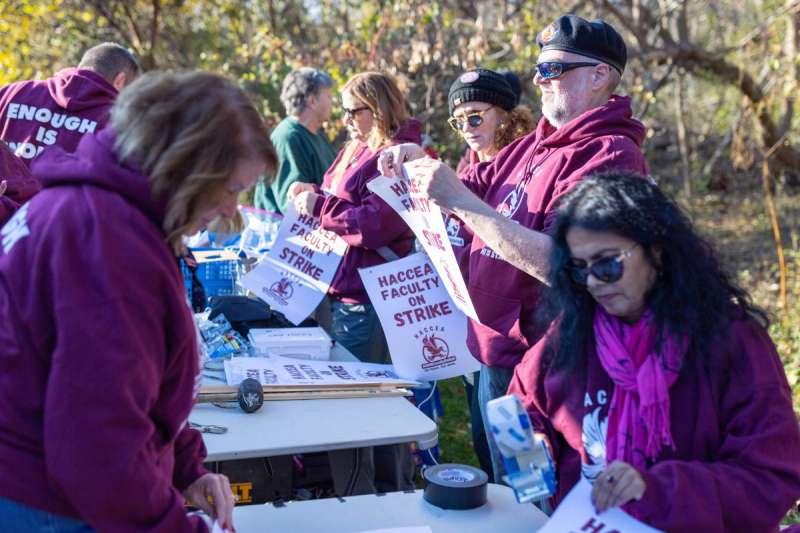
Harrisburg Area Community College (HACC) staff have been organizing for over five years. Now, they’re on strike.
After years of facing anti-union hostilities from the administration at Harrisburg Area Community College (HACC), hundreds of professors and faculty members went on strike Monday to secure their first union contract.
HACC’s administration has subjected its professors to union-busting and anti-union propaganda when they began circulating petitions to form a union more than five years ago. They have now gone more than 40 months without a resolution or a pay raise.
“It’s been 42 months without a contract. This started in our organizing campaign where a list was submitted by administration that had 1,100 plus faculty names on it. That was not an accurate list,” Amy Withrow, a 20-year English professor and the HACC Education Association’s (HACCEA) chief negotiator, said in an interview.
HACC’s administration tried delaying the signature collection process at the time by using an inflated list of ineligible bargaining unit members so the union would be unable to meet the required threshold to have an election.
“We certainly worked with the [Pennsylvania Labor Relations Board] to challenge that [list], and once again, in that particular case, the decision was made in favor of the union that that list was inaccurate. That was all the way back in the organizing campaign, and so now fast forward, we’ve unionized and the negotiations have been just incredibly slow.”
There are roughly 750 faculty members who teach classes at HACC’s campuses in Adams, Dauphin, Lancaster, Lebanon and York counties.
While professors were organizing in 2020 and 2021, Dr. John Sygielski, President of HACC, and the school’s administration sent around anti-union pamphlets that said “Union NO” and spread misleading videos about the card signing or petitioning process.
One video, which featured a human relations manager, incorrectly stated that if professors collected more than 50% of signatures from faculty during the petition process then there would be no union election and the union would be automatically approved.
In August 2020, Sygielski emailed HACC’s faculty warning them about the card authorization process.
“Over the next couple of weeks, we will be sending you information that we hope will show you that you are better off without the union,” Sygielski said at the time.
Despite the administration’s anti-union efforts, HACCEA was successful in collecting the needed signatures to hold an election and eventually voted in favor of unionizing in April 2022. Still, the signers have been working without a raise for 42 months even though HACC’s Board of Trustees approved 3% raises for all employees.
A spokesperson for HACC’s administration claimed that the school was not allowed to pass those raises along to the professors and faculty members because the school “is legally prohibited from unilaterally providing salary increases to unionized faculty until a contract is finalized” and “doing so would violate the terms of the memorandum of understanding and state labor law.”
A right-to-know request obtained by The Keystone shows that some HACC officials received raises of $10,000 to $23,000 in 2025, which were much greater than the 3% raises approved by the trustees.
Financial issues aren’t the only disagreements HACC professors and faculty members have with their administration. They’re claiming that the school has been dragging its feet on status quo agreements that keep the school operating on a day to day basis.
“ I’ve been here since 2000 and we’ve always had what’s called shared governance, which is sort of like a misnomer here,” Cindi Davis, a professor at HACC’s early childhood elementary education department, said in an interview.
Shared governance is a collaborative approach where faculty, administrators and other stakeholders set policies for the school or workplace, but the school doesn’t have to abide by those policies if they are not negotiated in a contract.
“I’ve been in faculty governance positions for a very long time, and it’s shared governance in word only because if they don’t feel like following whatever policies they’ve set up, they just don’t. So there’s nothing to back us up.”
She added, ”one of the status quo things that happened to most of us was class size was nine. That was the minimum to have classes. All of a sudden in the middle of things, they changed it to 12. So that was a status quo issue that got changed on us with zero ability for us to talk about it, change it, or do anything like that.”