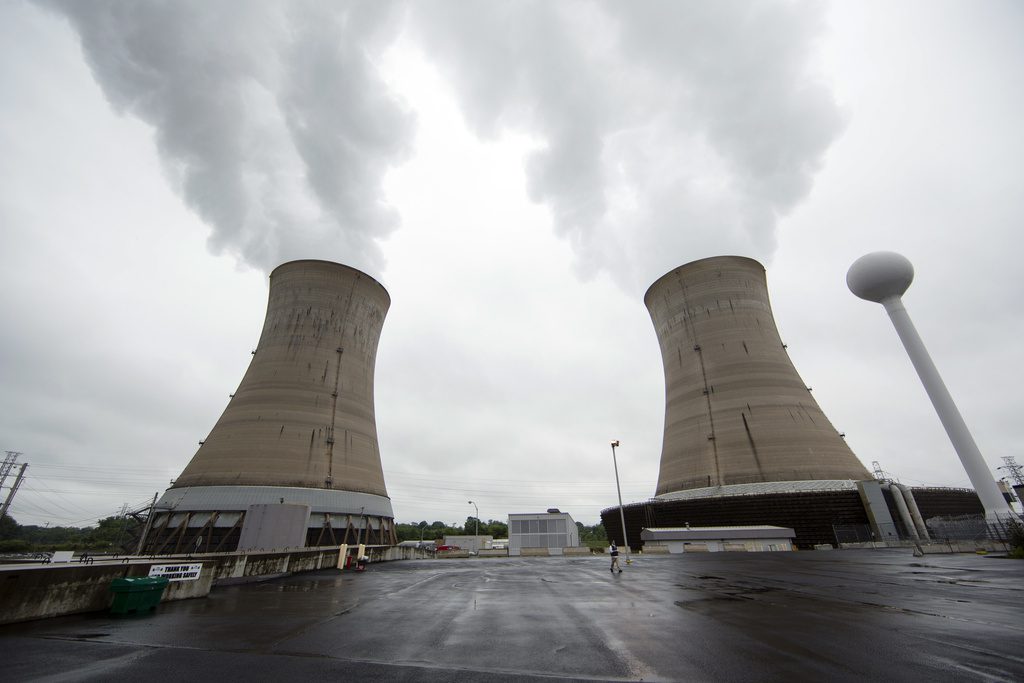
Microsoft and Constellation Energy’s effort to restart the nuclear power plant at Three Mile Island to power artificial intelligence is a poster child for the Trump administration’s agenda, U.S. Energy Secretary Christopher Wright said Wednesday.
“It’s delivering on two of our large promises,” he said after touring the 50-year-old power station in Dauphin County.
One, Wright said, is to reduce the cost of electricity as energy-intensive data centers drive up demand and prices.
The other is to win the race in AI, an endeavor with far-reaching economic, scientific and national security implications, he told workers readying the plant — rebranded as the Crane Clean Energy Center. It’s slated to begin generating power again in 2027.
Since his inauguration in January, President Donald Trump has issued executive orders directing the Energy Department to end support for wind and solar generation and clear the way for new nuclear development.
“We want to keep existing plants open. We want to open … plants that were prematurely closed. We are expediting the building of new plants,” Wright said.
But environmentalists warn that energy prices will continue to increase as renewable energy projects in the pipeline face delays to connect to the region’s electricity grid or are canceled outright.
PJM Interconnection, which manages the wholesale electricity market and grid in Pennsylvania and 12 other states, announced Wednesday that its most recent capacity auction fell short of securing enough generating capacity to meet its 20% reserve for peak demands in 2027-2028.
That was despite prices maxing out at a cap established in a settlement with the Commonwealth of Pennsylvania after an auction last year resulted in record capacity prices.
PJM said in a statement the auction result doesn’t mean that it will be unable to meet peak demands. The grid will have a 15% reserve and other factors could result in the margin being larger.
“But this auction leaves no doubt that data centers’ demand for electricity continues to far outstrip new supply, and the solution will require concerted action involving PJM, its stakeholders, state and federal partners, and the data center industry itself,” the agency’s incoming CEO Stu Bresler said.
Environmentalists, consumer advocates and state regulators have called on PJM to adopt new market rules that insulate consumers from costs driven by the needs of data centers, such as building new power plants and transmission lines.
“As we approach the holiday season, families should be spending their hard-earned dollars on family meals and presents for each other, not forking more money over to the utility companies and Big Tech’s power needs,” Sierra Club Senior Advisor Jessi Eidbo said.
She noted that the most recent residual capacity auction is the last covered by the Shapiro administration’s price cap settlement.
PJM’s independent market monitor, which serves as a watchdog for PJM consumers, has also asked federal regulators to adopt rules to prevent data centers and other large electricity users from connecting to the grid without an established capacity to meet their needs. To allow otherwise would put retail ratepayers on the hook for new power plants and transmission lines, the monitor argued in a filing with the Federal Energy Regulatory Commission (FERC).
Three Mile Island was mothballed in a move that Constellation CEO Joe Dominguez said was a mistake.
The plant was the site of a partial nuclear meltdown in 1979 – among the nation’s worst nuclear energy disasters – that permanently disabled one of its two reactors. The remaining unit restarted several years after the accident and remained in operation until Constellation decided it was no longer profitable in 2019.
Last year, the Baltimore-headquartered company announced it would restart the Unit 1 reactor in a $1.6 billion deal with Microsoft, which agreed to purchase the plant’s entire 835 megawatt output to power its data centers.
The Department of Energy last month announced it had closed a $1 billion loan for Constellation, which Dominguez said would reduce the cost of borrowing for the project. He said the company would reinvest the savings in upgrades for the plant.
“What we’re seeing right now is a renewed interest across the country in nuclear, understanding that the first and most important thing we need to do is bring back to life assets that we mistakenly closed,” Dominguez said.
Microsoft’s Vice President of Energy Bobby Hollis said Three Mile Island was a unique opportunity for the company as it positioned itself as a leader in AI.
“We’re seeing lots within the energy sector recognize what needs to be happening now, which is add energy capacity to the grid, find the opportunities that are not the typical opportunities,” Hollis said, adding that Three Mile Island and other recently closed nuclear plants will bring carbon-free electricity to market faster than technology still under development.
This year, Palisades Nuclear Generating Station in Michigan became the first in the nation to be restarted. The owner of the Duane Arnold Nuclear Power Plant in Iowa is also exploring potential deals with tech companies to restart that plant.
Asked about the proposed rules for new data center and large load connections in PJM, Wright said the Department of Energy is working to respond to the dynamics of the new energy economy.
“Sadly, we’ve had three decades of very little demand growth for electricity. It’s been a world more of stasis, and now we’re in a world of rapid growth,” Wright said, noting that the Nuclear Regulatory Commission and FERC are implementing reforms to speed the addition of new sources.
The use of AI and automation will also help regulators and operators like PJM optimize resources to best meet demand, he said. But the federal government is also pushing PJM and other operators to prioritize projects that are most likely to come to fruition.
Dominguez said the rules proposed by the independent market monitor are unworkable. To build a nuclear power plant or a natural gas-fired plant from scratch would take the best part of a decade.
“So if you want to tell the folks in our data economy that they can’t put AI to work until we get new power plants operating … and wait five, six, seven years … the AI race is going to be over,” he added.