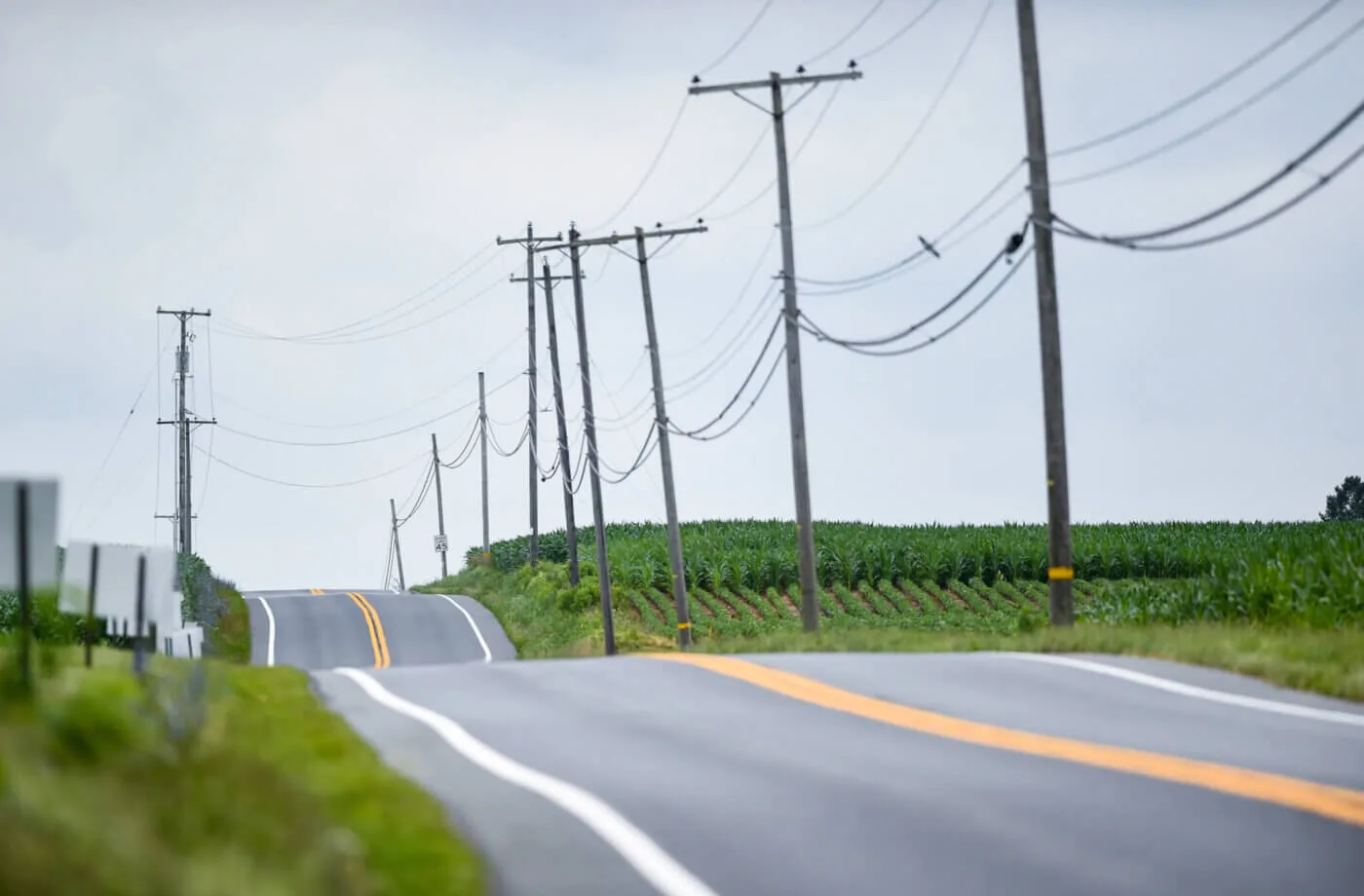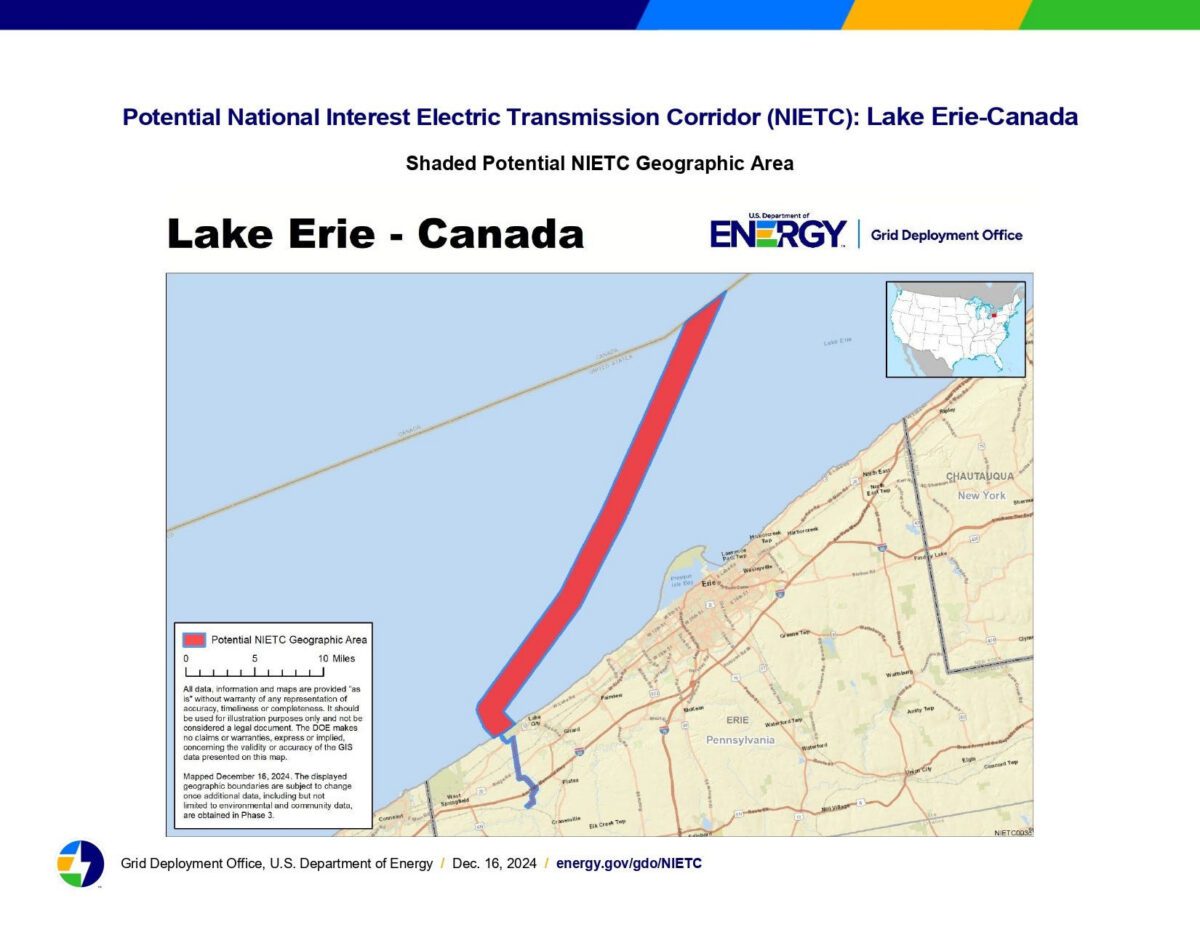
This map shows the U.S. portion of the proposed electric transmission line from the Canadian border in Lake Erie to the planned converter station in western Erie County. (Photo: USA Today Network)
A proposal to build an underwater line to transmit electricity from Canada to Erie County is once again seeking government approvals.
First proposed in 2013, the project had been suspended because of escalating costs in 2022.
It was revived by NextEra Energy Transmission, a subsidiary of Florida-based NextEra Energy, which acquired the project in January 2024.
Since then, the proposed Lake Erie transmission line has been identified as a potential “national interest electric transmission corridor” by the U.S. Department of Energy. Projects designated as NIETCs could qualify for accelerated permitting to boost transmission and reduce consumer costs in areas experiencing or expected to experience energy shortfalls.
On the state level, the Pennsylvania Department of Environmental Protection recently accepted public comments on the proposed transmission line. The department will consider the comments before determining whether the project meets requirements to conserve and protect the state-managed coastal zone.
A number of other approvals are still needed.
“Overall, the project is progressing through the regulatory process as expected for a project of this scale,” a spokesperson for NextEra Energy Transmission said in an email to the Erie Times-News.
If approved, the transmission line is expected to be operational in 2031, according to the company.
The proposal
The Lake Erie Connector would be a 73-mile transmission line to bring electricity from Nanticoke, Ontario, to Erie County.
Most of the line would be installed beneath Lake Erie. It would reach land in western Erie County and run underground for about seven miles through Springfield, Girard and Conneaut townships, mainly along road rights-of-way.
The line would carry power generated at various sites in Canada to a converter station that would be built west of Elk Creek in Springfield Township. The station would convert direct current electricity from the transmission line to the alternating current of the existing power network.
Electricity then would go to Penelec’s nearby Erie West substation for distribution.
The line would carry up to 1,000 megawatts, enough to power about 800,000 homes. The electricity would be distributed not only in western Pennsylvania but through the PJM grid, the nation’s largest, serving Pennsylvania, Ohio and 11 other states.
The new converter station alternately could convert AC power to direct current for transmission to Ontario.
Increasing demand
The Erie region is at high risk for shortfalls in available electricity by 2030, according to the annual 10-year reliability assessment released by the North American Electric Reliability Corp. on Jan. 29.
Demand for electricity is growing, due in part to increased use by artificial intelligence data centers, large industrial facilities, electric transportation and the digital economy, according to the report.
High-risk areas of the United States include all of Pennsylvania served by the PJM grid.
Nationally, the demand for electricity is expected to grow by 25% by 2030 and by 78% by 2050, according to an analysis by the data consulting firm ICF.
The Lake Erie Connector project would help solve grid issues in Erie County and beyond, the NextEra Energy Transmission spokesperson said.
“For residents in western Pennsylvania, increased transmission capacity would strengthen the electric system and support access to additional energy resources. Stronger regional connections also support grid resilience and can help residents benefit from competitive, low-cost power available across the PJM footprint.”
Years of planning
The Lake Erie transmission line was first proposed by Lake Erie Power Corp. of Canada in 2013. Michigan-based ITC Holdings took on the project but suspended it in 2022 due to rapidly rising costs, according to testimony presented to the Canadian Parliament in October 2024.
Costs initially had been projected at $1 billion.
The proposed route has been altered over the years to avoid Erie Bluffs State Park and other environmentally sensitive areas, according to the U.S. Department of Energy.
Author


Vanpool program aims to solve transportation problems for many workers
Transportation to and from work is a real issue for many in York County and Southcentral Pennsylvania. A new commuter vanpool service was unveiled...
As electricity costs rise, everyone wants data centers to pick up their tab. But how?
As outrage spreads over energy-hungry data centers, politicians from President Donald Trump to local lawmakers have found rare bipartisan agreement...
Metzgar legislation to stop Turnpike Commission use of eminent domain
State Rep. Carl Walker Metzgar (R-Somerset) has announced his intention to introduce legislation that would eliminate the ability of the...

Verizon says hourslong outage that disrupted calling and data services has been resolved
Verizon said it resolved an outage that disrupted many U.S. customers' calling and other cellular services for more than 10 hours on Wednesday. The...

PA Turnpike tolls are increasing in 2026, but there is good news
Tolls on the Pennsylvania Turnpike are rising again in 2026, but the silver lining is that it's the smallest annual increase set by the Pennsylvania...