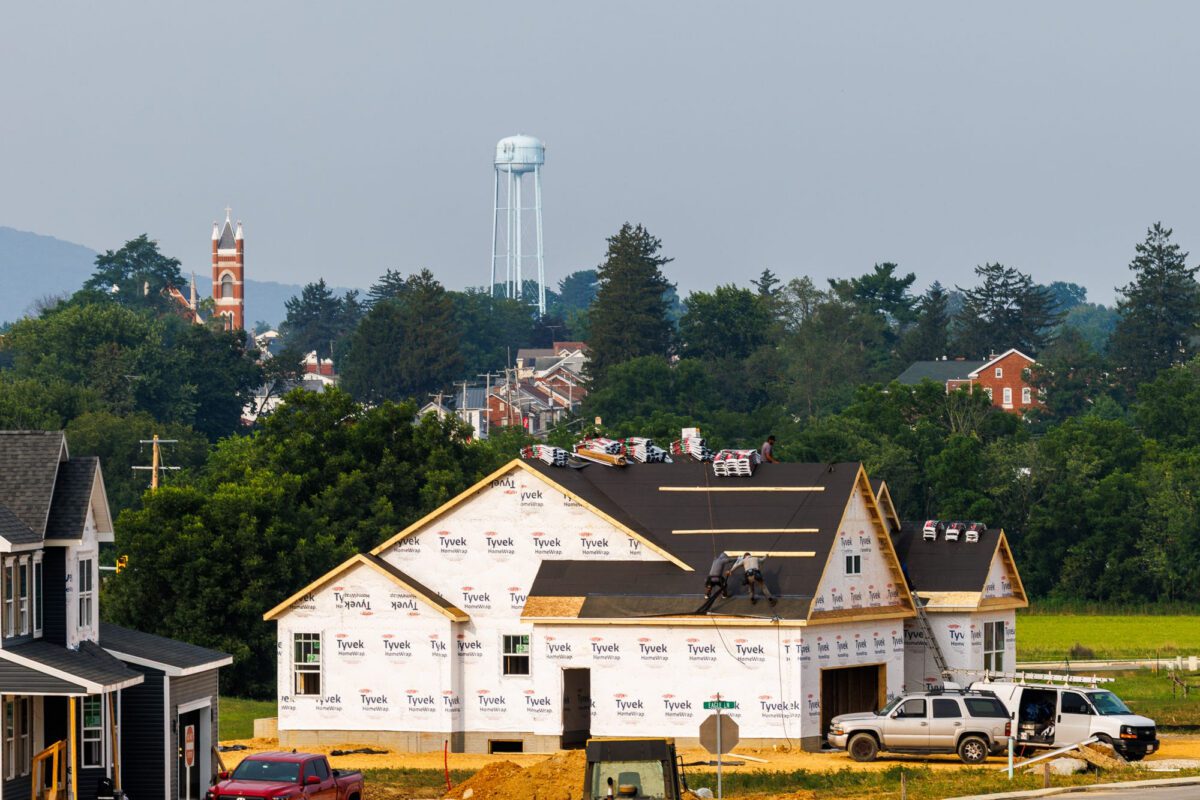
Construction crews work on houses in the new Eagle Rock housing development off of Route 116 in Conewago Township, Adams County, in August 2025. (Photo: USA Today Network)
Pennsylvania is short on homes, Gov. Josh Shapiro said in his budget address, which is making housing prices and rent too high.
To prevent the state’s home shortage from reaching 185,000 by 2035, Shapiro on Feb. 3 proposed $1 billion supported by bonds to go toward new housing, upgrades to old housing and other infrastructure projects for municipalities and schools.
Increasing money for the Pennsylvania Housing Affordability and Rehabilitation Enhancement Fund in last year’s budget helped. In the past 13 years, those funds have created or rehabbed nearly 4,000 affordable housing units across the state, according to the governor’s office.
But some builders believe their industry cannot build fast enough to meet demand.
“It’s impossible to catch up to the need if projects take three years to come to fruition. You can’t outpace that,” said Jeff Inch, founder of the development firm Inch & Co. that has projects in York, Dauphin, Adams, Cumberland and Lancaster counties. “If I have to carry a property for three years, pay interest, taxes, plus the amount to go back and forth with permits ― all that cost goes straight to the end user.”
While home building requires local permits, Dave Sanko with the Pennsylvania State Association of Township Supervisors believes state and federal regulations lead to more of a slog on the building process.
“Every place I go, I see stuff being built all the time in townships,” said Sanko, executive director of the organization that gives voice to more than 1,400 Second Class townships.
Different zoning laws across Pennsylvania’s 2,560 municipalities are not catalogued, Shapiro noted in his speech. Making one would help local governments understand what works best to build more.
This would be timely for municipalities that are tasked with figuring out how to allow data centers in their municipalities. Townships across Pennsylvania are faced with revising land use laws to make way for the new tech hubs required to fuel the artificial intelligence boom.
Updating the state’s Municipalities Planning Code is overdue, said Andrew Kaye, past president for the Pennsylvania Builders Association, who represents the state at the National Association of Home Builders.
Definitions have been added to the 1968-era planning code that Shapiro also wants to see updated. For instance, in 2013, electronic notice was defined in it. However, the law has not been amended since 1988.
An overhaul, Shapiro said, would help build where it makes sense and cut red tape where it is necessary.
“Whether it’s stormwater regulations, building codes ― we are just bogged down in red tape,” Kaye said of the building industry.
A recent survey of builders around the state showed that 30% of their costs go toward regulatory issues, Kaye said, with nearly half of that before construction starts.
Shortened timelines for permitting would help speed things up, Inch said. Without an incentive to move things along faster, he suggested the process is practically doomed.
“When you have groups of people that are not incentivized to build more houses, they have no reason to go faster,” he said. “I have to pay for a permit, and whether it takes one or 50 months, I can’t do anything about it. And they know that, so why go faster?”
Sanko pushed back on this notion, saying local government operates like a brake on the development process.
“The folks in the builders community would love it if there weren’t any rules,” he said. “Local government is to protect residents to make sure they’re getting quality housing units to maintain that community.”
Sanko said dozens of township supervisors have told him they have yet to see a project proposed with rent between $500 and $1,000 a month.
Agencies, particularly smaller governments that review massive development plans, could use more support since some do not have full-time planning and development employees, said Rob Bair, president of the Pennsylvania State Building and Construction Trades Council.
In the state’s largest city, with robust planning and permitting infrastructure, the Philadelphia Building and Construction Trades Council is working with Mayor Cherelle Parker to build more houses.
There, city officials are leveraging pension investment funds to cover affordable housing developments, said Ryan Boyer, business manager for the council that represents more than 50 labor unions in Philadelphia’s building and construction trades.
A modular home factory is being proposed in the city’s Logan Triangle, which Boyer said will allow indoor building to prevent weather delays that in Pennsylvania can last days or weeks.
What happens in Philadelphia with housing could be a model for the rest of the state. The city’s bureaucratic capacity to handle development gives it a natural advantage, Bair said.
“Cities can be leaders,” he said. “There is a lot that Philadelphia can do and is already doing just because of capacity.”
Author


Bipartisan coalition of state lawmakers looks to incentivize ‘pro-housing’ communities
A key area of reform would be pushing local governments to adopt “pro-housing” stances. A group of state lawmakers crossing party lines and...
Pa. lawmaker pitches ‘Golden Girls’ bill to reverse aged housing laws
Under Pennsylvania law, Rose, Blanche, Dorothy and Sophia couldn't commiserate over cheesecake in the kitchen they shared or spend time relaxing...
Do local camping bans criminalize homelessness? Lancaster County lawmaker says they do
A Pennsylvania lawmaker is decrying what he calls attempts to criminalize homelessness and says he wants to guarantee unsheltered people the right...

One of only 24 houseboats allowed at Presque Isle State Park is on the market
Only 24 houseboats are allowed to float on Horseshoe Pond at Presque Isle State Park and they don't often change owners. But for the second summer...
The most affordable places to live in Pennsylvania in 2025
See how far a dollar stretches in these 12 affordable places to live in Pennsylvania. Sometimes it feels like everything is getting more...