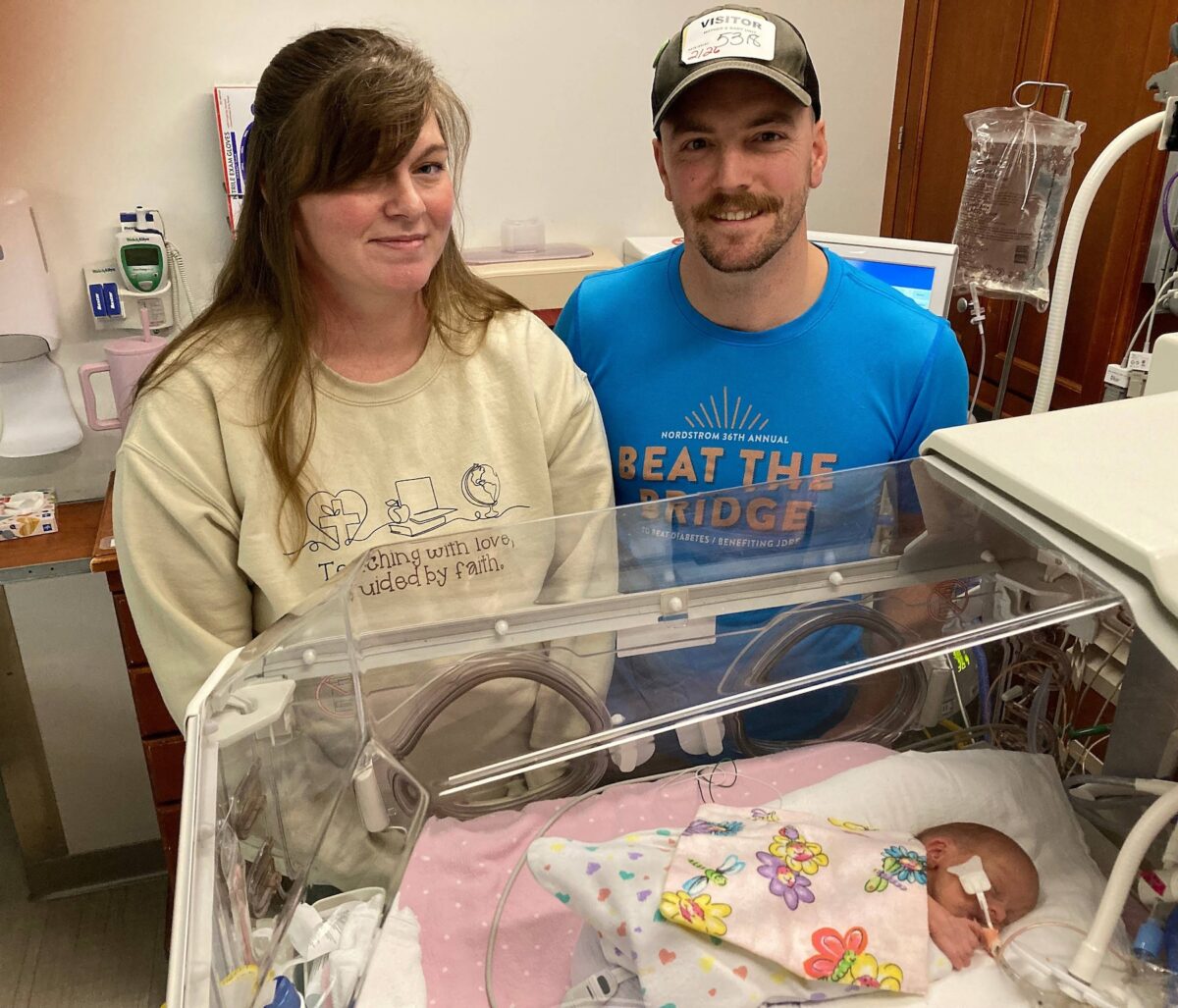
Mary Michel was born Feb. 16 at Saint Vincent Hospital, three months after her mother, Ericka, lost almost all of the baby's amniotic fluid. Ericka and Dustin Michel, of Corry, named their daughter after Jesus' mother. (Photo: USA Today Network)
Ericka Michel was standing on a stepstool in her Corry living room, spreading joint compound on drywall, when a small gush of fluid flowed between her legs.
Michel, almost 15 weeks pregnant at the time, thought she had wet her pants. She stepped off the stool and changed her clothes.
“I was pregnant and have four young children,” said Michel, 34. “My initial concern was about bladder control.”
The leakage didn’t stop, so Michel called her obstetrician’s office a few days later. She was told to head straight to the hospital.
Michel gathered her four children and drove to Saint Vincent Hospital, where doctors told her that she didn’t leak urine. It was amniotic fluid, the water-like substance that surrounds a fetus during pregnancy.
“They started explaining my options and I kind of clocked out,” Michel said. “So they called my husband, who was on active duty with the Air Force at the time in New Jersey.”
“They explained what happened and said there was no fluid in the baby’s amniotic sac,” said Dustin Michel, who then rushed home from New Jersey. “The options were to continue with the pregnancy or have her get a (dilation and curettage) and end the pregnancy.”
Since the fetus still had a heartbeat, the Michels chose to continue the pregnancy. Ericka Michel was given antibiotics in case the ruptured sac was infected, and allowed to go home.
The rupture, known as preterm premature rupture of membranes, occurs in 2% to 4% of all pregnancies. The survival rate for babies who suffer PPROM at 15 to 23 weeks of pregnancy is 26.8%, according to the National Institutes of Health.
“I can’t give you the exact percentage at 15 weeks, but survival is very unlikely,” said Dr. Alaaeldin Omar, a Saint Vincent neonatologist. “The problem is that the baby needs the fluid for several reasons, including lung development because the lungs at that stage aren’t mature enough to survive.”
Mom placed on ‘light duty’ and church hires helpers
Michel was placed on “light duty,” which meant no bending over, no heavy lifting. The family’s church paid to have high school- and college-age students help take care of the children and other household duties.
A follow-up visit to Michel’s obstetrician showed that her and the fetus’ bodies had replenished some of the amniotic fluid.
“We learned that the baby creates the fluid (after 19-20 weeks of pregnancy) by peeing,” Dustin Michel said. “So, we figured the more mom pees, the more the baby pees.”
“I was drinking a lot of fluid,” Ericka Michel said.
Michel had a couple of false alarms but the fetus continued to develop. She was admitted to Saint Vincent on Jan. 11 once doctors determined that the baby had developed enough to survive birth.
‘She was just so tiny’
Nearly five weeks later, Michel was playing cards with her husband’s aunt when she felt another gush of warm liquid between her legs.
“It was blood,” Michel said. “The obstetrician on call eventually came in said it was time to get my baby out.”
Mary Michel was born Feb. 16 by caesarean section and weighed two pounds, 14 ounces. She was placed in an incubator and wheeled to her mother.
“She was just so tiny,” Michel said.
During those stressful weeks of waiting, Michel said she found herself in conversation with Mary, the mother of Jesus.
“I did a lot of talking to Mary because I could relate to her story of having a child that she wouldn’t have forever,” Michel said.
The baby, who was going to be named Marie Lynn, got a new name inspired by those spiritual conversation. Her parents named her Mary.
‘This is a miracle’
Mary remains at Saint Vincent as she gains weight and develops her lungs.
She has been weaned off the ventilator for short periods of time, and Omar said she could be sent home before her original due date in May.
“This is a miracle,” Omar said. “There have been other babies who survived after suffering a rupture this early in the pregnancy but it is not common.”
Author


It’s 2026 and you’re uninsured. Now what?
It’s 2026, and you’re uninsured. Now what? Renuka Rayasam February 2, 2026 Health policy changes in Washington will ripple through the...

Two community hospitals in York County set to open this spring
Two new community hospitals in York County are expected to open in the spring, according to WellSpan's advertisements. One of the hospitals is just...
Report: Pa. hospitals face increasingly precarious financial future
Financial instability could force closures at more than a dozen Pennsylvania hospitals in the coming five years if state policymakers fail to act...

Pa. Pennie enrollment drops as Congress wrestles with health insurance subsidy vote
Some Pennsylvanians stay enrolled and pay tripled premiums with the hope lawmakers will vote to extend tax credits. Thousands of Pennsylvanians have...

House takes step toward extending Affordable Care Act subsidies, overpowering GOP leadership
Overpowering Speaker Mike Johnson, a bipartisan coalition in the House voted Wednesday to push forward a measure that would revive an enhanced...