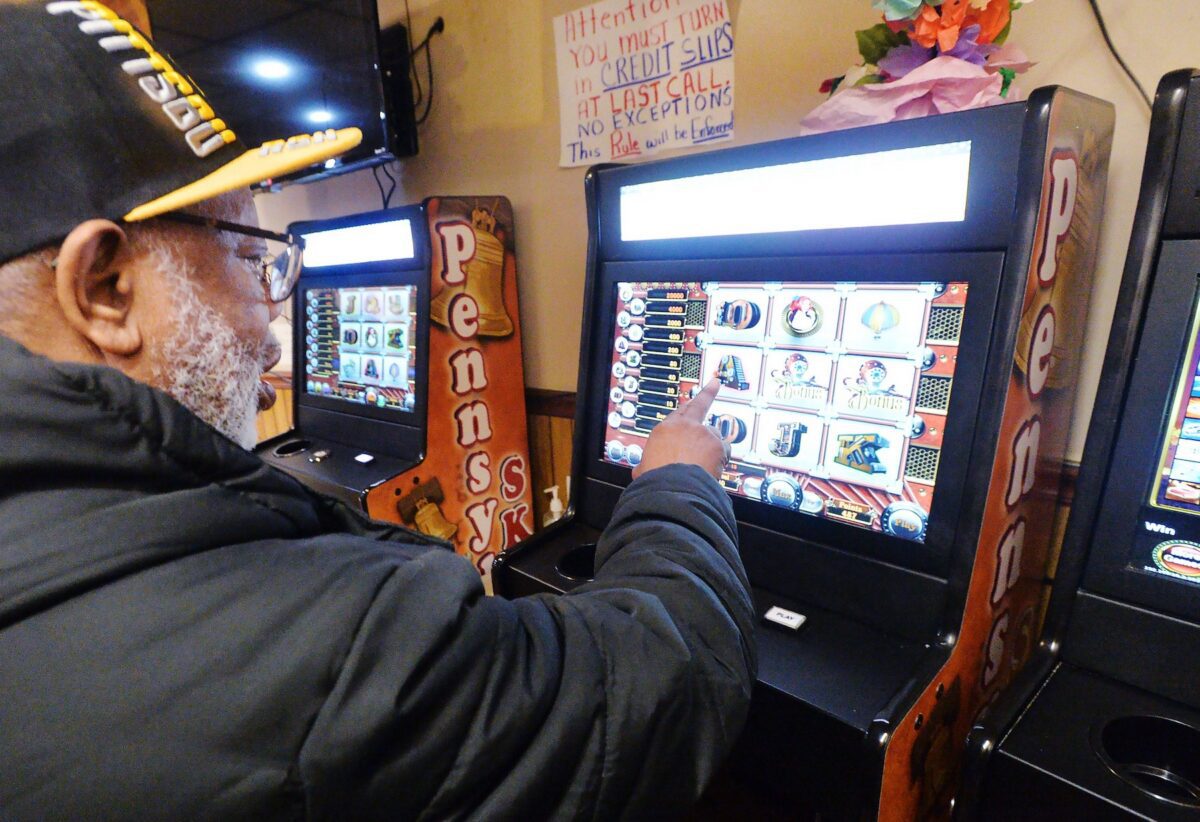
Hank Copeland, 72, points out a bonus roll while playing a Pennsylvania Skills game located inside American Legion Post 771 in Erie on Feb. 28, 2024. Copeland was up $15 at the time. (Photo: USA Today Network)
Pennsylvania could pocket more than $1 billion each year in revenue by regulating and taxing skill games, the slot-like terminals tucked in many convenience stores and bars around the commonwealth.
Lawmakers have debated imposing a levy on these machines in recent years, but their proposals have fizzled amid partisan disagreement and forceful pushback from the gaming lobby.
But Gov. Josh Shapiro in his February budget address renewed the call for a skill game tax, and independent fiscal analysts have released their estimates of what the plan could mean for the Keystone State.
What does Shapiro want to do about skill games?
Gaming officials in the commonwealth already regulate luck-based video game terminals (VGTs) in truck stops, but tens of thousands of skill game machines — which industry members say don’t operate on chance alone — fall outside this oversight. Shapiro’s administration wants to expand taxation to these devices.
His proposal would cap the combined number of VGTs and skill game machines at 40,000 and impose a 52% tax on proceeds.
In his budget speech, Shapiro said prosecutors from around the commonwealth have urged state leaders to begin regulating the terminals.
“Everyone knows we need to get this done,” the Democrat said in his Feb. 3 address to state lawmakers. “So let’s come together and finally get it over the finish line.”
How much revenue could this generate for Pa.?
Based on data from other states, independent analysts estimated that each skill game machine will generate about $58,000 in the first year and that the amount will increase gradually over time.
Assuming the state quickly reaches the 40,000-terminal cap, these projections mean the devices would generate more than $1.1 billion in tax revenue for the commonwealth in the 2027-2028 budget year, according to the Independent Fiscal Office. Within another three years, the total could exceed $1.24 billion, the analysis shows.
They predict much of the added tax burden — about $905 million of it — will fall on Pennsylvania businesses, including the owners and operators of the terminals and on the establishments that host them. But businesses will end up passing about $370 million to players and patrons by lowering payouts and hiking food and drink prices, according to the projections.
What has happened in the past?
State lawmakers have spent years arguing over this issue but have remained locked in disagreement over the specifics.
Shapiro also suggested in 2025 adding a 52% tax for the games, while some Senate Republicans wanted a lower rate of 35% of gross terminal revenue. Still other lawmakers suggested charging a monthly fee rather than a tax.
Legislators couldn’t reach a consensus before the passage of last year’s budget, but they expressed hope that they’d finally land on a solution in 2026, Spotlight PA has reported.
Author

Targeted and alone: Why Pennsylvania seniors are losing millions to tech-enabled scams
In Pennsylvania, more than 4,000 scam-related complaints were filed in 2025 as residents lost more than $76 million to scammers. Kate Kleinert...

Support pours in for Pike County Islamic Center after shooting
While the police investigation of the shooting at the Pike County Islamic Center in Westfall Township continues, state and local leaders are...
Shapiro hints at permit denial to stop Pa. ICE detention centers
Permitting and infrastructure concerns may trip up immigration detention centers despite DHS secretly purchasing two empty, rural Pennsylvania...
Pa. small businesses cheer U.S. Supreme Court tariffs decision, but still face uncertainty
by Whitney Downard, Pennsylvania Capital-Star February 23, 2026 Thousands of small businesses across the commonwealth paid billions of dollars under...
ACLU calls for ‘full, transparent’ investigation of Quakertown ICE protest
ACLU of Pennsylvania is calling for a "full and transparent investigation" of an off-campus ICE walkout that resulted in physical confrontations...