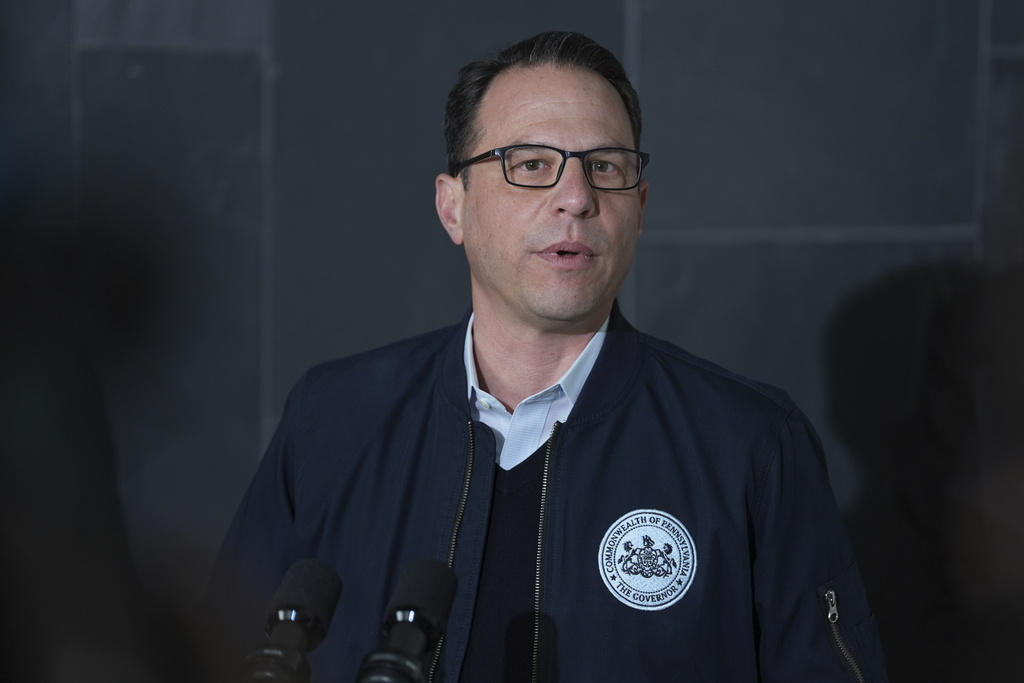
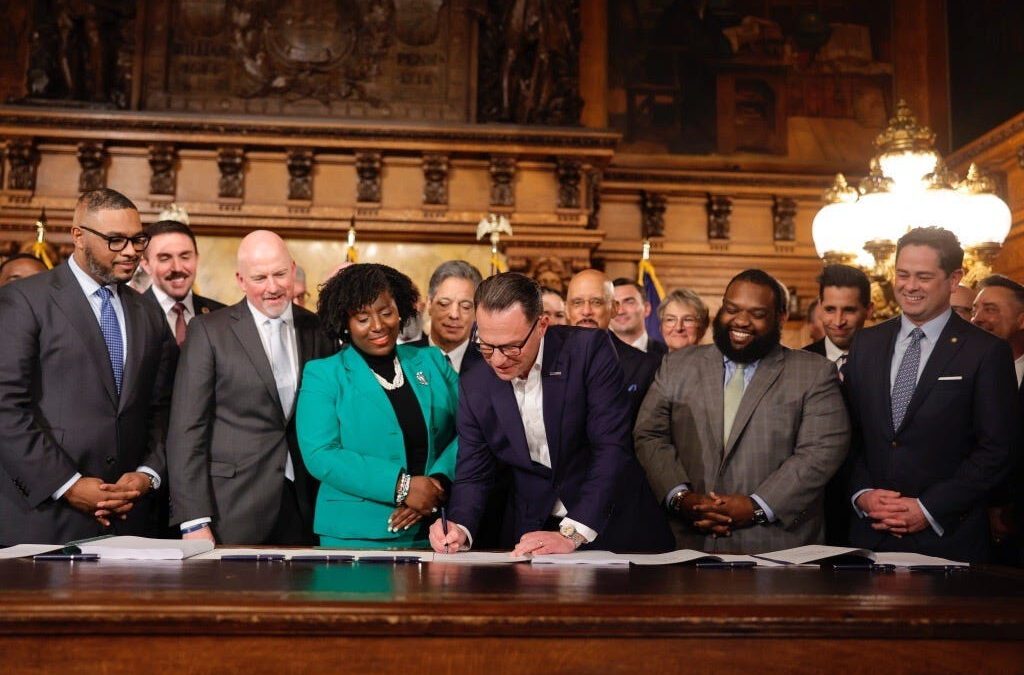
Governor Josh Shapiro (AP Photo/Matt Rourke)
Autumn Fingerhood is a hospitality worker who lives in northeast Philadelphia and is a member of Unite Here Local 274. As a single mother working three jobs to support her two children, her family is one of thousands in the region who rely on the Southeastern Pennsylvania Transportation Authority (SEPTA).
With the transit agency that serves some 800,000 people daily just days away from implementing service cuts, if funding isn’t delivered from the state, she and a group of lawmakers on Sunday had a clear message.
“It seems that there has been a war declared on our community,” Fingerhood said. “And the politicians who serve Harrisburg, you need to wake up.”
“You need to get it together. You need to do your job, and you need to fund SEPTA,” she added. “We, the working people, do our job every day. It’s time to do your job and put working families over billionaires.”
Fingerhood was one of several speakers at a press conference on Sunday at SEPTA’s headquarters in Philadelphia, as Gov. Josh Shapiro and Democrats apply a full court press to get the transportation spending bill approved along with a state budget.
“We are past the point of short-term stopgap measures. We are past the point of a few months of fixes,” Shapiro said. “It is time to have recurring long term revenue for SEPTA and for the other mass transit agencies across Pennsylvania, and the time to act is now.”
Shapiro’s budget proposal included a spending package that would fund mass transit agencies across the state and increase spending for roads and bridges.
The state House has passed legislation on multiple occasions, but it has not advanced in the Senate.
The latest bill Democrats have put forward is House Bill 1788, authored by Rep. Sean Dougherty (D-Philadelphia). The bill would provide $600 million to mass transit and roads and bridges, while also increasing accountability on the transit agencies and public-private projects. The accountability portion of the proposal was originally put forth by GOP Sen. Joe Picozzi, of Philadelphia.
The House Transportation Committee voted to advance this bill by a 16-10 vote on Wednesday with the support of every Democrat and two Bucks County Republicans.
Shapiro said he met with SEPTA General Manager Scott Sauer, state Transportation Secretary Mike Carroll and other leaders about the urgency of the issue.
“I want to be clear. We do not want to make these devastating changes,” Sauer said. “However, without a funding solution, we will have to advance a 20% service cut that starts on August 24 and an overall 45% cut this fiscal year.”
Shapiro lauded Sauer’s leadership and said SEPTA’s GM walked him through some of the changes made by the transit agency to create a “far more efficient operation.”
Sauer said that SEPTA has enacted an austerity plan that has resulted in more than $30 million in savings over the last eight months, lowered its structural budget deficit from $240 million to $213 million and is embracing the accountability and oversight measures being considered by the General Assembly. He also noted that ridership is up for the fiscal year that just ended and that they have seen a reduction in crime on the system.
“I’m confident that SEPTA is on the rise, and all of us have embraced a customer focused mission that puts safety and security, reliability and service at the forefront, and if we can get the support that’s needed to avoid these devastating cuts, we’ll move swiftly to implement new initiatives that will enhance service across the system,” Sauer said.
Lt. Gov. Austin Davis was also in Pittsburgh on Sunday in an effort to raise awareness about mass transit funding. Adam Brandolph, a spokesperson for the Pittsburgh Regional Transit (PRT), told the Capital-Star earlier in the week that although they don’t have a “hard and fast deadline” at this current time for state funding, service cuts and fare increases will not occur until February 2026 at the earliest.
House members returned to Harrisburg for a voting session on Sunday and the Senate is due back in session on Tuesday, But, a budget bill passed by the House still has not been taken up by the GOP-controlled Senate.
Senate President Pro Tempore Kim Ward (R-Westmoreland) said she would support a short-term budget solution that would allow the commonwealth to provide funding for school districts and local governments, City & State PA reported on Aug. 5.
However, Shapiro said he is not open to a short-term budget proposal.
“I can tell you the time for short-term spending plans is long over and will not be entertained by me,” Shapiro said on Sunday. “We need to pass an annual budget, and that annual budget needs to fund mass transit.”
“Lawmakers have very few enumerated responsibilities. One of them is to pass an annual budget,” he added. “It’s time for them to do that now.”
One proposal championed by Sen. Sharif Street (D-Philadelphia) would legalize adult-use cannabis that would provide funding for mass transit agencies.
“So, that bill has support from Senate Republicans, House Republicans, House Democrats and Senate Democrats. It is both bicameral and bipartisan,” Street told reporters. “It would provide adequate funding to fund mass transit and transportation on a recurring basis for the foreseeable future. So it’s not a one time fix. It’s a permanent fix, and certainly, I think all things remain on the table until there’s a solution.”
However, Republican leaders in the Senate have not appeared to be as open to passing adult-use cannabis legislation.
Another recent change for SEPTA was a state-appointed special prosecutor beginning to prosecute incidents taking place on the transit system. That was the result of a bill that passed the General Assembly with bipartisan support and signed into law by Shapiro, despite opposition from Philadelphia District Attorney Larry Krasner, who argued it was unconstitutional.
State Attorney General Dave Sunday told NBC 10 in Philadelphia in late July that he believes the term for the prosecutor, which is set to expire at the end of 2026, should be extended.
“I think if it is extended, maybe with a few tweaks, I think that we will be in a place where we can really provide a tremendous value added to the citizens of Philadelphia,” he said.
Shapiro didn’t endorse or dismiss the possibility of extending it past the current deadline.
“Well, it’s in place until the end of next year,” Shapiro said in response to a question from the Capital-Star. “And if that’s an issue that’s important to folks who are involved in the conversations, I’m sure we’ll talk about it.”
Author

Pa. lawmaker’s new job raises questions of ethics
State Rep. Seth Grove is raising alarms about working for a trade organization while setting laws for that industry. Questions about whether or not...
A look at new laws taking effect in Pennsylvania in 2026
Several new state laws are set to go into effect in early 2026, laws that offer new tax credits to laws that ban hair discrimination and force...
Pa. lawmakers received their annual raise. Rank and file members now make $113,000
An automatic cost of living adjustment bumped state lawmakers’ salaries to $113,000 per year, for rank and file members. According to the National...

OPINION: Pennsylvania students deserve better than a delayed state budget
When students are unable to meet their basic everyday needs, their capacity to learn is fundamentally impaired. My 8th-grade student, Juan, shuffled...

Movement on the state budget in the Pa. Senate – more than 130 days after the deadline
Lawmakers made a series of moves to advance a reported $50.1 billion spending, but few details have emerged. More than four months after state...