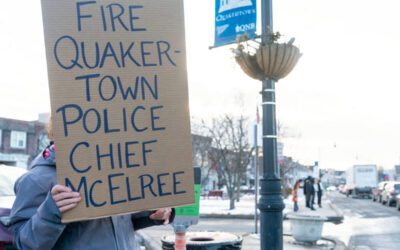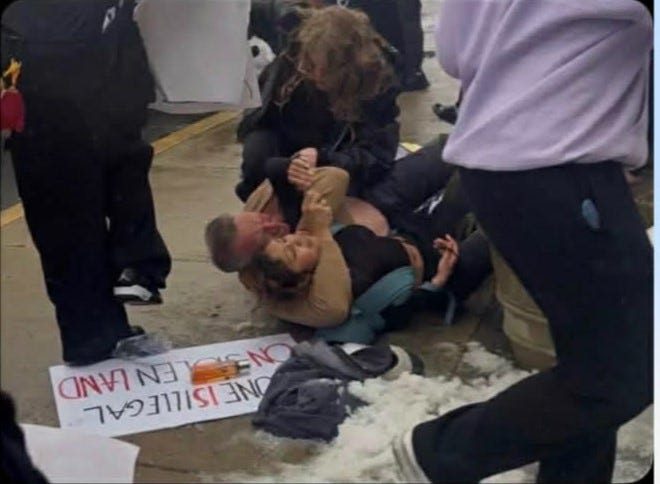
Violence erupted during a student-led protest against U.S. Immigration and Customs Enforcement tactics in Quakertown on Friday, Feb. 20 after the high school canceled plans for a walkout on campus. Some students left and walked into the downtown. (Photo: USA Today Network)
A recent police chief-led review of the violent clash between police and student protesters in Quakertown in February is under fire from the students’ attorneys and others.
The report released last week largely maintained that Quakertown police responded appropriately during the incident.
A private investigator hired by attorneys for five teens charged, however, contended that his preliminary investigation findings suggests that Chief Scott McElree’s actions escalated the situation, prompting the violence that resulted in injuries and arrests.
“There is no indication that chief McElree identified himself as a police officer or issued clear verbal commands prior to initiating physical contact,” said Tom Beiser of LATRO Digital Forensics, a business based out of Somerset, New Jersey.
The defense attorneys and witnesses have said that students believed McElree was among a group of counterprotesters who followed and harassed them, and that they acted in self-defense and defense of others.
Attorney Tim Prendergast characterized the new report, which relied on borough-provided video footage and police reports, as self-serving, contrary to the facts and “in no way comprehensive.”
“I’m not surprised they would come up with such a ridiculous version of the events,” said Prendergast, who represents one of the teens who was arrested.
The reactions follow the release of an eight-page independent administrative review of the police response to the Feb. 20 protest by members of the Police Chiefs’ Association of Bucks County. It was conducted at the request of Quakertown solicitor Peter Nelson.
The report released April 16 was prepared by police chiefs from Bensalem, Buckingham, Morrisville and Upper Southampton. None of the chiefs responded to questions about the findings that were emailed to them.
Middletown Police Chief Joe Bartorilla, who heads the chief’s association, referred questions and comment requests about the report to Nelson, but defended the report findings.
Bartorilla reiterated that the report found that the police response to the protest was consistent with established training, best practices and professional standards, and that the officers acted within the scope of department policy “during a challenging and volatile situation.”
McElree, 72, remains out on workers’ compensation leave for injuries he sustained during the protest. Three students were also injured, their attorneys said.
Felony charges, including aggravated assault, have been withdrawn against three of the five teens, and the district attorney has offered to drop felonies against a fourth, his lawyer said. An adult man was also taken into custody after he laid on top of McElree who was on top of a student, but he was not charged.
Quakertown officers were repeatedly praised in the report for their use of de-escalation techniques and showing restraint by not resorting to higher uses of force. The chiefs in their report said additional force would have been justified.
The chiefs acknowledged that McElree, who was in plain clothes, was “not clearly identifiable as a police officer on that day,” and that the confrontation didn’t turn violent until after the chief entered the crowd attempting to detain a protester.
Moving forward, their report recommended that plainclothes police officers should display a badge or other police markings prominently “when required or needed” and that only uniformed officers should make arrests.
Ettore Angelo, an attorney representing a teen defendant, pointed out that other uniformed police officers were peacefully managing the protesters and that things didn’t turn physical until after McElree arrived.
“He charged into a group of children who were not violent in the least until he chose violence and they defended themselves,” Angelo said.
Another major criticism defense attorneys had with the report is it ignored whether McElree violated a use of force standard in place countywide since 2020 that prohibits using techniques that restrain oxygen intake for purposes of gaining control of a subject.
McElree, who is also Quakertown’s manager, has faced public scrutiny over his conduct, particularly for widely shared images showing him allegedly with his arm wrapped around the neck area of a 15-year-old protester.
McElree has maintained that he was protecting the girl as they fell, not restraining her. The chiefs agreed that a viral screenshot of McElree and the girl “did not rise to the level of an attempted chokehold.”
But defense attorneys have expressed doubts about whether the chiefs could conduct an objective and independent investigation of an incident that involved one of the organization’s members.
“If the intent was (to) get to the truth those involved would have worked, hand-in-hand, with the district attorney’s office. They did not,” said attorney Don Souders, who represented a 16-year-old boy who was arrested. “This was an attempt to get ahead of that investigation.”
The Bucks County District Attorney’s Office is investigating the police conduct at the protest, but there’s no timeline on when that report will be completed.
The defense attorneys also railed against the report’s repeated references to protesters as foul-mouthed, unruly, and disrespectful to police and showing “blatant disregard for constitutional law.”
“It is a disgrace that four police chiefs could demean the courageous protest of these children,” Angelo said. “That is infuriating in its inaccuracy and unfairness.”
Beiser said that his preliminary investigation confirmed that, prior to the physical confrontation outside Sunday’s Deli, there were only four isolated acts involving three protesters out of at least 35 participants.
The incidents involved two students entering the road, one of them twice, a student allegedly striking and hitting a vehicle, and a student allegedly throwing an object.
“These may represent isolated unlawful acts by individuals. However, classifying the entire protest as ‘unlawful’ based on these limited actions appears to be an overgeneralization,” Beiser said.
Several new screenshots included in the report also showed most student protesters weren’t physically in the street.
An adult resident who observed the protest said that students used crosswalks and, in some cases, the light changed before all the students reached the other side of the street.
“That is not stopping traffic,” she said. “Nowhere did I see whole groups stopping traffic.”
Author

Megan’s Law data shows 1,000 Pa. offenders out of registry compliance
There are 1,000 people on Pennsylvania’s sex offender registry who have not reported their information to the Pennsylvania State Police as required,...
Ahead of busy tourism year, Pa. lawmakers scrutinize aggressive driving
Pennsylvania—and its drivers—will be in the spotlight with events like the FIFA World Cup, America250 events and the NFL Draft. On April 16, 2024,...
Pennsylvania men charged with bringing bombs to NYC protest were recorded discussing terror plot, indictment says
The two men charged with bringing homemade bombs to a protest outside the home of New York City’s mayor were recorded describing their plan to kill...
Quakertown chief says he was protecting not choking student: Police report
Newly obtained police reports give Quakertown Police Chief Scott McElree’s version of what happened during when a student protest turned violent...
Tensions continue in Quakertown over police-student clash at ICE protest
A demonstrator was confronted Wednesday outside Quakertown Borough Hall before a council meeting where again the public demanded accountability in...