
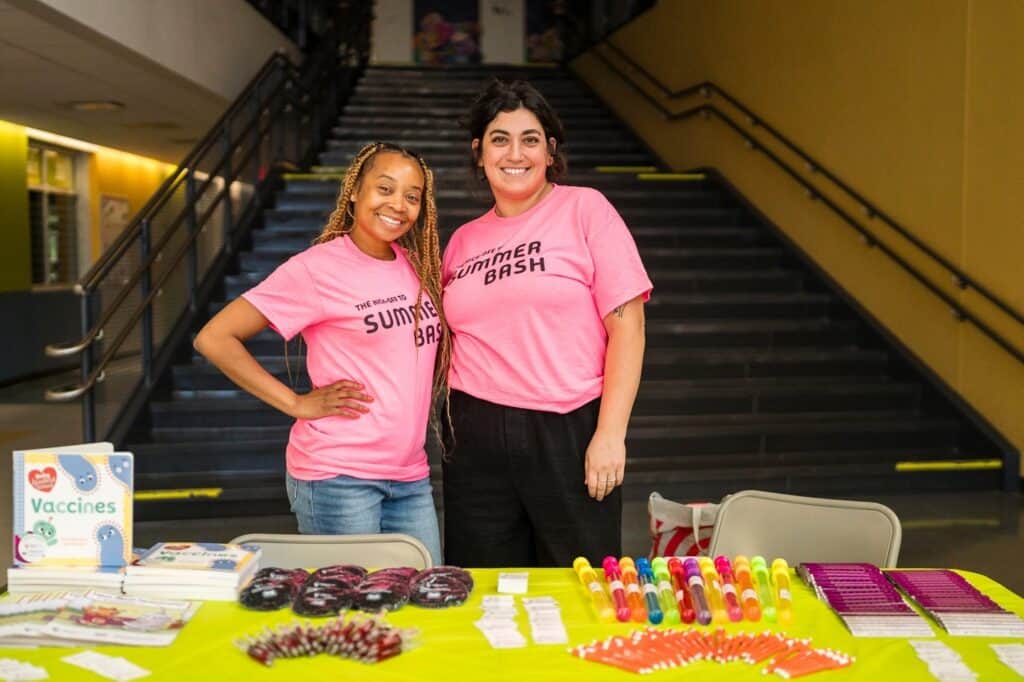
MCC staff coloring with children at a community event. (Maternity Care Coalition/Instagram)
Reading the news can be a sobering activity these days, especially when it comes to reproductive rights, racial equity, and food justice. In an increasingly fragile social and political context, caring for ourselves and each other becomes all the more important.
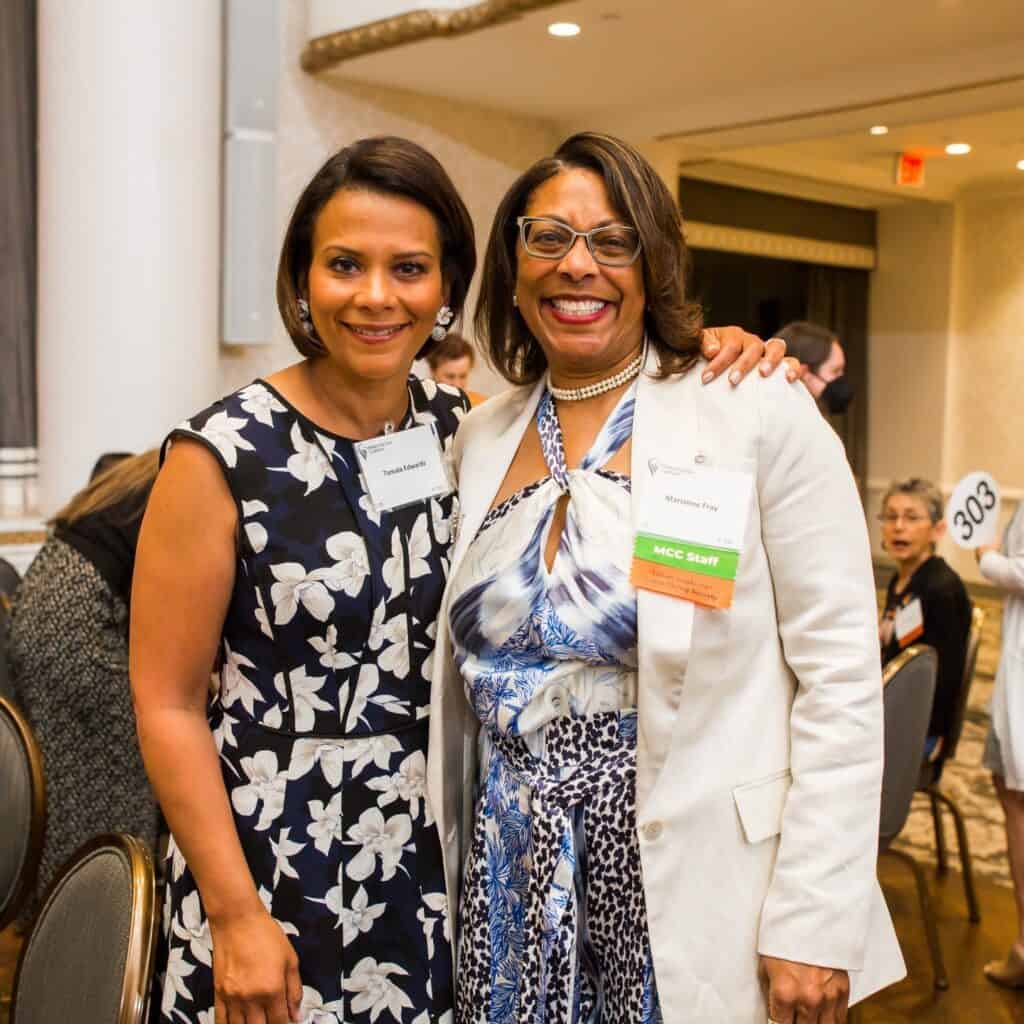
We had the pleasure of speaking with Marianne Fray, President and CEO of Maternity Care Coalition, located in Southeastern Pennsylvania. The organization’s work addresses the specific needs of clients in the area, as well as social inequities in healthcare and the workforce, and government policies that impact high-risk and vulnerable groups.
We spoke about the work she does to create a better future for children and families in MCC’s community—and what it takes to keep showing up when the political climate makes that work harder than ever.
MCC’s Theory of Change
I asked Fray about MCC’s Theory of Change, a mission statement of sorts completed in 2021. MCC was founded by a concerned group of Philadelphia community members in 1980, and its current Theory of Change outlines the breadth of services provided for parents and children today.
One portion reads, “MCC believes in an equitable and just future for all families and is committed to challenging the structures that create barriers to equity. We envision a future where parents impacted by racial and social inequities in Southeastern Pennsylvania can birth with dignity, parent with autonomy and raise babies who are healthy, growing, and thriving.”
When speaking with Fray, she explained the org’s mission in her own words. “I would say MCC’s work revolves around something that we call ‘centering parenting families’ that are impacted by racial and social inequities.” However, she went on to explain that the term “centering” can be overused to the point of vagueness. She described it instead as “a deliberate, proactive practice that is really aimed at dismantling power imbalances and challenging dominant cultural narratives.” She clarified, “That’s what we mean by centering parenting families. Everything we do revolves around that.”
Fray’s ethos, and that of MCC, is entirely based around the client and the ways they are supported. This creates a framework for its services and how they expand: from client-level to community-level, then reaching into policy work and research.
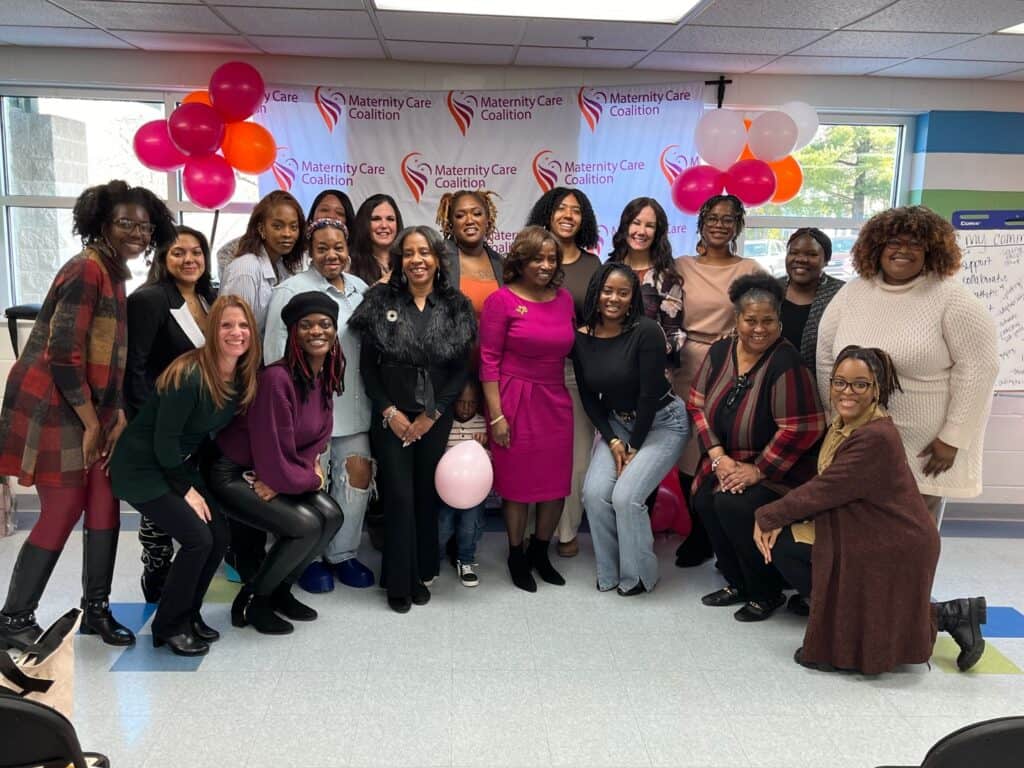
Community capacity building
I came across a term on MCC’s website that I hadn’t encountered before, despite my previous experiences in social work and nonprofits: community capacity building.
As it applies to her work, Fray describes this practice as “collaboratively working with community members to strengthen their collective skills, their resource systems, so that together, the community members and whatever organization can identify and solve local challenges. That way, we’re fostering self-reliance and sustainable development in areas like health, the economy, the environment… and we’re building leadership and fostering cohesion, creating structures that can effectively move things forward.”
There’s a universal application here—decenter yourself in the work, and recenter your community. By engaging with the concrete needs of individuals across the broader Southeastern Pennsylvania area and connecting them with local support structures, Fray and MCC are equipping their community with the tools and pathways to create further change in their own lives and those around them.
Fray has received recognition for her excellent leadership, including being on the 2025 Most Admirable CEO list. On the topic of her accolades, her values show through—it is all a collaboration, and her team is her greatest resource.
In the past few years, Fray has become involved in local and statewide initiatives: She is on several steering committees, including the Black Nonprofit Chief Executives of Philadelphia and the Nonprofit Leadership Leaders Group, as well as the board of the Pennsylvania Association of Nonprofits. She explained that these committees are “all designed to build collective muscle and advocacy for nonprofits.” She added, “That, to me, is a contributing way that organizations can sort of build out or amplify their mission and accelerate it, because together, we’re stronger than alone.”
It is not the work of one organization or group of people committed to their cause to solve systemic issues in isolation—it must be through a network of advocates working in tandem.

MCC demonstrates “vigilant, nimble responses” to issues facing the community
Of course, the past year has presented challenges to our communities in almost every sector, including cuts to benefit programs like SNAP and changes in healthcare costs and coverage. Because of this, organizations like MCC must become increasingly flexible, allowing themselves room to expand and change to meet the needs of their community at this moment in history.
Beyond the usual business of dispensing necessary supplies like diapers, wipes, formula, and menstrual products, the org expanded its access hours and days during the SNAP benefits freeze in November 2025. It also provided a way for participants and staff to anonymously request gift cards for the purchase of essential supplies, retaining the privacy and dignity that the org prioritizes for its community members.
Fray shared that 211 gift cards totaling $16,425 in aid were dispersed to 168 families and 43 staff members. “This was our way of showing resilience in action and standing in solidarity with our families when they needed us most.”
Helpful frameworks for change
Fray was recently encouraged by a piece she saw on LinkedIn by Shawn Alexander Ginwright, titled “To the Ones Who Are Tired: A Message for the Cathedral Builders.”
Ginwright stressed, “Cathedrals are not built in a year. They are not built in a grant cycle. They are not built in a four-year funding window or a three-year strategic plan.”
Like this author, Fray often feels like her efforts are laying the groundwork for change, brick by brick. “I feel like my role is to continually point our collective eyes towards the Cathedral of Justice that we’re all building,” she shared. Quoting her favorite line from the piece, “‘Every day you show up, you are laying bricks. You may not see the wall rising. But the wall is rising.’”
Though Fray works primarily on the systemic side of the organization, she is witness to the individual impact of MCC’s mission. Recently, a pregnant woman who learned about MCC from one of its Spanish-language flyers went on to join a parenting class. She not only found community through this group, but also support when she suffered from preeclampsia and had an emergency C-section. Through her MCC advocate, she was able to gain referrals for housing and job opportunities, becoming a new parent with greater resources at her disposal. “More than just surviving, but thriving,” Fray updated us.
As Ginwright wrote, these building blocks of progress can take many forms: “When you create moments of dignity in systems that move too fast to notice humanity, when you slow down long enough to see people rather than just process them, you are laying bricks.”
Continued learning & collaboration
When asked if she had any advice for other changemakers and organizations, Fray said, “Any organization, ours included, has to start by looking in the mirror, interrogating how we approach the work of community capacity building in itself, as well as the idea of centering families, [which] means that you have to decenter something else.” She explained that thinking you have all the answers “doesn’t allow for the community to have their voices prioritized. So you start by looking in the mirror.”
She also recommends getting involved with other organizations beyond yours to learn about resources and tools that have increased their impact. Besides grants, MCC can provide increased care to its clients thanks to its donors and partnerships—building relationships and cooperating with the broader community is an indispensable part of serving families.
Between Fray’s position on the frontlines with families and her advocacy and policy work, her attitude remains hopeful. Even though she may not be able to see the proverbial wall rise as she and her colleagues place bricks, she continues to show up day after day. This CEO takes advice from other changemakers and thinkers, putting herself to the daily task of resourcing a community. And, in knowing that she doesn’t know it all, she readies herself for further learning.
To learn more about MCC and get involved, you can visit maternitycarecoalition.org, call 215-972-0700, or follow its social media channels. Programs at MCC include, but are not limited to, home visiting, child care, community and parenting education, community doula and lactation training, behavioral health, and community reproductive health services. In our conversation, Fray also mentioned workforce development programs, distributing essential supplies, and individual support advocates for clients.
Author


Stephen Colbert, Amanda Seyfried shout out Bucks County and Lehigh Valley events on ‘Late Show’
Host Stephen Colbert and actress Amanda Seyfried, an Allentown native, mentioned the events as part of the show's recurring "community calendar"...

Pennsylvanians to vote for state’s ‘2026 River of the Year’
By Mark Richardson Produced for the Pennsylvania Independent. Broadcast version by Mark Richardson for Keystone State News Connection...

Pennsylvania landmarks you have to see (and hear) to believe
From structures that conjure Stonehenge, to rocks that sing, to a hotel with a Ouija board for a roof, these Pennsylvania destinations each have a...

Pennsylvania’s most heartwarming news stories of 2025
The news isn’t always depressing, and these 10 stories prove it. When reading the headlines of your local paper or favorite online news outlet, it’s...

When the ball just won’t do: The wacky things Pennsylvania drops on New Year’s Eve
The abundance of hometown pride is evident in the different New Year’s Eve celebrations across the state, when weird things start dropping at...