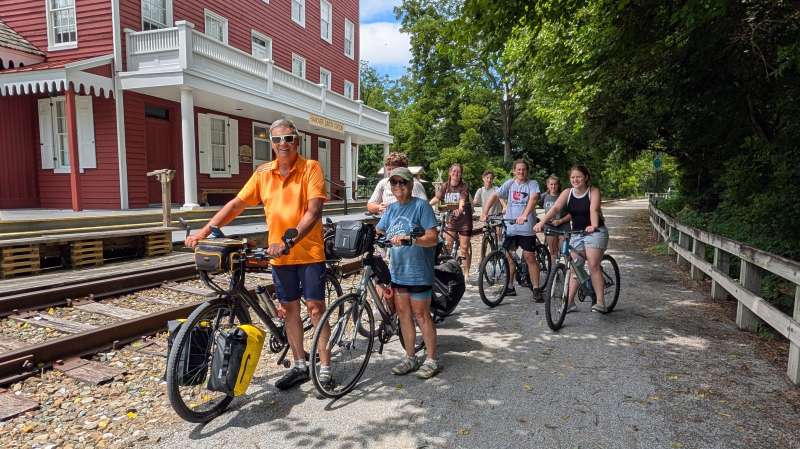
Bruce White and a group of cyclists flash past rain-spattered cotton fields, undeterred by the wet June weather as they pedal toward Reading on their monthlong trek around the 9/11 National Memorial Trail.
They’d been on the roughly 1,500-mile route for more than a week, setting out under a favorable blue sky that arced over the Pentagon Memorial. It’s harder to press forward on soggy days like these, with rain coursing down White’s nose and blurring the screen of the phone he uses for navigation.
He would never compare the challenges of the trail to anything the victims and first responders on 9/11 experienced. But the physical discomfort — the aching muscles and 100-degree days — do give him an occasion to reflect on their stories.
He pictures the New York City firefighters, dressed in 80 pounds of gear and staring up a flight of World Trade Center stairs before beginning their climb.
“Could you do that?” White asks himself as he pedals. “And I can’t honestly answer that question.”
White, a retired horticulturist from Virginia, and his companions are among the hardy few who make the memorial trail’s entire circuit, their bicycle tires tracing the line that connects all three sites of the Sept. 11, 2001, terrorist attacks in New York City, the Pentagon and western Pennsylvania.
But the team of volunteers and nonprofit workers who care for the trail say it’s not only meant for the hardcore few.
They’ve sewn together bits and pieces of greenway over the past quarter-decade in the hope that these peaceful, natural settings will give even casual passersby a space to reflect — to set aside distractions and remember the 3,000 lives lost that day and the acts of bravery amid tragedy.
The inspiration for the memorial emerged just days after the attacks, the brainchild of a Virginia parks and recreation official who convinced like-minded colleagues they should use their love of trails to honor the victims.
The triangular route passes through six states and Washington, D.C., but the longest segment, totaling more than 900 miles, stretches through Pennsylvania.
The expanse and shape of the trail is itself a tribute to the victims of Sept. 11, White points out.
The terrorists aboard United Airlines Flight 93 had intended to plow the plane into a Washington, D.C., target, a maneuver that would’ve added unknown sums to the death toll. Instead, the aircraft crashed into a Somerset County field as passengers struggled to wrest control back from the hijackers.
When he cycles through the commonwealth, White remembers, he’s only traveling these miles because “of the heroes on Flight 93.”
Trail a ‘living, breathing’ memorial to 9/11
The idea for the trail came to David Brickley, then director of Virginia’s recreation and conservation department, just days after the 9/11 attacks.
Despite the terrorist acts, he and others had decided to proceed with a planned northern Virginia conference where parks officials from around the nation were supposed to talk about establishing more greenways. On the final day of the gathering, Brickley remembers standing behind a dais and making his case to the crowd of hundreds: “We’ve got to find a way to merge our love of trails and greenways with this horrific event,” he recalls telling them.
To the former Boy Scout who has always been fond of the outdoors, there was no better way to remember than by building a “living, breathing trail.” In 2002, he began mapping out the trail and founded the nonprofit that has stewarded the project ever since.
The route covers several dozen existing trails and greenways, such as the Delaware & Lehigh National Heritage Corridor and Great Allegheny Passage.
In 2021, U.S. lawmakers and then-President Joe Biden designated the trail as a federally recognized memorial.
“It’s probably the last time Congress unanimously voted on anything,” White joked.
But organizers say the trail will always be a work in progress, as they continue to add wayfinding, raise awareness and convert road miles to bike path miles. Though the full circuit can be traversed, travelers have to use roadways for nearly half the distance, and nonprofit leaders hope to decrease that share over time.
That work is moving forward bit by bit. CSX donated an abandoned railroad corridor that will provide an 11-mile trail connection to the Flight 93 crash site, and Brickley said the project broke ground this year. But piecing the memorial together is a painstaking effort and largely dependent on grant funding, said Jeffrey McCauley, president of the September 11th National Memorial Trail Alliance, the nonprofit that manages the trail.
In the leadup to the 25th anniversary of 9/11, work was in progress across the commonwealth to add signage along the path. The alliance collaborated with PennDOT to identify sites for nearly 750 signs in the state, and Gov. Josh Shapiro reached out to more than 100 municipalities encouraging them to lend their support the project.
The first sign went up in Allentown in June and, when complete, there will be almost a thousand of them spread across the Keystone State, according to the alliance.
Trail town stories
Debby Borza, whose 20-year-old daughter, Deora Bodley, was the youngest passenger killed on Flight 93, sees the path as a way of pulling together the many facets and meanings of that day.
“It captures all points of September the 11th. The aspect of New York City, this big city. And then, the symbol of our military in the United States, at the Pentagon,” said Borza, a trail alliance board member. “And then, this beautiful field … this wide-open space that Flight 93 is.”
The triangle formed by the trail also touches some of the nation’s historical landmarks, major pieces of the American story that preceded 9/11.
It hits Valley Forge, crosses the Mason-Dixon line twice, runs through Harpers Ferry and passes the Statue of Liberty. The trail’s founders added a special loop at the top of the route so it would swoop through Gettysburg.
Travelers might stop by the Pennsylvania Chautauqua in Mt. Gretna, one of roughly 200 sites that proliferated from the 19th- and 20th-centuries Chautauqua movement, an effort to educate people of all social backgrounds about the arts, sciences and religion. The Pennsylvania site is one of just 16 Chautauquas left in the nation.
“We wanted to hit those special parts of America’s history along our route as much as possible,” Brickley said.
Circumnavigating the path also gives people a chance to meet the communities and people who steward stories of the past.
In Pennsylvania, the route links together more than a third of the commonwealth’s counties and 129 municipalities, passing through Philadelphia, Pittsburgh, Amish farm country and the Poconos.
During their summer trip, White and his band of cyclists listened to a Johnstown local describe the devastating flood that killed hundreds of people there in the 1880s. They toured the nation’s oldest continuously operating anthracite mine and dined with the mayor in a Lehigh Valley township.
In Portage, a small Cambria County borough, they ate a lunch prepared by the historical society.
“We were treated like royalty and long-lost family,” White wrote in a Facebook post. “This is much more than just a bike ride.”
Do people know about the 9/11 trail?
After nearly a quarter-century of work, the trail’s supporters are proud of the memorial circuit. They just wish more people knew about it.
White — who volunteers with the trail alliance — said most of the people who show up at his booth in the Philadelphia Bike Expo each year have no idea the route exists.
“I wish I could stand on a corner and pound a drum and make everybody listen,” he said.
Married couple Patrick and Lisa Hogan were unaware they were traveling the 9/11 trail as they cycled one August day before heading to a Lebanon County ice cream parlor.
“It’s just something we enjoy, getting out into nature and some fresh air,” Patrick Hogan said.
David and Sharon Lucas, who were biking through York County in late July, weren’t aware of the trail’s connection with Sept. 11, either. The Bernville couple were on a two-day trip with six of their grandchildren, traveling from York to Maryland before heading back.
As they were going south, they stopped for a water break at the Hanover Junction, noteworthy as the spot where President Abraham Lincoln changed trains in 1863 on his way to deliver the Gettysburg Address.
White has tried to introduce cyclists to the trail by organizing guided trips, and this year’s trek was the fourth time he’s led a group around the full loop. Twenty-eight people were on board for at least a section, while a committed dozen joined him for the entire circuit.
The band hailed from nine different states including Florida, Nebraska, New Mexico and California.
Brickley has traversed the full route once, he said, and has traveled sections of it on many occasions. He tries to walk it in silence, without listening to music or turning to other distractions.
But “being an old politician,” he also finds himself talking to passersby, trying to spread the trail’s story. Maybe they’ll tell their families at the dinner table about the chance encounter and share a bit of the path’s history, he hopes.
What it takes to remember
To Brickley, the outdoors offer the opportunity to replace phone screens with silence, and the trail space invites people to linger over memories of a painful event rather than pushing them away.
And with roughly a third of the U.S. population born since 9/11, Borza hopes communities along the trail can use it as a jumping-off point to introduce children and teenagers to the attacks and the people who died in them. It’s a way, she says, to weave remembrance into daily life, without a special pilgrimage to New York City, D.C. or Shanksville.
Borza enjoyed making the path a part of her routine during her years living in Maryland, walking sections between Annapolis and Baltimore.
“There’s a nice coffee shop there,” said Borza, who moved back to California several years ago. “It’s a great place to pull your bike over and have a cup of coffee, meet with friends and be able to reflect.”
Robert Roos didn’t realize he was on the 9/11 trail as he biked over the Nesquehoning Bridge along the Delaware & Lehigh Trail, stopping to take photos of the scenic river below.
But when a reporter brought it to his attention, Roos talked about how he was in middle school at the time of the attacks. The Jim Thorpe native said he couldn’t believe it had been 25 years since then.
“Such a long time, and it’s had such a big impact on our history since then,” he said. “It’s good to keep remembering.”
On a hot August day, 33-year-old Megan Shvarts and her toddler, Zoey, stopped by the Garden of Reflection — a trailside memorial built in Lower Makefield, a Bucks County town that was closely connected to 18 victims in the attacks.
Shvarts said she used to walk by the tear-shaped memorial when she was pregnant and now takes Zoey for the playground.
She was in third grade when 9/11 happened.
“On the actual anniversary I always think of it,” Shvarts said.
Twenty-five years after 9/11, Borza said she hopes people think about the dedication and care required to preserve a memory. The trail is just one example; its supporters have spent years improving it, putting sections together piece by piece, leading cyclists on monthlong treks around it.
“I hope (people are) reflecting,” Borza said, “on what it takes to keep the memory of almost 3,000 people alive.”