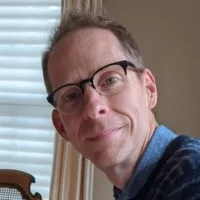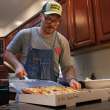
Editor’s note: For the last year, York Daily Record photojournalist Dawn J. Sagert has followed York County Sheriff Lt. Dave Godfrey as he recovered from grievous injuries sustained during the Sept. 17, 2025, shooting in North Codorus Township. Sagert interviewed Godfrey for this story and accompanied him to ceremonies, a school visit and physical therapy. Due to the nature of the subject matter, this article contains some potentially disturbing and violent content.
“Hey, I’m hit.”
The words hung in the still air as York County Sheriff Lt. Dave Godfrey recounted what, on the afternoon of Sept. 17 last year in rural North Codorus Township, felt like his final moments.
Tucked behind the driver-side wheel well of his police cruiser following the initial barrage of gunfire, Godfrey remembered lying on the ground bleeding profusely, his ammunition spent, waiting for his hidden attacker — the 24-year-old Matthew Ruth — to finish him off.
In what Godfrey believed were his final minutes alive, he called his wife, a nurse on duty at WellSpan York Hospital.
She didn’t pick up. And so he left a message.
Recounting those moments, eight months later, Godfrey’s body grows still. His glistening eyes focus somewhere in the middle distance and his breathing slows. He swallows, forces a soft, deep exhale. Then he continues.
“I don’t think I’m coming home tonight,” Godfrey told his wife via voicemail. “Love you, bye.”
Godfrey, seemingly lost in the moment, returns to the here and now. His posture loosens, his intonation lightens, as he remembers his first thoughts after sharing what he believed were his last words to his wife: “Well, that sucked. Who leaves a message like that?”
Then Godfrey’s law enforcement muscle memory kicked in. He was still breathing, even as he bled out there on the ground, and so he rallied. Godfrey managed to climb back into his cruiser.
Reaching over to the radio, he called out: “1283 to York — shots fired — multiple officers down — send help.”
Godfrey then crawled back toward the front of the vehicle, behind the engine block, and hit send to call his wife once more before he passed out into blackness.
“I remember thinking to myself, ‘You’re dying, you’re dead.’ And I was good with it; I felt that I did all that I could, and I was pretty much at ease,” he said.
He remembered pieces after that, such as Det. Jack Asper ripping the belt from his waist to use it as an improvised tourniquet on his leg. Moments later, he recalls “the most annoying voice in the world” — belonging to Deputy Sheriff Thomas Dryer — who spoke to Godfrey as he replaced the belt with two tourniquets. He remembers the “green-haired man” named Casey who arrived at the scene in an ambulance. He remembers rolling into the operating room and then waking up late that Friday night when they removed the breathing tube from his chest.
It’s been one year since the fateful day that changed Godfrey’s life and the lives of countless others.
In retelling his story, one theme resounds: ”You can’t give up, no matter what it is. Adapt. Move forward. Keep going.”
Godfrey and his care team would win the fight for his life, but his arduous journey toward recovery was only beginning.
Godfrey’s long career included work with K-9s and drones
Godfrey grew up in York County, and after serving four years in the U.S. Marines and a five-year stint as a correctional officer in a North Carolina prison, he, his wife Christina, and their 4-year-old daughter Brittany moved back to York.
Although Christina didn’t want him to work in law enforcement because it was dangerous, Godfrey has been with the York County Sheriff’s Office since 2001. During that time, he’s worked with courts and security, training, in the warrant division, with the Marshal’s task force, took over the K-9 Unit in 2013 and became the handler for Capt. Dargo, the county’s first explosives-detecting K-9.
Godfrey oversees the training and operations of the K-9 Unit as a master trainer and started the sheriff’s office’s drone division. He also handles community services, spearheaded the Axon program that integrates the tasers with the department’s in-car cameras and bodycams, as well as handling the department’s webpage and social media accounts.
Over his 25 years, Godfrey frequently worked with many other county agencies. On Tuesday, Sept. 16, 2025, just before midnight, Northern York County Regional Police Department received information about a stalking suspect seen through a trail camera on their caller’s property, possibly with a rifle.
“Whenever there was a call for assistance from the sheriff’s office, they would always call me,” said Godfrey.
Godfrey said, according to the most current report, Ruth had dated a resident of the property once or twice.
“She got some bad vibes from him and cut him off,” said Godfrey. “Well, he didn’t accept that.”
Northern Regional reached out to the sheriff’s office for drone and K-9 coverage, and Godfrey, Cpl. Shane Kauffman and K-9 Sgt. Prince joined the investigation. At around 2:30 a.m. on Wednesday, Sept. 17, after finding nothing, they all dispersed. Godfrey left the property and went to K-9 training.
Later that morning, he got a call from Northern Regional Det. Sgt. Cody Becker requesting his drone support later that day. The detectives, on warrant service, would search the suspect’s home first, and this would be a follow-up at the property where Godfrey had provided drone support the night before. This time, they would just be clearing the property ahead of the family’s return and wanted Godfrey to be able to monitor for the suspect, to make sure he didn’t ambush them from the wood line.
There was a solid working relationship that had formed over the years with the detectives he accompanied that day.
Upon their return, Godfrey stood about 100 yards from the house, on a flat surface near the road, and put his drone in the air to monitor the surrounding area. Northern Regional Det. Mark Baker, Det. Sgt. Cody Becker, Det. Isaiah Emenheiser and Det. Zachary Grey then cleared the outbuildings and made their way to the house while Det. Jack Asper oversaw rear security.
Godfrey was switching back and forth between infrared (looking for heat signatures) and normal views from the drone when, about one minute into the search, he looked up and knew something was wrong.
“I saw Izzy,” said Godfrey, referring to Emenheiser. “I saw him fall out the door. The way he fell — it just — it looked weird. It wasn’t like a trip and fall.”
Godfrey didn’t hear gunfire because the suspect was using a suppressor on his rifle. Realizing what was happening, he tossed aside his drone controller and leaned inside the passenger side of his cruiser, reaching for his rifle.
That’s when the first shot hit him in the back. He didn’t know where the shots were coming from, but he knew he needed cover. Through a barrage of fire, Godfrey repeatedly moved and was shot while making his way around the rear of his Chevy Tahoe. After being hit numerous times with .223/5.56 cartridges fired from a suppressed rifle, he finally reached the driver’s side door and had his attacker in sight, about 15-20 feet away.
Godfrey remembers seeing Ruth’s eyes. The hate was palpable. “I could see in his eyes just the pure will and just [a] desire to kill me,” Godfrey said. “I will never forget that look that he had on his face.”
Godfrey finally found cover at the front of the vehicle, behind the engine block, and lay down on his right side.
He rolled out, drew his gun and fired.
Pop-pop-pop-pop-pop.
Godfrey remembered fighting to focus through blurry eyes and to keep his aim stable.
Pop-pop-pop-pop-pop.
All the while, Godfrey was losing blood. Later, medical staff would tell him he’d lost seven of the eight pints of blood in his body.
Pop-pop-pop-pop-pop.
He fired the last of his magazine’s 15 bullets.
“I can remember unloading my entire gun,” said Godfrey, “I could not get the rounds off fast enough to finally return fire when I had that chance. It was two, maybe three seconds.”
With his magazine spent, Godfrey dropped his gun.
That’s when he called his wife, when he had no more bullets to fire and death seemed surely at hand.
“I just wanted to hear her voice one more time,” said Godfrey. In retrospect, he’s glad she never answered, because he thinks that’s what kept him going.
‘I didn’t think he’d make it’
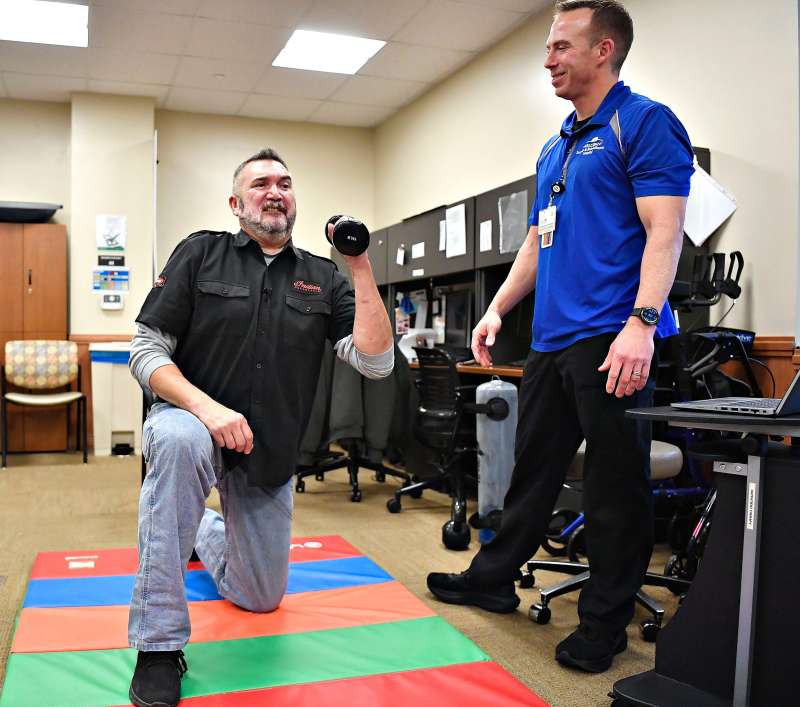
Not quite three months later, on a cold, windy morning in December, rooms hummed with conversation as therapists connected with their patients through small talk, building rapport while encouraging them to practice simple movements that build muscle and dexterity.
With a resistance band around his ankles, Godfrey side-stepped on the mat facing the tall, wall-length mirror. Next, he was on his right knee in front of a chair, lifting a 20-pound kettlebell with both arms from the floor on his right side, up and over his head to the left. He switched to his left knee and paused to catch his breath. His outpatient physical therapist, David Weaver at WellSpan Surgery & Rehabilitation Hospital, offered to let Godfrey switch to a more comfortable position for a little bit to give him a break, but Godfrey refused.
“Nope, just taking a minute before I do it again,” he said.
Ten seconds later, Godfrey’s eyes closed tight in concentration. With his brow furrowed, strain flushed his face as he worked the left side of his torso to raise the kettlebell up and to the right.
In a different room, Godfrey lay on an inclined exercise bench. He winced as he worked his left leg to slide the bench up along its track. Layered in a gray thermal under a black button-down Indian Motorcycles shirt, denim pants and sneakers, Godfrey spent an hour of his morning pushing through sets of more than a dozen exercises given to him by Weaver. He went three times per week.
Godfrey was shot eight times: twice in the back, three times in the abdomen, twice in the leg, once in the groin. He sustained three large blast exit wounds to the front of his torso.
“Shot number 7 — and I will never forget it — that was the worst one out of all eight. Don’t get me wrong, the other seven sucked, but shot number 7 — when that hit me in my chest — I thought I was paralyzed,” he said. “That one hurt, that one hurt bad.”
Northern York County Regional Police Det. Mark Baker, 53; Det. Sgt. Cody Becker, 29; and Det. Isaiah Emenheiser, 43; didn’t make it out. They were killed in the line of duty on Sept. 17, 2025. Det. Zachary Grey was shot in the arm and abdomen.
Following the life-saving efforts of Northern Regional Det. Jack Asper and then his own Sheriff’s Deputy Thomas Dreyer and Cpl. Brandon Polash, when they arrived at the scene, Godfrey was taken to WellSpan York Hospital, where he was intubated for days, survival uncertain. Godfrey says his daughter, Brittany Godfrey-Williamson, told him that he was very unstable.
“Even as an ICU nurse, I didn’t think he’d make it,” said Godfrey-Williamson.
Godfrey suffered fractured ribs, a collapsed lung, pulmonary embolism, damage to his abdominal wall, pancreatic sac/area, diaphragm and stomach tract, a severed sciatic nerve, had his spleen removed and had three large blast exit wounds.
He was left with more than 30 pieces of shrapnel in his left side, a bullet lodged in front of his spine and loss of feeling/control of his left foot.
After 12 surgeries and 30 days in the hospital, Godfrey was released but would continue his recovery, working to gain strength and mobility through physical therapy.
Days after the shooting, when Godfrey’s wife was going through his belongings, she opened the wallet that had been in the pocket of the cargo pants he wore on the day of the shooting — a thin leather wallet that had been positioned just at his femoral artery — when a bullet fell out. The shot had stopped at one of the four credit cards that was in the wallet. The card that stopped it was customized with a picture of K-9 Capt. Dargo, the bomb-sniffing canine that Godfrey had been the handler for from 2013 to 2023, when Dargo retired on his 12th birthday. Dargo died in 2024.
Godfrey jokes that Dargo wasn’t ready to see him yet.
A positive outlook has been key to Godfrey’s recovery. He also attributes the basics instilled in him during his Marine training.
“That day, I found six ways to fail because every shooting position I took, where he shot me more times and I was still getting hit, that was failure. You get up, you keep moving,” Godfrey said.
Godfrey wasn’t told about what happened to the other officers until about a week later.
His first thought was: “Did I do it? Did I cause it? Did I screw up and that’s the reason they died?”
He says he then analyzed everything that he did at that scene and even talked to a fellow drone operator.
“Realizing what we did, the tactics we used and how we approached, and that they had no chance whatsoever,” said Godfrey, “that got me past that stage.”
He adds: ” I don’t think you ever get used to it — it’s just, it’s more slowly and over time it becomes the normal.”
‘You always have to keep going,’ Godfrey tells students
While he was in the hospital, officers were assigned for overwatch to guard him around the clock. He says he tried to tell each one of them: “Always keep going, always keep fighting.”
This same message was clear in mid-May, when Godfrey shared his story with about 41 high school and middle school students in leadership positions at Red Lion Area High School. Dressed comfortably in a gray polo shirt, cargo shorts and loafers, he began his presentation by offering that the most important message that he hoped to convey was that failure is not the end.
Godfrey had spoken at the school before, with the K-9 Unit, working with the school’s criminal justice and military programs. He was on the school’s list of speakers for the year before the September shooting incident occurred.
He slowly paced around the small table holding his laptop, leaning from time to time on the back of the chair as he spoke, often favoring his left foot that was protected by an ankle brace.
“You can translate this to anything that is thrown at you in life,” he told them. “You always have to keep going.”
At the end of May, Godfrey broke his left ankle the morning of the York County Sheriff’s Office Annual Awards Ceremony. Despite the new setback in his recovery, he was seated in the front row, hobbling on crutches to the stage time and again to offer his deep gratitude and hearty embrace.
“Thank you for saving Brit,” said Godfrey to Sgt. Cole Zimmerman and Cpl. Shane Kauffman, while warmly embracing each after they received medals for their heroism during an active shooter/hostage situation at UPMC Memorial on Feb. 22. Godfrey was referring to his daughter, who was working at the hospital during the incident.
During the ceremony, Godfrey received a Medal of Valor, the Curtis D. Sowers Medal and the Line of Duty Injury Medal. At the end of the ceremony, he was also presented with the Pro Football Hall of Fame Award of Character by Jarrett Payton (son of the late professional football athlete Walter Payton) and former professional football athlete Harry Carson in partnership with the Pro Football Hall of Fame and USA TODAY. By this, Godfrey says he was caught off guard.
“It’s nice to be recognized,” he said, “but yet I don’t know if I feel I deserve to be recognized. I’m just Dave,” he continues, “I’m just a guy that was there doing a job that day.”
Before the ankle break, Godfrey was working to get to a place where he hoped he could eventually return to work. Godfrey’s ankle break required surgery and brought his current rehab progress to a standstill.
Now, three months after the break, he’s still healing.
“It took me a minute to get my head wrapped around yet another injury that popped up from the incident,” Godfrey said. ”You think you’re getting to a certain point and you’re truckin’ pretty good and then you just get wacked again.”
While medically in limbo, still going from appointment to appointment and waiting for healing so he can return to physical therapy, Godfrey finds ways to give back. On June 8, days after his surgery, Godfrey was sitting just inside The Verandah Room at York Expo Center with his cast-covered leg propped on a knee scooter while he greeted potential blood donors for the Lt. Dave Godfrey Replenishment Blood Drive event that was announced in early May.
Following the shooting, Godfrey was told that he had needed 30 units of blood product. When approached about a potential drive by his friends Richard and Cathy Pope (Richard is regional manager for the Central Pennsylvania Blood Bank), Godfrey was eager to give back, taking to Facebook to promote the event and rally donors.
He’s also been sharing his story of resilience with others. He’s spoken to high school students, soon-to-be graduates of the sheriff’s academy, and the Sheriff’s Association, to name a few.
Godfrey remembers that the speakers who have impacted him most over the years have been the speakers who “were there” and experienced what they are talking about vs. someone lecturing out of a book, and he hopes that his experiences can help others.
“So, if I could just let the people know it’s gonna be tough, but move on,” said Godfrey,” show them it can be done so they can persevere,” he adds. “I like doing that.”
‘York County is a good place’
Godfrey has had people he doesn’t know approach him and tell him stories about him and Dargo, or they have thanked him for something that he stopped and did for them 20 years ago and they tell him how much of an impact it had.
“The whole thing has been very humbling,” said Godfrey. “It makes you feel really good about the job you’ve done. You never try to win people over − you do the job just to do the job, and you do the job right because it’s the right thing to do,” he said.
He continued: “Our community, the way that they’ve come together and the support they’ve shown for all of us that were involved — it’s awesome. York County is a good place.”
After having experienced such a traumatic moment, that sense of community has been reassuring.
“One thing I really noticed is how much this impacted the county, how supportive and how great everybody in the county has been,” said Godfrey. “It’s helped us through the entire process,” he noted. “Without all the support, we wouldn’t be doing as good as what we are.”
“I truly am blessed,“ Godfrey continued. “God got me through that day, and I am here, and I’m still going.”