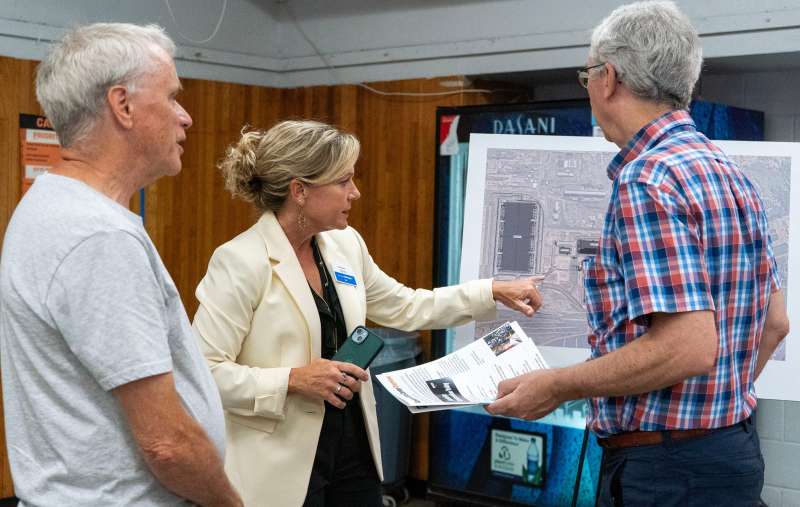
Kevin and Diane Ball made their way past enthusiastic Amazon representatives eager to bat down negative press the couple may have heard about the company’s massive data center under construction at the Keystone Trade Center in Falls.
Each rep stood before sharp, polished placards trying to explain away fears that the plant will be a drag on the environment, won’t be as loud as activists warn, and will have no ill effects on the Delaware River, from which the data center could draw up to 5 million gallons of river water daily.
“I’m hearing that electricity in the area is going to go through the roof because of the power that they need,” said Diane Ball, who lives in the Birch Valley section in Falls. “I’m worried about the Delaware River either no longer existing or being so polluted, it’s worthless.”
Asked what concerns him, Kevin Ball said, “Well, environment and air (quality) because I have COPD.”
And, just about everything else that has to do with the data center, he said.
“The loss of power in case they (Amazon) decide they want to (operate) it through heat waves, they can take all the power (and) we don’t have electricity. Just all kinds of concerns. I’m worried.”
The July 14 open house by Amazon at Pennsbury High School in Fairless Hills drew hundreds of people before PECO hosted its own informational meeting to answer questions about the data center now under construction at the former U.S. Steel industrial site along the river. But how much Amazon did to allay fears isn’t clear. The representatives seemed prepped and scripted. A reporter was given five minutes for questions (plus a bonus round a bit later) but an Amazon representative timed it to the last seconds.
The Balls believe the open house was highly managed to favor Amazon.
“I feel that there’s a lot we’re not being told,” Kevin Ball said. “They’re (Amazon representatives) obviously trained to talk to people like us, and I don’t believe that they are going to be forthcoming with real information.”
Ever since Falls approved the facility in 2025, the issue of data centers has roared to life across the country.
Amazon intends to spend $20 billion on data centers in Pennsylvania. As for Falls, its plant will be large, but not its largest, an Amazon rep said. Its $11 billion data center, called Project Ranier, in New Carlisle, Indiana spreads 30 buildings over 1,200 acres and is expected to consume 2.2 gigawatts of electricity.
Amazon has not disclosed how much energy its Falls facility will need.
Still, any hope that Amazon will walk away from its Falls facility is unlikely, since it intends to spend $1 billion for ten buildings covering 3 million square feet at the site of the shuttered Fairless Works steel plant.
Here is what we know to date about the Falls data center:
What are data centers?
Data centers are buildings that contain IT equipment, like computer servers. Without this equipment, web searches, email, social media, electronic payments and all other digital services could not exist.
Companies are racing to build more data centers due to society’s rapid adoption of generative AI and digital needs. Compared to other digital services, generative AI demands much more processing power.
Will electricity bills rise?
Amazon says “no,” but it’s unclear. While PECO only delivers electricity over its lines (it hasn’t generated electricity for years) the power is generated by a competitive wholesale market managed by Pennsylvania-New Jersey-Maryland Interconnection, called “PJM,” a mix of independent power producers. PECO assured Falls residents that its present grid can handle power delivery to Amazon’s data center without needing to increase its rates. But PJM has increased resdiential and business power rates due to the growth of energy-gulping data servers in 13 eastern states.
Will my water rates rise?
No, according to the Morrisville Municipal Authority, which will supply river water for cooling the data center.
Amazon has requested a maximum peak daily withdraw of 4.4 million gallons of water per day from the Delaware River, said John Warenda, executive director of the Morrisville Municipal Authority, which operates the Keystone Trade Center’s water service. However, U.S. Steel’s Fairless Works had a “Certificate of Entitlement” from the Delaware River Basin Commission to draw 525 million gallons of water per day to cool the “hot end” of the plant. On average, the steel maker drew 350 million gallons of water per day from the river from its start in 1951 through the 1990s. That authorization was still valid through 2010, he said.
That coolong water will come directly from the Delaware River and is not connected to the authority’s drinking and bathing water supply (“potable” water), he said.
“The previous use of the property as a steel manufacturing facility offers the unique ability to supply untreated water from the Delaware River,” Warenda said. “This service water system is isolated from the (drinking) water system both operationally and financially. Domestic water supply and rates will not be impacted.”
How loud will the data center be and will I hear it if I live in or near Falls Township?
Usually, the place will be no noisier than the rest of the industrial park, Amazon said, but during power outages (or routine backup power equipment tests), noise will increase.
The noise will come from the data center’s proposed 283 gas fired generators, and three more diesel generators. Each generator produces 65 decibels, about the same sound as a city bus passing you from 20 feet away, so it will be loud. Amazon said when its generators are in service the sound won’t be heard by the local population, since the nearest house in Falls Township is about 5,000 feet (about 1 mile) from the data center’s location in the Keystone Trade Center. They also said they are a back-up energy supply and won’t be used daily.
Why are 283 generators needed at Falls data center?
Amazon plans to use emergency generators fueled by natural gas and diesel if the data center’s power supply is ever interrupted. The Pennsylvania DEP has already approved 76 generators for the site and is currently reviewing Amazon’s application to install 286 more.
If approved, the data center would be required to limit its annual emissions to less than than 25 tons of volatile organic compounds and nitrogen oxides. The center would be classified as a “minor source” of these pollutants, which can contribute to health problems such as respiratory distress and environmental problems such as acid rain.
How much revenue will the data center produce for Falls?
It’s unclear. “We do not know specific tax revenue until the building is assessed (with respect to real estate tax),” said Falls Manager John Shepherd. “Other taxes, such as EIT, depend on the number of workers and salary. So unknown at this point.”
What’s in it for Fall Township and Bucks County residents?
Amazon officials said that about 1,800 construction jobs will be created through 2031 as the ten buildings at the data center campus is completed. It’s unclear if those jobs will be required to pay union wages.
After completion, Amazon spokesman Roger Wehner said an array of permanent positions will be needed to operate and maintain the facility, up to 200 positions, from maintenance staff to HVAC and electricians, as well as software engineers. Many of those jobs will pay between $70,000 and $80,000 a year, he said.
What legislation has been proposed in Harrisburg to regulate data centers?
HB 2650: Passed by the House, this codifies the Governor’s Responsible Infrastructure Development (GRID) standards, linking data center tax benefits to community engagement, environmental protection, and energy affordability.
HB 2496: Passed by the House, this “pause button” bill grants municipalities up to a six-month window to halt data center applications while they update local land-use and zoning ordinances.
Is there any chance the Amazon data center in Falls can be stopped?
No, only regulated. It was approved by the township board of supervisors in 2025 and the main data center warehouse, which is 1 million square feet, is already built. Amazon said it will sink more than $800 million into the data center campus. If Amazon meets all local, state and federal regulations, it’s a done deal. The site was built in a pre-existing “brown field” industrial area and did not require the same approvals as if it was proposed in a residential zone, where it would not be permitted.
How will it affect the local environment, including the Delaware River?
A major concern from the public, activist and advocacy groups, including the Delaware Riverkeeper Network, is the data center’s water usage and its effect on the Delaware River. The water used to cool the facility will be returned at “ambient” temperatures, meaning not too hot or cold, officials said.
Amazon has requested a maximum peak daily withdraw of 4.4 million gallons of water per day from the Delaware River, said John Warenda, executive director of the Morrisville Municipal Authority, which operates the Keystone Trade Center’s water service.
To compare, U.S. Steel’s Fairless Works had a “Certificate of Entitlement” from the Delaware River Basin Commission to draw 525 million gallons of water per day to cool the “hot end” of the plant. On average, the steel maker drew 350 million gallons of water per day from the river from its start in 1951 through the 1990s. That authorization was still valid through 2010 when it was terminated, he said.
Why did Amazon choose Falls?
The Keystone Trade Center is a massive 1,850 acre industrial property on the Delaware River that has been the site of the Fairless Works steel plant, owned by U.S. Steel/USX. It has been remarkably resilient, first for steelmaking in the second half of the 20th century, and in the 21st century has been redeveloped as a massive logistics and digital infrastructure hub. It has all necessary infrastructure for a massive AI data center, including water, electricity, rail and roads, and is located far from most of Falls Township’s residential neighborhoods.
What do data centers look like?
From the outside, data centers look like big, windowless warehouses. Inside, there are rows of computer servers and other equipment. The Amazon’s “digital infrastructure campus” in Falls Township will comprise ten buildings totaling 2 million square feet.
Have any other data centers been approved for Bucks County?
The Falls Township project is currently the only data center approved for Bucks County.
Pennsylvania law forbids municipalities from totally banning data centers, or any specific use. Every municipality must zone land for all types of development, including data centers. However, some Bucks County towns have pursued less-sweeping limits as towns can direct where they want different kinds of buildings and uses through zoning laws.
In June, Bensalem Township issued a six-month moratorium on any potential data centers so officials can research their effects on the quality of life. No centers have been proposed there. In April, West Rockhill Township passed a zoning ordinance enacting stricter regulations on any future data centers.
Middletown is currently considering data center regulations, including keeping sound to a maximum of 75 decibels, a level produced by a vacuum cleaner.
What groups are objecting to the Falls data center?
At a July 14 public meeting, all speakers, including Falls residents, members of the public from other places in Bucks County, New Jersey officials and others, expressed opposition to the project.
Activists from groups including the Delaware Riverkeeper Network and BuxMont DSA were present at the meeting. Both organizations have advocated against data centers.
A petition demanding lawmakers issue a moratorium against new data center projects and enact more stringent regulations on existing facilities had gathered over 4,300 signatures as of July 16.