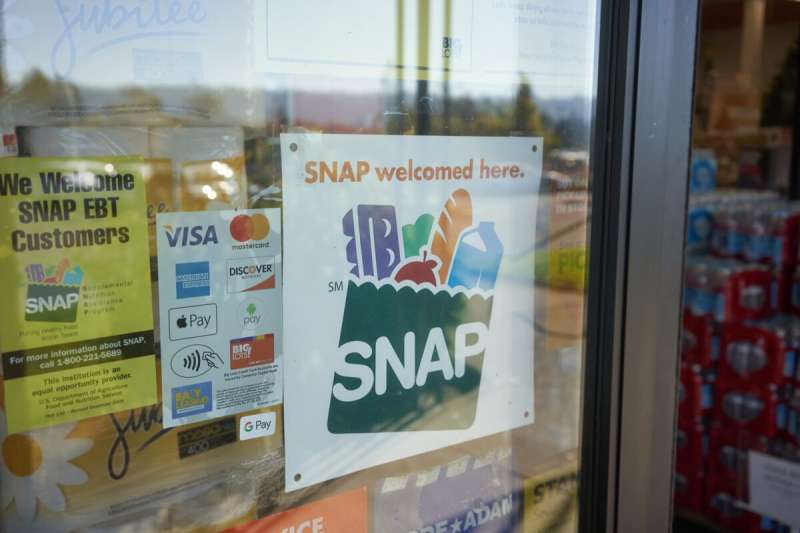
Pennsylvania has brought down its error rate for issuing food stamps over the past year, but its reported mistakes could still put the commonwealth on the hook for more than $400 million in additional annual program costs.
These mistakes happen when officials either underpay or overpay recipients, and while advocates say they usually involve small amounts, President Donald Trump’s administration has cracked down on them and plans to begin penalizing states for them in 2027.
Historically, the federal government has fully funded benefits delivered through the Supplemental Nutrition Assistance Program, which feeds nearly two million Pennsylvanians each year.
But under H.R. 1, or the “big, beautiful” tax bill passed by Congress in 2025, states that make too many administrative errors will have to shoulder a portion of this spending.
These recent changes “created new pressures and rules that jeopardize SNAP funding and has destabilized this program, leaving vulnerable people without food,” a spokesperson for the Pennsylvania Department of Human Services said in a statement to USA TODAY Network Pennsylvania.
Pennsylvania posted a SNAP error rate of 9.21% for fiscal 2025, the U.S. Department of Agriculture reported in late June. That’s a bit below the national average and a slight drop from 2025, when the commonwealth’s error rate stood at 10.76%.
But under the new rules, the Keystone State would still have to fund a tenth of the nutrition assistance issued to its residents, potentially shifting $410 million a year in costs to the commonwealth, according to an estimate by the Center on Budget and Policy Priorities.
States with error rates exceeding 5% must cover between 5% and 15% of their SNAP benefits, with more mistakes resulting in a larger penalty. Most states have error rates that would make them liable for some level of cost-sharing, according to the fiscal 2025 data.
Why Pa.’s SNAP outcome is still uncertain
The first round of cost-sharing — scheduled to begin in October 2027 — will be based on error rates from either fiscal 2025 or 2026, but states will be able to choose which year they want to use. This means Pennsylvania has another year to bring their number down even further.
However, DHS spokesperson Brandon Cwalina said officials hope Congress will delay the cost-sharing changes further as part of the 2026 Farm Bill, thereby taking action to “correct this threat to live-saving food assistance.”
Gov. Josh Shapiro’s administration has been upgrading SNAP systems, in part to cut down on mistakes in the program.
In December 2025, the state rolled out new tools to scan people’s eligibility documents to make sure they’re readable and not blurry. Over the past year, case workers also have gained new methods for verifying income and systems for flagging missing information on benefit applications.
State officials noted the frequency of mistakes has fallen significantly since around the time Shapiro took office, when the rate was 16.6%.
How important are SNAP payment errors?
The Trump administration has decried what it sees as rampant fraud, waste and abuse in public assistance programs and has placed the issue of SNAP errors inside this broader framework.
“These payment error rates are further proof that state accountability is severely lacking in SNAP,” Agriculture Secretary Brooke Rollins said in a statement that estimated the nationwide financial impact of the mistakes was about $10 billion in fiscal 2025.
But advocates say it’s unfair to punish states for error rates that emerge as local workers process complex cases, often dealing with understaffing and ever-shifting program guidelines. In addition, they contend, the mistakes only reflect one aspect of program performance and don’t capture other important metrics, such as case processing times or accessibility.
Far from helping solve these problems, H.R. 1 makes it more challenging by offloading SNAP administrative costs to the state, said Gina Plata-Nino, SNAP policy and advocacy director at the Food Research and Action Center. Previously, the federal government had paid half these expenses, but the 2025 bill increased the state’s burden to three-quarters of the total.
Handing hundreds of millions of dollars in benefit payments over to the states could weaken these programs and force officials to make painful tradeoffs, advocates say.
“States are going to face a very difficult decision. What is going to be cut? Is it K-12? Is it higher ed? Is it transportation?” Plata-Nino said. “But more importantly, do they even try to continue the program?”
About 30% of states that participated in a recent survey indicated they might have to narrow SNAP eligibility in the aftermath of H.R. 1, while a tenth of the respondents mentioned withdrawing from the program altogether as a potential risk. The findings of the American Public Human Services Association survey did not specify which states were looking at these scenarios.