A draft proposal calls for $62 million – less than one-sixth of monthly benefits received by Pennsylvanians.
Some state lawmakers want to give grants to food assistance programs to help offset the potential loss of Supplemental Nutrition Assistance Program (SNAP) support.
The Pennsylvania Food and Hunger Relief Grant Program would divert $50 million from interest earned on the commonwealth’s rainy day fund to food banks and $10 million to Meals on Wheels Pennsylvania, plus $2 million to the state Department of Agriculture.
That’s a fraction of the $360-plus million in monthly SNAP benefits that two million Pennsylvanians receive – and will have to go without, starting in November due to the federal government shutdown. That’s more than 15 percent of the number of people who live in the commonwealth, a share that ranks ninth among the states.
Put another way: the number of people losing food stamps rivals the combined populations of the commonwealth’s two largest cities: Philadelphia and Pittsburgh.
“We must take care of our neighbors at this desperate time,” said state Sen. Art Haywood (D-Montgomery/Philadelphia). “Hunger does not discriminate based upon race or gender or zip code or any other way we might want to identify. We need to accept that on November the first, millions of Pennsylvanians will not have food assistance that they will be relying on.”
“A perfect storm”
Haywood joined a few other Senate Democrats to announce the proposal Tuesday afternoon, alongside representatives from Feeding Pennsylvania and one of its nine member organizations — the Central Pennsylvania Food Bank.
Only the commonwealth faces the loss of SNAP without having a state budget, which is nearly four months late.
Given that, “Pennsylvanians are going to be the hardest hit by these SNAP cuts,” said state Sen. Lindsey Williams (D-Allegheny).
Food assistance programs – including senior programs with food aid components typically financed by lottery funds being withheld amid the budget impasse – have gone without state funding. That’s on top of federal funds held back during the federal government shutdown that’s now approaching the one-month mark. Not to mention, there’s another nearly $20 million lost to federal program cuts since last year, according to Julie Bancroft, who’s the CEO of Feeding Pennsylvania.
And providers already were seeing unprecedented demand even before the dual budget gridlocks affected not only their funding, but also much of the rest of the social safety net. They have resulted in furloughs, layoffs and reduced hours and pay for workers on the payroll at federal and county governments as well as contractors.
All this, as new rules for SNAP take effect.
“We are facing a perfect storm,” Bancroft said.
Pennsylvania is one of 22 states plus Washington, D.C., suing the federal government over its failure to fund SNAP after the United States Department of Agriculture scrapped a previous plan to tap into $6 billion in contingency funds to continue SNAP benefits during the shutdown.
“Eight of our nine food banks are accessing cash reserves to try to put money on account for pantries to keep their shelves stocked,” Bancroft said. “These backup resources are not infinite and will quickly dry up if we don’t get funding moving.”
Some other states have already granted tens of millions of dollars to food assistance and distribution networks. Virginia has committed to continue paying SNAP benefits in full using state funds, according to reporting by Newsweek.
Asked if the state Senate GOP would support the proposal, Majority Leader Joe Pittman said through a spokesman: “Art Haywood needs to tell Chuck Schumer to listen to John Fetterman.”
At last check, food assistance wasn’t among uses listed in applicants to the state Department of Treasury’s grant program, according to spokesman Steven Chizmar.
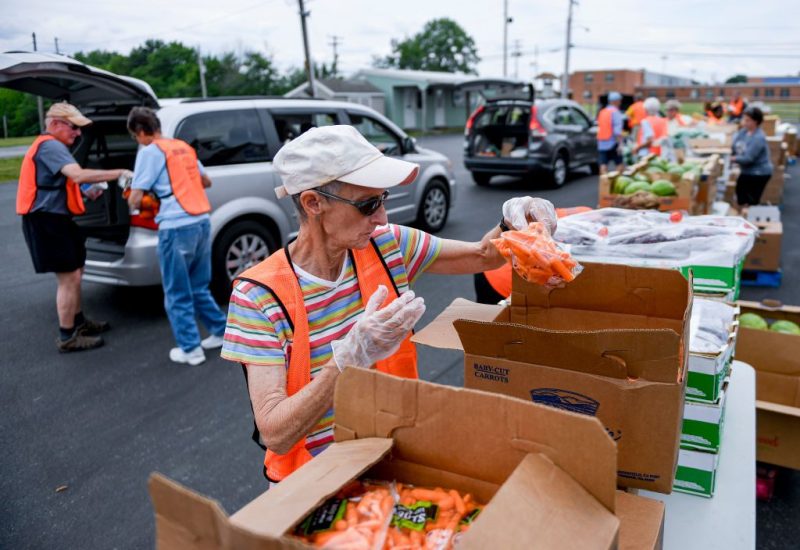
The state Department of Human Services has directed people losing benefits to food banks. But the commonwealth’s food assistance network can’t fill the void, even when funded as usual.
“The SNAP program is nine times larger than all of the food banks combined in terms of the amount of food that we collectively distribute,” said George Matysik, executive director of Share Food Program in Philadelphia. “So, to ask any social service nonprofit to fill in a gap of this size is just completely unrealistic. We will all do what we can. But it’s going to be an immense challenge for any of us to keep up with that pace of demand.”
Share Food bought an extra half million dollars worth of food last week in preparation for SNAP’s cessation Nov. 1, Matysik said.
He contrasted the current scenario to the demand inundating food banks during the COVID-19 pandemic.
Back then, the U.S. Department of Agriculture sent additional resources to Share Food and similar programs promptly, he said.
“The idea that reinforcements are coming, like they did in 2020, and [the recession] in 2008 is not there,” Matysik said. “It’s like the reinforcements have turned against us. Our own government is doing this to its people. That’s the disheartening part of all this.”
Pennsylvanians have started stepping in.
Following news that SNAP benefits would cease absent federal lawmakers reaching an agreement, Feeding Pennsylvania’s donations jumped 2000% this month compared to last October, according to spokeswoman Lauren Duff.
At least one food bank in its umbrella indicated a boost, Duff said, on top of WellSpan Health’s donation of $275,000 (equivalent to one million meals) to the Central Pennsylvania Food Bank last week.
Nonprofit foundations in Chester County, meanwhile, are banding together for a $100,000 fundraising challenge to benefit the county’s food bank, according to Kevin Ressler, President & CEO of the The Alliance for Health Equity. Based in Coatesville, the Alliance is partnering with the Chester County United Way and Chester County Community Foundation.
While heartening, Ressler noted, “we cannot fund our way out of this through private philanthropy.”
“The government provides so much support in this country,” Ressler said. “Foundations cannot replace the loss of government support for our hardworking neighbors – most of whom have jobs [or] are children or older adults who can’t just go out and get a job.”
Duff advised going to Feeding Pennsylvania’s website to support the statewide or local efforts through donations or to identify volunteer opportunities locally.
“It’s inhumane”
The situation with SNAP echoes the recent funding crisis for the related Women, Infants & Children program that provides cash for groceries and other support to new and expecting mothers and their children.
But there are major differences.
To start, Pennsylvania’s WIC program gets $278 million annually in federal funding vs $4.4 billion for SNAP (i.e., more for SNAP in a single month than for WIC in an entire year). About two million people get benefits through SNAP versus about 186,000 through WIC.
WIC benefits also are loaded three months at a time – so, recipients have some buffer time if funding stops. With SNAP, that’s not the case – lending more urgency to the looming freeze.
The federal government’s recent approach has been different, too. The U.S. Department of Agriculture stayed relatively quiet as WIC money was drying up and released short-term funding at the last-minute.
But USDA officials ordered state DHS officials to stop new enrollments and draw-downs three weeks ahead of funding possibly drying up, in letter sent Oct. 10 – a move that “shocked” Tricia Fonzi, FHCCP’s president and CEO.
Northampton County Commissioner Lori Vargo Heffner questioned the motivation behind the directive – and condemned it.
“We’re traumatizing these people by even threatening this,” she said. “It’s inhumane.”
Matysik agreed.
“We entrust our federal government to assist the working class, not to use us as a negotiating chip,” Matysik said. “If you want to talk about why folks don’t trust the government, this is the reason. This is food on the table for 42 million Americans. And the political class has very [few] qualms about ripping that from their dining room table in the pursuit of some type of political negotiation.”