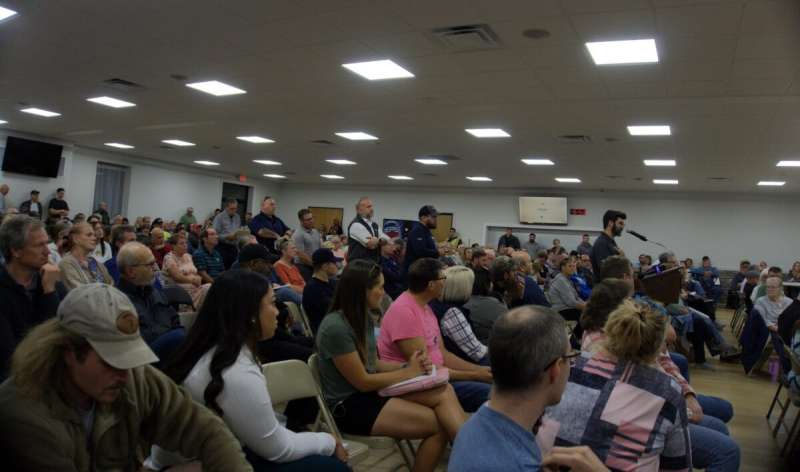
Opening the October 2025 meeting of the East Manchester Township board of supervisors, Chairman David Naylor told the crowd that “likely some uncomfortable decisions must be made.”
Those “uncomfortable decisions” had to do with the possibility that the mostly rural northeastern York County township would become the host of a massive data center.
The township is attractive to data center developers. It had open spaces, fairly inexpensive land and access to high-tension power lines running from the Brunner Island gas/coal generating station, along the Susquehanna River, the township’s east border.
Although the township hadn’t received any formal plans, there was word that data center developers were eyeing the Royal Manchester Golf Links and the 300-acre York Baker Farm, in the eastern part of the township, as possible sites for one of the massive facilities.
At the meeting – moved to the fire hall in Manchester to accommodate the crowd – Naylor immediately shot down the golf course rumor, saying the township would not rezone the land to permit. The Baker farm, though, remained in play.
But Nayor assured those in attendance that the township would do what it could, within the law, “to make the standards high enough so that any data center will be built where and how the township dictates in order to protect the community.”
This month, nearly six months after that meeting, the township passed a zoning ordinance that restricts where any data center can be built and how it must be built.
“We tried to address every concern residents expressed to us,” said Naylor, a township supervisor for more than two decades. “I feel we did that. I’m proud of the result.”
The ordinance, one of several being considered by York County local governments, is detailed in its restrictions. For instance, the dense landscaping buffer is required to include one shade tree for every 5,625 square feet of buffer, one ornamental flowering tree, at least eight feet tall, for every 2,500 square feet of vegetation, and one shrub, “fully branched” and at least three feet tall, for every 25 square feet of buffer.
It also limits the height of the buildings and mandates that they be situated to minimize sight lines from adjacent streets and residential areas. It requires buildings to have windows and facades with defined entries.
When cooling equipment is located close to a road or residential area, it must be enclosed in a building, according to the ordinance. Any rooftop equipment had to be behind a parapet wall or housed in an equipment penthouse.
It sets limits on the levels of sound or vibrations that can emanate from the property. It mandates studies on how the development would affect local wildlife and orders developers to comply with any measures that would mitigate effects on wildlife. It mandates strict environmental measures.
“We thought and rethought everything that was presented to us,” Naylor said.
East Manchester Township is among several townships in York County that have felt compelled to address data center development in the past year or two, responding to residents’ concerns that such facilities would change the character of their rural communities and create noise, pollution and other nuisances. Residents also expressed concern over electric rates, since data centers require massive amounts of power, but that issue is the purview of the state Public Utility Commission and, indirectly, the PJM power grid. A data center built anywhere within the grid has the potential to affect rates that residents and businesses pay.
Another township grappling with the issue is Conewago Township, which has received informal proposals for two properties, including 541 acres owned by Rexroth Farms off Bowers Bridge Road. The township did not respond to a request for comment.
Neighboring Manchester Township is considering a strict ordinance to regulate data center development. Township manager Tim James said they started with the model ordinance developed by the York County Planning Commission and “simplified it,” reducing it from 14 pages to eight while “beefing up” restrictions on such facilities and limiting them to industrial areas. James expects the township to pass the ordinance in May or June, once it passes muster with county planners.
The township, he said, “doesn’t have the available land” to host a hyperscale data center. “We’re trying to get ahead of this,” James said. “Unfortunately, we don’t believe we can stop data centers entirely, but we want to prepare ourselves.”
Windsor Township manager Jennifer Gunnet said the township’s amended zoning ordinance is under review by the county planning commission. She said the issue was discussed at multiple meetings and that residents’ concerns were addressed in the law. At the same time, she said, the township had to comply with state law. “The legal concern was that the Township is required to accommodate all uses, which can create a balancing act,” she said.
The state is getting into the act too. The state House recently passed a bill that asks a local government commission to develop a model ordinance governing data center development and offer it to locales seeking to regulate it. The model ordinance, though, would not be mandated, according to the bill.
Under state law, townships cannot simply prohibit data centers. At that October meeting, East Manchester solicitor Andrew Miller told the crowd that the township can’t impose “unreasonable restrictions,” or regulate issues governed by other agencies, or take other measures outside the scope of its governing powers. It can, though, “adopt provisions that make sense (and) allow sensible development and protect impact on the public,” he said at the meeting.
Naylor said, “we got some very strong opposition. I felt a lot of people misread what our intent was.” He said the township did not consider the monetary aspects of the development, tax revenues that such a huge development could bring in, which could be substantial. “We don’t look at something moving into the township for the tax revenue,” he said. “Our intent was to manage it, to protect our residents.”
He said, “We just can’t say no to data centers. But we can make it restrictive enough so developers may give the township a second thought if they propose one here. If one does come, we’re prepared.”