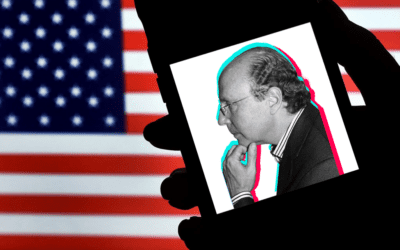
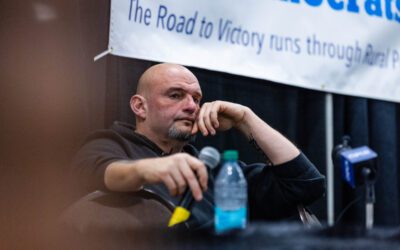
FILE - In this Sept. 16, 2019 file photo, union members picket outside a General Motors facility in Langhorne, Pa. General Motors CEO Mary Barra joined negotiators at the bargaining table Tuesday, Oct. 15, an indication that a deal may be near to end a monthlong strike by members of the United Auto Workers union that has paralyzed the company’s factories. (AP Photo/Matt Rourke, File)
Even though there has never been a nationwide general strike, mass strikes have played a large role in Pennsylvania history.
Chicago Mayor Brandon Johnson received a lot of attention on Saturday after he called for a nationwide general strike to defeat President Donald Trump’s authoritarianism and corruption through his support of the country’s ultra wealthy during his city’s “No Kings” rally.
“We are going to make them pay their fair share in taxes to fund our school, to fund jobs, to fund healthcare, to fund transportation,” Johnson said. “Democracy will live on because of this generation. Are you ready to take it to the courts and to the streets?”
What is a general strike?
General strikes happen when workers and unions from multiple sectors and industries go on strike to bring a country’s, or a region’s, economic activity to a halt. The end goal is to bring social and economic change to a specific sector or society as a whole.
Has a general strike happened in Pennsylvania?
Yes, there have been multiple general strikes throughout Pennsylvania’s history. In fact, Philadelphia was home to the country’s first general strike in 1835.
According to City Cast Philadelphia, coal heavers working along the Schuylkill River went on a strike seeking a 10-hour workday in May 1835. This strike grew to encompass over 40 trades and 20,000 workers by June, and, at the end of the month, they eventually won a 10-hour workday.
A second general strike occurred in March 1910 when the Philadelphia Rapid Transit Company fired 173 workers associated with Amalgamated Association of Street and Electric Railway Transit Employees of America. The Central Federated Union called for a general strike to support the fired workers, and over 140,000 walked off the job.
Then, in 1919, there was the Great Steel Strike of 1919, when 350,000 US Steel workers walked off the job across the country. This strike was centered in Pittsburgh, and during World War I, workers in the industry had shorter hours, better pay and a promise of union recognition.
That changed immediately after the war ended as the steel companies began harassing the workers and denied organizers from entering the region. The strike eventually collapsed in January 1920 when the American Federation of Labor (AFL) did not have the funds to support its members.
Why general strikes are rare
While there have been national strikes such as the Great Railroad Strike of 1877 or the Great Steel Strike of 1919, there has never been a national general strike in the history of the US.
Erik Loomis, a labor historian, points out that general strikes are so rare in the country’s history because they are hard to organize and banned by the Taft-Hartley Act of 1947.
Taft-Hartley limits labor’s ability to strike and bans political or sympathy strikes, which happen when members of one union strike in sympathy with members of another union who are on strike. It also allows states to undermine labor regulations even further by giving them the power to pass “right to work” laws, which are designed to drain union resources by allowing non-union members to be protected by the union without having to pay for union services through fees.
Earlier this month, A.J. Schuman, with Inequality.org, said he believes that the country is ripe for a general strike regardless of the barriers that could prevent one from happening.
“These obstacles are real. But strikes are not born of ideal conditions; they arise precisely because conditions have become intolerable,” Schuman writes. “Which makes now—with economic inequality rapidly accelerating and authoritarianism knocking at the door—exactly the right time to revive the general strike.”
Author

Support Our Cause
Thank you for taking the time to read our work. Before you go, we hope you'll consider supporting our values-driven journalism, which has always strived to make clear what's really at stake for Pennsylvanians and our future.
Since day one, our goal here at The Keystone has always been to empower people across the commonwealth with fact-based news and information. We believe that when people are armed with knowledge about what's happening in their local, state, and federal governments—including who is working on their behalf and who is actively trying to block efforts aimed at improving the daily lives of Pennsylvania families—they will be inspired to become civically engaged.

Transgender Marine veteran & nurse among challengers to Lloyd Smucker
History could be made in more ways than one in this year’s race for the 11th District. Three candidates – two Democrats and one Independent – have...
Philly lawmaker makes the case for impeaching DHS Secretary Kristi Noem
Democrats are becoming more vocal about their support for impeaching Homeland Security Secretary Kristi Noem following the deaths of two citizens in...

Sen. McCormick talks immigration enforcement, shooting death, ICE funding during telephone town hall
The Republican says two investigations are underway into the death of Alex Pretti. Two separate investigations are underway into the Saturday...
FAFO: Krasner joins accountability fight against federal immigration agents
Fight Against Federal Outreach (FAFO) looks to bring local prosecutors together and charge federal agents with crimes following killings in...
All seven Pa. House Democrats now signed onto Noem impeachment articles
Sen. Fetterman joins chorus of Democrats calling for Noem’s removal. Rep. Chrissy Houlahan announced she’s supporting the effort to remove...