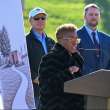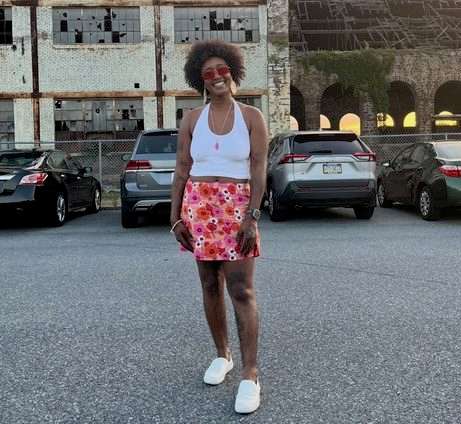
Tiersa Curry wants to make an important point. “LGBTQ history doesn’t just happen in big cities. You can look in your own town.”
The 26-year-old Archives Coordinator at the Bradbury-Sullivan LGBT Community Center in Allentown knows from experience. Her professional mission is to record and document the long, rich history of the LGBTQ+ community—not just in Allentown, but throughout the entire Lehigh Valley.
It’s an exciting job for the graduate of Kutztown University. “I really love my job…making history more accessible and being able to collect more, so I can preserve as much as I can,” Curry said.
Recording local history for current and future generations is why the archive was started in 2016, as a coordinated effort between the Bradbury-Sullivan Center and Muhlenberg College, also in Allentown.
Now Curry, who identifies as queer, is dedicated to making archive materials available to anyone who wants to see them, and to continuing to collect the stories of members of the Lehigh LGBTQ+ community.
This includes video recording the oral histories of everyday people in the area. “A lot of (LGBTQ+) community members don’t see their lives as important or historical in the first place,”Curry said. “I try to tell them, even if you weren’t a leader of an organization, even if you weren’t running for office as an open LGBTQ person, anything that you did as an LGBTQ person in the Valley is important to me.”
She added that it’s the more “everyday” moments that tend to capture the hearts and minds of visitors to the archives.
“We have three photo albums just full of photos from the three gay bars that used to be in the LeHigh Valley, and those go over so well with people from the older generation…because some of them are able to point themselves out, they’re able to point their friends out,” Curry said.
It’s that personal connection to local residents that Curry is really trying to make with the Lehigh Valley LGBTQ Community Archive, which contains material going back to the late 1960s. She wants locals to know their history—just as knowing her own led her to the work in the first place.
Curry grew up living with her mother, an aunt, and her Pop Pop (her maternal grandfather) in a home built on land that her great-grandfather bought in the 1930s.
His family had moved to the Reading area in the 1920s during the Great Migration, when roughly 6 million Black southerners migrated to the North and Midwest to escape racial violence and oppressive Jim Crow segregationist laws.
Curry’s interest in her background sparked an interest in anthropology—a subject she earned a bachelor’s degree in from Kutztown University. But her graduation didn’t bring an end to her studies.
“The main scholarship that I focus on in my life in general is racism—specifically anti-Black racism that’s portrayed in the LGBTQ community,” Curry said. “I think a lot of the time people associate being LGBTQ or being queer with being white and it’s obviously not true.”
In her archival work, Curry says she wants to gather more of the experiences of LGBTQ+ people of color, the Latino community, the Asian American community, and the disability community to represent “the true demographics of the Lehigh Valley.”
“We care about them. Their history matters and they matter,” Curry said.
Since the archives are relatively new, its first collection of oral histories focuses on the ways the COVID pandemic mirrored the AIDS crisis. Curry worked on those recordings with Dr. Mary Foltz, Professor of English and Women, Gender, and Sexuality Studies at Lehigh University.
Curry said that not all of the cultural collections are rooted in crisis. “I have a community member who worked as a drag king, called Apollo King at Diamonz (Nite Club), one of our gay bars. They have all these headshots, they have costumes, I have t-shirts that they wore at nearly 2,000 of their events,” Curry said. “Those are the types of things that I want to be able to share because they are so important.”
Curry had some of Apollo King’s show tapes digitized, and during the annual Lehigh Valley Pride festival this past August, she showed them in the Steel Stacks theater while Apollo performed in person. ”So it had their performances from 2003 on the big screen while they were doing the performance now, in reality. It was really cool.”
Curry also collects magazines, periodicals, event flyers and even the minutes of meetings from local LGBTQ+ organizations. She acquired collections of materials from local groups as well as personal collections, including one donated by Dixie Dugan White, who was president of the Pennsylvania chapter of the National Organization for Women (NOW) in the 1970s.
“Her collection is 17 boxes of documents from NOW meetings and then it’s also filled with photos of her,” Curry said. ”My job was to take all the boxes…go through them and organize them.”
In order to preserve materials that Curry collects and to make them accessible to the public, everything is entered into a database and housed at the Trexler Library.
“Anyone that has the internet can see what we have and make an appointment with me,” Curry said.
Curry also has her own archive space during Lehigh Valley Pride, and brings different materials from the archive to put on display for the community. At the 2024 Pride celebration, she wanted to create a collaborative art project,so she put a giant, 96-piece puzzle together, spray painted it white, and had community members decorate it.
Now, it will be placed in the archive.
The results of the 2024 presidential election have already had a material impact on the Bradbury Sullivan LGBTQ Community Center, which is displaying a letter on its website explaining a concern about future funding and a pause on some exhibits.
The letter acknowledges that “the election results have a tangible impact not only on our work but also on our identities and our sense of safety,” and adds “while much of what lies ahead remains uncertain, the rhetoric and promises that defined this campaign season raise serious concerns, especially for trans and gender-diverse individuals.”
The letter goes on: “Yet, if history has taught us anything, it is that our community is resilient. We have faced challenges with courage, determination, and solidarity—and we will continue to do so. For ourselves. For each other. For our future.”
Curry herself promises to carry on her work, too. “I’m going to continue to do my job. I’m going to continue to collect, preserve and document the (LGBTQ+) history of the Lehigh Valley.”
She hopes her work will help young LGBTQ+ people in the Lehigh Valley see that “we’ve always been in jeopardy” and that the community has been able to get past dark times before.
“These are all things, not that far in Lehigh Valley’s history,” Curry said. “But every single time, we fought and fought and fought, and that doesn’t change now.”