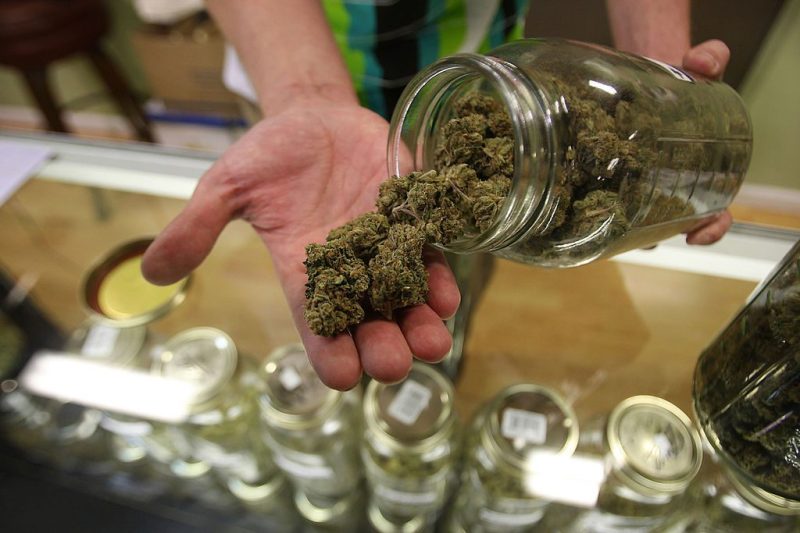
A state Senate committee has advanced a bill to create a Cannabis Control Board that would allow more oversight of the existing medical marijuana program. It would also regulate hemp-derived products, which contain intoxicating cannabinoids and are currently sold in head shops and gas stations around the commonwealth.
The bill’s sponsor, Republican Sen. Dan Laughlin (R-Erie), who has advocated for the legalization of recreational marijuana, says it would not legalize adult-use cannabis in Pennsylvania, but he hopes it can serve as a step towards that goal.
“I think we need the board whether we ever legalize adult-use cannabis,” Laughlin said. “But if and when we do legalize adult-use cannabis, this is kind of laying the foundation for that.”
The bill has the support of cannabis industry groups, and has garnered several co-sponsors who have been hesitant on previous efforts to legalize recreational marijuana. It’s also earned opponents who are in favor of a broader legalization effort.
How would the board work?
Senate Bill 49 would take regulatory authority of the existing medical marijuana program from the state Department of Health and transfer it to a new Cannabis Control Board – sort of like how the Gaming Control Board oversees gambling in the commonwealth.
‘While the Department of Health has worked hard within its authority, it was never designed to manage a rapidly growing industry, resulting in a program bogged down by slow responses, inconsistent oversight and a lack of clarity – frustrating patients and legitimate businesses,” Laughlin said in a statement.
The new board, he said, would be able to move more quickly and to make decisions affecting the program without always requiring the approval of the legislature.
“The goal is obviously, if we create this board ahead of time, we can run all things cannabis in Pennsylvania in a professional manner,” Laughlin said. “And if you have a board that is set up, and they are allowed to promulgate regulations, we won’t have to pass a separate bill every time something pops up.”
The panel would also take on the regulation of hemp-derived products like Delta-8 THC and other intoxicating cannabinoids.
These products, which are available for sale at stores around Pennsylvania, proliferated after the 2018 federal Farm Bill redefined hemp in an attempt to allow farmers to more easily grow the crop, even when it contains trace amounts of delta-9 THC, the intoxicating substance in marijuana.
But the legal change also opened a loophole, allowing people to process those hemp plants into products with other intoxicating compounds derived from it, like delta-8 THC.
The items are now commonly found in stores across the state, face virtually no regulatory oversight, and are generally not evaluated by the U.S. Food and Drug Administration.
The FDA has warned that the proliferation of the products has led to an uptick in calls to poison control centers and reports of so-called adverse events. The agency says the products can be mislabeled or contain potentially harmful chemicals.
And Laughlin says, in some cases, they’re sold to young Pennsylvanians without ID requirements.
The effort to create a cannabis control board in Pennsylvania has earned praise from the pro-cannabis lobbying group, Responsible PA, which represents many cannabis businesses like dispensaries operating under Pennsylvania’s medical program. Their clients’ products face significantly more regulation than over-the-counter hemp-derived products.
“I would say this is a step forward,” said Monica McCafferty, a Responsible PA spokesperson. “We know that about 70% of Pennsylvanians do want adult-use legalization, so we as an advocate group are focused on that, but Senate Bill 49 is a step forward.”
She praised the effort to regulate hemp-derived products and also called it a move in the right direction, “in terms of keeping the conversation going and ultimately getting to a place where we have comprehensive cannabis regulation.”
Some sellers of medical cannabis have also embraced the effort.
“While licensed marijuana operators adhere to some of the nation’s strictest safety and testing protocols, 87% of Pennsylvanians are unaware that hemp-derived products are not currently held to those same requirements,” said Marcus Peter, the vice president of external affairs for Terrapin, a company that was among the earliest recipients of a marijuana grower/processor licenses through Pennsylvania’s medical program. “By establishing a Cannabis Control Board, we can ensure that every operator—regardless of the product’s origin—meets the same high bar for consumer safety and lab-tested quality.”
Notably, the federal definition of hemp is set to change again in November in an attempt to close what’s known as the “hemp loophole.” The change in law will severely restrict the amount of THC that hemp-derived products sold in stores can contain, and ban synthetic cannabinoids altogether.
Will it lead to legalization?
While Laughlin has stressed that his bill would not legalize recreational cannabis in Pennsylvania, he told reporters that he hopes it will be “a step that’s needed to make that happen.”
“This bill does not legalize adult-use cannabis, but eventually we probably will,” he added. “If we have this board set up ahead of time, they can do it in a professional manner.”
Laughlin has long been a supporter of legalizing cannabis since a time, he said, the stance was “cutting edge” for a Republican.
As it stands, the Republican-controlled Senate remains the largest obstacle to legalizing recreational cannabis.
Gov. Josh Shapiro, for his part, has included legalizing cannabis in each of his annual budget proposals since taking office. House Democrats have also expressed support for legalization, and passed a bill to that end last year, which died in the Senate.
But Laughlin is hopeful that times are changing. More Republicans, he said, have expressed openness to legalizing cannabis for recreational use in recent months and years. That’s been especially true since the Trump administration took steps to reclassify cannabis from a Schedule I to Schedule III substance, which acknowledges potential medical benefits and clears the way for more research on its effects.
“Some of our more conservative members are watching the president kind of wade into this, if you will. And times are changing pretty rapidly,” he said.
It’s unclear what practical effects, if any, rescheduling could have in marijuana-related criminal cases, the existing medical market, or how the substance is treated in the commonwealth.
Sen. President Pro Tempore Kim Ward (R-Westmoreland) is one of the bill’s co-sponsors. As Senate president, she plays a key role in deciding which committees bills are sent to, and whether they receive a floor vote in the chamber. In the past, she’s expressed hesitance about efforts to legalize recreational marijuana for adults in Pennsylvania.
A spokesperson for Ward did not respond to questions from the Capital-Star about her support of the bill or where she stands on recreational legalization.
On the other hand, Laughlin’s bill was opposed by all Democrats on the Senate Law & Justice Committee, where it received a 6-5 vote Monday. Sen. Dawn Keefer (R-York) joined every Democrat on the panel in opposing it.
A spokesperson for Senate Democrats said the caucus is in favor of full legalization, but opposes what they see as a stop-gap measure, especially as key figures in the Republican party continue to oppose recreational cannabis.
Their statement cited a recent comment from Republican gubernatorial candidate Stacey Garrity, who told a Philadelphia NBC station, “I don’t support legalizing recreational marijuana … [the legislature is] never going to pass it, not as long as Senate Republicans are in control of the Senate.”
“Senate Democrats have long championed legalizing recreational marijuana as the right and smart move for the Commonwealth,” the spokesperson said. “SB 49 does not move us closer to this goal. Senate Democrats are committed to ensuring that cannabis products are safe and regulated, but SB 49 does not meet our standards.
“Perhaps most importantly, the Republican candidate for Governor made it clear that Senate Republicans are not interested in legalizing adult-use recreational cannabis. Pennsylvania is leaving money on the table by entertaining distractions about a regulatory board in the absence of a conversation about legalizing adult-use marijuana.”
A spokesperson for Shapiro did not respond to questions about whether the governor supports the effort.
All of Pennsylvania’s neighboring states, save West Virginia, have legalized recreational marijuana. The Independent Fiscal Office has estimated that regulated recreational marijuana could bring in $140 million in the 2026-2027 fiscal year, which would grow to over $430 million annually by 2031.
Laughlin said he thinks the Cannabis Control Board bill has a “very good chance” of receiving a full Senate vote in June.