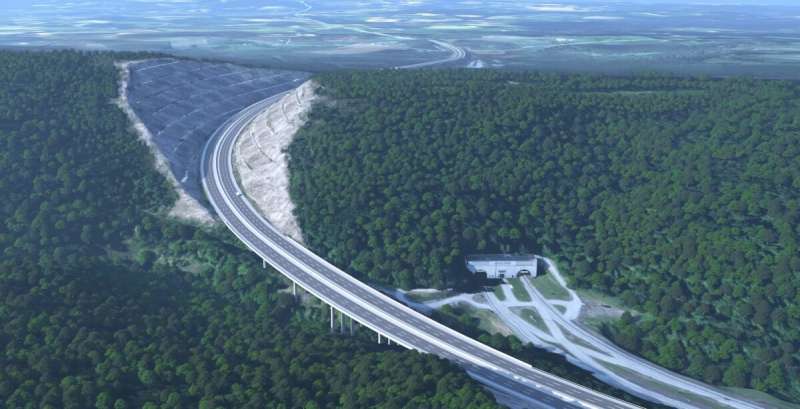
A Pennsylvania Turnpike Commission proposal to reroute the cross-state highway by blasting a 1,000-foot-wide cut through Allegheny Mountain faces opposition from Somerset County leaders, who say it would disrupt a pristine wilderness and permanently scar the landscape.
The twin-tube Allegheny Tunnel, which carries Interstates 70 and 76 through the eastern continental divide, is aging and increasingly challenging to maintain, the turnpike commission says. The safest and most cost-effective replacement, it says, is to reroute the entire highway through a 250-foot-deep gorge at the top of the mountain with new approaches on either side.
It’s necessary to address aging infrastructure, greater traffic volume, crashes and hazardous material shipments, which now must leave the turnpike and take smaller local roads to avoid the tunnel where they’re prohibited, according to the commission.
Now in the preliminary design stage, the project has been under consideration for about 30 years. In that time, the commission has studied alternatives and gathered public input on all feasible solutions. The realignment would cost more than $300 million, while the price tag of adding capacity to the tunnel is at least double, a commission spokesperson said.
But opponents say the state should reconsider rehabilitating the tunnel and building a third tube to add three lanes to the historic road.
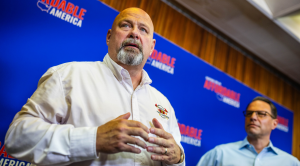
Somerset County elected officials, conservationists and members of the public gathered Tuesday at the state Capitol to call on the turnpike commission, state policymakers and Gov. Josh Shapiro to “pump the brakes” and come up with a solution that has less impact on the area’s ecology and surrounding communities.
“The people agree, and we just need leaders who can turn broad consensus into a reality,” Tom Schuster, director of the Sierra Club’s Pennsylvania chapter. “Ultimately, this just isn’t just about one project. It’s not just about Somerset County. It’s about what it means to live in Penn’s woods.”
State Rep. Carl Metzgar (R-Somerset) said the commission and the people of Somerset County have tried to be good neighbors since the toll road opened in 1940. The first of the two tunnel bores then carried a single lane in each direction, while the second opened to traffic in 1965, adding another two lanes.
The dramatic impact of the realignment and his constituents’ opposition to the project cannot be ignored, Metzgar said. That prompted him to introduce House Bill 2205, which would strip the commission of its authority to take land by eminent domain.
“It’s not my intent to try and punish them, but it’s my intent to invite them back to the fold, to be good neighbors again, to have a discussion on a way to do something so that it doesn’t destroy the place that we love and hold dear,” he said.
Much of the land affected by the project is owned by the Mountain Field and Stream Club, a private organization that doesn’t want to give it up, Metzgar said.
Eminent domain is the power the government has to take private property when it serves the greater good. The property owner gets a fair market price for their land from the government.
Since its opening, the turnpike has played a critical role in the lives of Pennsylvanians, supporting economic growth and connecting people and businesses, commission Press Secretary Marissa Orbanek said.
“Eminent Domain is a necessary tool that allows the Pennsylvania Turnpike to carry out its statutory duties and deliver projects that improve the safety and reliability of our system,” she said in a statement to the Capital-Star.
The realignment project would support the entire commonwealth with a safe and reliable seven-lane highway, Orbanek added, while those demanding a third tunnel overlook the safety of motorists, first responders and highway workers.
“Two decades worth of studies and numerous strategies to relieve increasing traffic and flatten sharp curves at an area with the highest crash rate on our system has proven that the core issue at Allegheny Mountain remains: the tunnel itself is the problem,” Orbanek said.
The road cut itself would be on a scale unlike any other in the commonwealth, opponents say.
Mark Kissel, secretary-treasurer of Citizens to Save Allegheny Mountain (CSAM), said the scale of the excavation, which will move 12 million cubic yards, is hard to grasp. In an effort to visualize it, Kissel said he calculated that the rock removed from the cut would stack up to 5,600 feet tall if it was placed in the footprint of a football field.
“The road cut would carve a gash through the spine of the Allegheny Mountain ridge, exacting permanent devastation on the natural habitat, wildlife migration patterns and water quality,” Kissel said. “The scale of the road cut is enormous.”
Drivers on the proposed highway would lose the tunnel’s protection from the worst of the weather near the turnpike’s highest point, 2,600 feet above sea level, where fog, icing and high winds are frequent hazards, Randy Musser, chairman of CSAM said.
“Opening a deep trench through the mountain would intensify those weather hazards, rather than solve them,” Musser said.