Gas prices typically drop as the summer driving season ends around Labor Day and refineries turn to making a cheaper winter blend.
That’s not the case this year, as gas prices are rising again across the country and the commonwealth, due to the war in Iran.
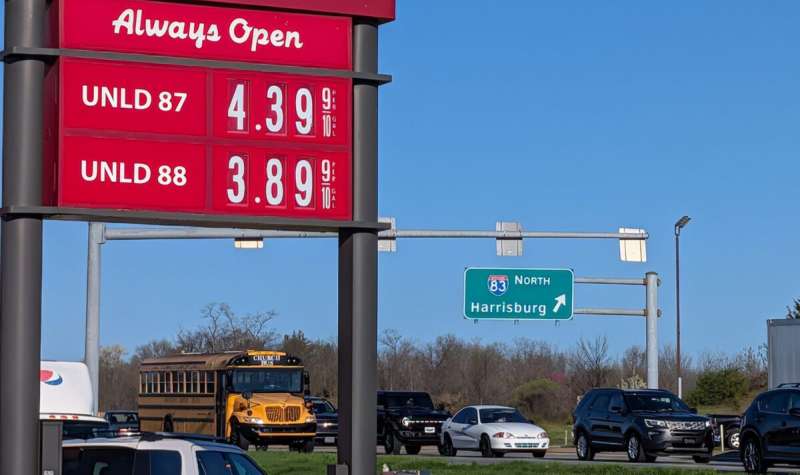
The average price for a gallon of gas in Pennsylvania jumped to $4.36 on Wednesday, according to motor club AAA. That’s up from $4.28 this time last week, and $4.11 a month ago.
This time last year, a gallon of regular in Pennsylvania was $3.37.
Gas prices in Pennsylvania have increased by 40% since the US began its attacks on Iran Feb. 28, when Pennsylvanians were paying $3.12 a gallon. The high mark for gas prices in Pennsylvania since the start of the war was $4.69 a gallon on May 7.
Pennsylvania’s average gas price also remains higher than the national average, which is currently $4.22.
Diesel prices, which can have an outsized impact on consumers because it is used in shipping and production, are climbing at an even higher rate. Currently, the statewide average is $6.13 a gallon, up from $5.97 last week, $5.55 a month ago, and $4.24 when the war began. This time last year, diesel was $3.99 a gallon.
Gas prices across the state
At $4.46, Cambria County currently has the highest average price for a gallon of gas in the commonwealth.
Franklin County has the lowest average cost, at $4.13 a gallon.
Here’s a breakdown of the current average gas cost per gallon in Pennsylvania’s top 10 metro areas, with last week’s prices in parentheses:
- Allentown-Bethlehem-Easton: $4.31 ($4.21)
- East Stroudsburg: $4.31 ($4.22)
- Erie: $4.38 ($4.31)
- Harrisburg-Carlisle: $4.28 ($4.19)
- Lancaster: $4.29 ($4.22)
- Philadelphia: $4.43 ($4.31)
- Pittsburgh: $4.43 ($4.35)
- Reading: $4.40 ($4.31)
- Scranton-Wilkes-Barre: $4.31 ($4.24)
- York-Hanover: $4.32 ($4.27)
How is the war impacting gas prices?
Prices shot up after the US and Israel attacked Iran in February and have not settled down since. Crude oil traffic through the key Strait of Hormuz has plunged, and Iran has refused to reopen the waterway through which a fifth of the world’s oil supply passed before the war began.
“Everything points to the Iran war and the Strait of Hormuz,” Tom Seng, a professor of energy finance at Texas Christian University, told the Associated Press.
The price of oil surpassed $100 a barrel on Wednesday for the first time since July after the US military reported striking five Iranian tankers in response to attempted missile attacks on a Navy warship and after attacks by an Iranian-backed Houthi rebel group ignited fires at oil facilities in Saudi Arabia.
The attacks threatened to debilitate an already weakened supply chain.
Gas prices will likely get worse as the strikes continue and further damage is done to the oil supply and infrastructure.
What is the Trump administration saying about rising gas prices?
Energy Secretary Chris Wright offered few specifics on when the nation’s drivers might see relief at the gas pump, acknowledging that prices are higher now than Labor Day 2025.
“Yes, they’re higher today, but we’re doing everything we can to push them down,” Wright said Sunday on ABC’s “This Week.”
Wright said the Trump administration was taking steps to increase production and that the markets forecast lower prices in the coming months.
“If you look at the futures prices, if you wanted to buy today in bulk gasoline for two months out in November, it’s about $0.35 cheaper than it is today. So the marketplace thinks gasoline prices are going to move meaningfully lower,” he said.
What about the Trump-hyped Freedom Fuel gas stations?
Not even Freedom Fuel, the gas station chain that opened dozens of locations across Pennsylvania and New Jersey earlier this summer in support of President Trump, is immune to the effects of the war in Iran.
Freedom Fuel gas stations began springing up across the Philadelphia region, along with a location in Camp Hill, Cumberland County, in early July, with gas prices set at $3.47 per gallon in support of the 47th president.
By the end of July, Freedom Fuel prices were approaching $4 per gallon, and customers were taking notice.
In the latest twist for Freedom Fuel, a federal lawsuit was filed in Pennsylvania last month alleging that the gas station chain received $4 million worth of gas that hasn’t been paid for by a company called KRSM, which bought the fuel from a Georgia oil company in July, then delivered it to Freedom Fuel stations.
How Pennsylvania lawmakers are trying to ease pain at the pump
Pennsylvania has the fourth-highest gasoline tax in the nation, at 57.6 cents per gallon, and the highest diesel fuel tax at 74.1 cents a gallon. The national average gas tax is 33 cents a gallon.
State and federal gas taxes provide more than 70% of the state’s highway and bridge funding. Some of that money goes to municipalities to support locally owned roads, as well as the Pennsylvania Turnpike and the Pennsylvania State Police.
Since the start of the Iran war, lawmakers on both sides of the aisle have proposed legislation that would lower or pause Pennsylvania’s gas tax. The latest such effort comes from Republican state Rep. Rayn Warner (Fayette).
Why is Pennsylvania’s gas tax rate so high?
Pennsylvania’s high gas tax rate goes back to 2013, when the Republican-controlled legislature passed H.B. 1060 with bipartisan support. Then-Gov. Tom Corbett, a Republican, signed the bill into law as Act 89 of 2013.
Lawmakers at the time estimated that the bill would generate an additional $2.4 billion annually within five years for transportation infrastructure projects at the state and local level. Today, PennDOT estimates it generates $3.5 billion.
Act 89 of 2013 eliminated the 12-cent flat tax on a gallon of gasoline and the cap on the Oil Company Franchise Tax.
The gas tax rate increased by about 10% annually between 2014 and 2016. In 2017, the law mandated that PennDOT set the tax rate based on the annual wholesale price (AWP) of gasoline. If the AWP exceeded $2.99 a gallon, the price would go up, as it did for the first time in 2023, when the rate jumped from about 57.6 cents to 61.1 cents. If it fell below that mark, as it did in 2024 (and where it has stayed), the gas tax would go down.
In 2022, Republican Sen. Wayne Langerholc proposed legislation to stop any further increases in the gas tax. His bill passed the Senate 29-19, with 27 Republicans and two Democrats backing the bill and 19 Democrats opposing it. The bill was then referred to the House Finance Committee, where it died.
How to find the cheapest gas prices
Whether you’re traveling or at home, the website GasBuddy offers information to find the cheapest prices for gasoline.
Enter your state, city, or ZIP code to find the cheapest fuel prices in the area.
Information from the Associated Press and USA Today via Reuters Connect was used in this report.