The fight to raise Pennsylvania’s minimum wage has been going on for nearly 20 years, making the commonwealth one of the last states in the nation stuck at $7.25/hour.
For the past three of those years, Democrats in Pennsylvania’s lower chamber have tried to pass legislation that would effectively double the minimum wage. And at each opportunity, Republicans in the Senate have voted against it.
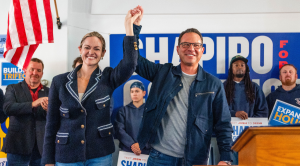
But with midterm elections on the horizon, Dems are hoping to secure a trifecta of power with Gov. Josh Shapiro’s reelection and a majority in both the State House and Senate. With control of all three branches, experts say long-stalled bills such as minimum wage, codification of reproductive rights, and LGBTQ+ protections could finally sail through.
“If Democrats do claim the trifecta for the first time in over 30 years, it would open the door for movement on issues long bottled up in the legislature,” said Christopher Borick, a political science professor and the director of the Muhlenberg College Institute of Public Opinion, adding that this year’s midterms offer the best opportunity Democrats have had to gain control in the state since the turn of the century.
The last time the Keystone State saw a Dem trifecta was in 1993, while Republicans have enjoyed total control of the state government for 12 of the last 34 years: from 1995-2002 and 2011-2014.
Key districts to watch
Republicans currently hold 27 of the seats in the Senate to Democrats’ 23. In the House, Democrats have a narrow majority of 102 to 99 with two vacancies. Of course, the likelihood of these chambers flipping comes down to a much higher number of races: all of the 203 seats in the House are on the ballot this year, plus about half the Senate.
Caroline Welles, Executive Director of The First Ask, a PAC that aims to get progressive women elected to office, believes Shapiro is likely to be reelected over Republican candidate and current Pennsylvania Treasurer Stacy Garrity. Both Shapiro and Garrity ran unopposed for their parties in the May 19 primaries.
A handful of districts with swing potential could decide Senate control come November, especially those in the northeast region of the state.
And certain congressional districts—primarily 7 (Lehigh Valley), 8 (NEPA) and 10
(south-central Pa.)—are being closely watched as Democrats set their sights on control of US Congress as well.
As far as a Dem trifecta in the state, Welles was encouraged by a special election in Lancaster in March 2025 when the district replaced the retiring Republican with a Democratic candidate by a margin of 500 votes, calling it “a tremendous flip” considering President Donald Trump had won the 36th district by 15 percentage points in 2024.
“We’re also seeing a number of those across the country, so it’s not an outlier, but part of a pretty big trend, not just in Lancaster or Pennsylvania but everywhere,” she said. “Which is what we saw in 2017, too, but actually this has been on a much larger scale.”
Bills regarding adult-use cannabis, LGBTQ+ rights in limbo
In March, Pennsylvania House Democrats passed HB 2189, which would raise the state’s minimum wage to $15 per hour, sending it to the Senate for a vote. At the time, Shapiro called the state’s minimum wage of $7.25 “too damn low” in a Facebook post and took to X to share his views.
“This is the THIRD year in a row that the House has stepped up to do their part. The ball is now in the Senate Republicans’ court,” he wrote. “It’s time for them to bring this to a vote and send it to my desk.”
In addition to minimum wage, Borick predicts increased funding for mass transit and codified protections for reproductive rights.
“Democratic control may also open the door for legalization of recreational marijauna, but by no means guarantee a change on that front,” he added.
Medical marijuana is currently legal in the state, but decisions about legalizing adult-use cannabis have similarly stalled, despite a Susquehanna Polling and Research survey showing most voters from all parties support it. With the exception of West Virginia, every state bordering Pennsylvania has legalized adult-use, and Shapiro has spoken on record multiple times highlighting just how much tax revenue the state is losing by not passing a legalization law.
Garrity has promised to vote against a recreational marijuana bill if elected.
“We did our part in the House, but the Senate is still falling on the job,” Democratic Rep. Darisha Parker told CBS Pittsburgh in April.
Welles also outlined eight bills in the state that would help the LGBTQ+ community, making it unlawful to deny housing or employment or access to public accommodations based on sexual orientation or gender identity. HB 300, also known as The Fairness Act, passed the House by a single vote in April and is headed to the Senate.
Similarly, Democrats have sought to codify same sex marriage in Pennsylvania’s code, expand the definition of hate crimes in the state, and eliminate a requirement to publish notice of a name change.
Codifying these sorts of protections is key should a trifecta be established, Welles said.
“If I were a Dem who was about to win the majority, I’m going to try to pass legislation that can’t just be undone by a bad 2028,” she said.