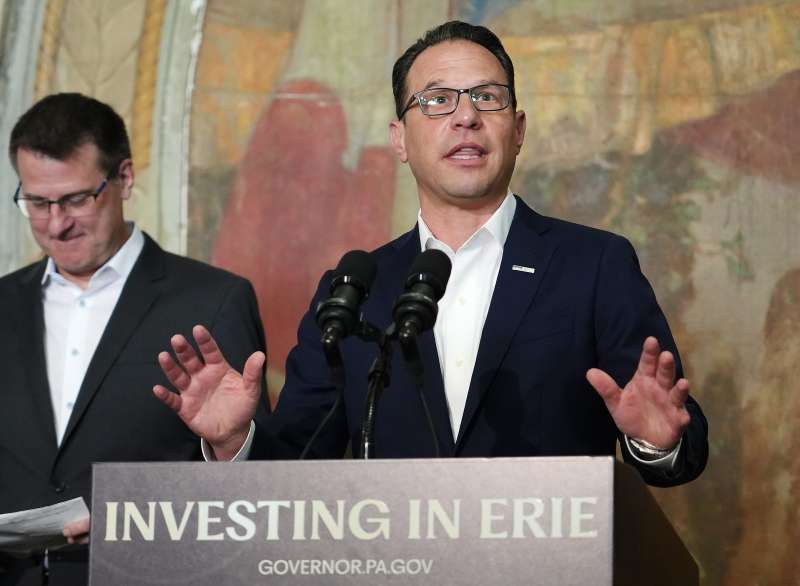
Pennsylvania lawmakers and Gov. Josh Shapiro approved a $50.8 billion state budget over the weekend that did not raid the state’s rainy day fund, instead adding nearly $1 billion to it.
Shapiro’s initial plan called for a nearly $4.7 billion dip into the state’s savings, which Republican leaders in the Legislature insisted would hurt the state’s credit rating and lead to future tax hikes. It would have taken the account from north of $7 billion to below $3 billion.
What’s in the budget?
Major policy items that Shapiro and fellow Democrats touted to increase revenue were off the negotiating table by June. These included legalizing recreational marijuana, taxing skill games and raising the state’s minimum wage, items that will be debated another day in Harrisburg.
A pension raise was approved for state employees who retired before 2001. Public schools – for regular and special education – received millions more than Shapiro had proposed initially.
Notably missing from the budget were highly touted measures to eliminate the state’s gross receipts tax on consumers’ electricity bills and force data centers to pay sales tax on their infrastructure purchases.
“The budget expands or maintains these (data center) tax breaks without clearly defining what Pennsylvanians receive in return, including job quality, local hiring, or community benefits,” according to a paper from the left-leaning Pennsylvania Policy Center.
Now, the state starts its 2026-27 fiscal year with around $8 billion in reserves, spurred largely by the state’s revenue collections from the last fiscal year outdoing estimates by around $1 billion.
“The budget passed by the General Assembly today continues our recent history of scouring every corner of state government for existing taxpayer dollars to avoid tax increases, cuts to government services or tapping into the Commonwealth’s rainy day fund,” state House Republican Leader Jesse Topper, who represents Bedford County, said Sunday.
How did lawmakers preserve rainy day funds?
Creativity was required to avoid using rainy day money, which Nathan Benefield, chief policy officer with the conservative Commonwealth Foundation, called “draining the couch cushions.”
The tactic diverted several hundred million dollars from state funds outside the general fund, Benefield explained to USA TODAY Network Pennsylvania.
“There are hundreds of state funds. Some are not spending what they’re getting, so they’re sitting on some money that taxpayers have already spent,” Benefield said.
While these funds are transparently managed by the state Department of Revenue, Benefield said lapsed funds were also used. An example of this would be if a state agency requested general fund money in the past for hiring and did not spend it all.
“There is less transparency around that,” he added. “Getting a handle on how much gets spent there is difficult.”
Additionally, the state deferred roughly $1 billion in payments to next year for state healthcare access.
“It moved things from this year to next – a little bit more of a gimmick to avoid consequences now but you still have to deal with it next year,” Benefield said.
Felicity Williams, executive director of the left-leaning Pennsylvania Policy Center, told USA TODAY Network Pennsylvania that while she was grateful that healthcare access was not cut in this budget, she noted future federal cuts are coming next year. The move kicked the can down the road, she said, and that will come due July 1, 2027.
In his remarks, Shapiro touted the state’s economic growth — the state’s economy grew 5.4%, outpacing the 2% prediction.
“This allowed us to make important investments in this budget, and still have an $8 billion surplus at the end of the 2026-27 fiscal year,” Shapiro said Sunday.
How did it pass?
The Democratic-controlled House and Republican-controlled Senate passed the budget with bipartisan votes.
The Senate voted 44-6 before the House delivered a 167-35 vote on Sunday coming off a rare weekend of legislative work for the divided government.
Shapiro signed it, tying off a process that some described as a status quo budget.
“This is the fourth year in a row where – despite working with one of the only divided legislatures in the country, where we have some really profound differences – we stayed at the table and brought Democrats and Republicans together to get stuff done, again,” Shapiro said in his budget remarks.
For the fifth year in a row, Pennsylvania’s budget missed its statutorily mandated June 30 deadline.
“I would describe it as a compromise, maintenance budget,” Williams said.
One exception, she noted, was the continued investment in adequacy funding for public education. After three years of extra payments, the state has sent hundreds of millions of dollars to school districts.