With President Donald Trump’s war in Iran nearing the three-month mark and a global disruption in the energy markets, consumers across the US and the rest of the world are turning to solar power and other renewables to offset the costs of rising gas and energy prices.
Democratic lawmakers in Pennsylvania see this ongoing crisis as an opportunity to expand solar power generation and storage by making it easier to install solar panels on large warehouses across the commonwealth.
“One aspect of [the Iran War] that we’re seeing is how dependent all of our systems are on fossil fuels, and we hear a lot of talk about energy independence on both sides of the aisle,” State Sen. Nikil Saval (D-Philadelphia) said in an interview.
“Solar is one of the cheapest—maybe the cheapest——ways to get energy to households. We have abundant ways to do that … A lot of that is using rooftops that we already have.”
Saval is sponsoring legislation in the Pennsylvania Senate that requires all new warehouses that are at least 100,000 square feet to be solar-ready and provide tax credits so existing warehouses can make the necessary modifications to install solar panels.
Democrats in the Pennsylvania House passed House Bill 1260, which is identical to Saval’s, earlier this year.
“It’s also no secret that Pennsylvania’s electric generation portfolio is overly reliant on natural gas. By adding solar and increasing energy diversity, we will reduce our dependence on any single fuel, supplier, or technology, and we decrease the likelihood of disruptions and price swings,” State Rep. Jacklyn Rusnock (D-Berks), the prime sponsor of HB 1260, said at a press conference in Harrisburg earlier this month.
She added, “Warehouse rooftops are massive. They are unobstructed spaces with lots of rooms for these panels. It just makes sense that we utilize all of this available space and take control of our energy consumption.”
A 2023 report from PennEnvironment, a state environmental policy group, states that Pennsylvania has more than 16,000 warehouses with over 516 million square feet of rooftop space to house solar panels, which could power over 800,000 homes.
Greenfield Manufacturing, a warehouse in Northeast Philadelphia, has more than 3,600 solar panels on its roof, making it the city’s second largest solar array.
“ I was lucky to visit a warehouse in Northeast Philadelphia where they had solar on top of the roof, and they’re actually not only not paying for their energy costs, they’re getting money back, and their excess energy is being distributed to the surrounding community,” Saval said.
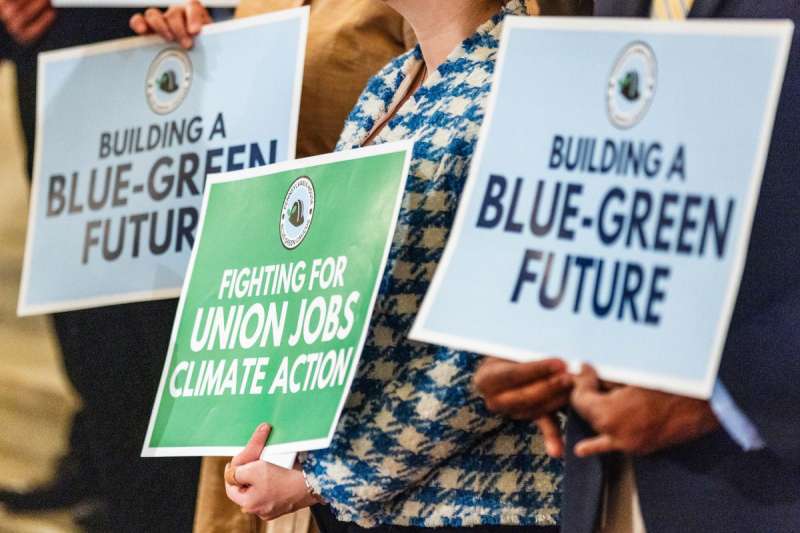
Democrats in the Pennsylvania legislature and leaders from the building trade unions began more closely supporting each others’ priorities with the formation of the Blue-Green Caucus in 2021, and last month, the caucus touted a packet of 10 energy-related bills the two sides worked on together.
“Anything we can do to offset costs right now is important. We all know ratepayers are front and center in the discussion here in Pennsylvania with the war going on in Iran and energy prices are going up,” said Rob Bair, president of the Pennsylvania State Building and Construction Trades Council, in an interview.
He added, ”We’re an all-the-above energy strategy, from solar to wind to nukes to all of it, but these type of bills where you can lower taxpayer rates, put money back into school districts, utilize roof spaces are really important. It creates a whole lot of jobs, good-paying, family-sustaining jobs for my members.”