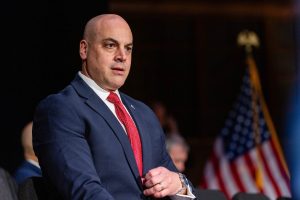
When Kristin Volchansky talks about healthcare, she talks in numbers.
A $6,000 deductible. A $1,400 ambulance bill. Thousands more in lingering medical debt. Collection agencies calling every other month. Student loans waiting in the background.
Behind every number is a decision Volchansky and others across the commonwealth have to make: delay treatment and risk getting sicker, or get care and risk financial ruin.
“If I don’t treat the immune deficiency, I’m running a higher risk for cancer and getting sick constantly,” said Volchansky, a Northampton County resident who receives monthly infusions for a rare immune disorder. “I have had to delay my treatments in the past because of affordability.”
Volchansky isn’t alone. More Pennsylvania families have seen their insurance premiums rise and their deductibles increase over the past year. Groceries, gas, and housing costs are squeezing already tight budgets. And now, many, like Volchansky, fear that Republican-backed cuts to Medicaid and the expiration of the enhanced Affordable Care Act subsidies are pushing healthcare even further out of reach.
A lifetime of illness and bills
Volchansky’s health problems began after a severe case of mononucleosis while she was a college student. What she thought was a routine case of mono turned into years of debilitating illness, weight loss, and repeated infections before she was finally diagnosed with a genetic immune deficiency.
Before the Affordable Care Act, Volchansky said insurers would not fully cover her because of preexisting condition rules. Medicaid denied her because she lived with her parents, even though she had no income.
The ACA changed that.
“Without that, I don’t know what I would’ve done,” she said.
Later, Pennsylvania’s Medicaid expansion under former Gov. Tom Wolf became, in her words, “the first time that I didn’t worry about medical bills.”
But that relief didn’t last.
After pandemic-era Medicaid protections ended, Volchansky returned to an ACA marketplace plan with deductibles that climbed from roughly $5,600 to nearly $7,000.
Now married and covered under her husband’s employer-provided insurance, she still hits their $3,500 deductible almost immediately each year because her monthly treatments cost roughly $30,000 before insurance adjustments.
“How do you realistically save for the cost of some of these medical expenses?” Volchansky said. “For the average middle-class family, especially with the rising cost of groceries, gas and student loans, that’s living in a fantasy world.”
Caregivers on the brink
For Lynn Weidner, an Allentown home healthcare worker, the healthcare crisis collides with another growing problem: caregiving itself is becoming economically unsustainable.
Weidner cares for her partner, who has cerebral palsy, her mother, who has Alzheimer’s disease, and often her young niece. She works roughly 80 hours a week through a participant-directed Medicaid program that allows people with disabilities to remain at home instead of in institutions.
Despite the workload, she earns $16 an hour.
“The whole time I’ve been a home care worker—15,16 years —I have not had access to health care through my employer,” Weidner said.
Like Volchansky, the ACA allowed her to finally get insurance coverage despite preexisting conditions. But the cost has exploded.
Weidner said her monthly premium jumped from $400 to $700 after Republicans cut enhanced ACA subsidies at the end of 2025.
“All of the $2-an-hour raise that I got this year is going straight to my subsidy,” Weidner said. “$700 a month when you are already living paycheck to paycheck is insane.”
She has downgraded internet service, cut groceries, and stopped buying beef because prices have climbed too high.
“We cut out our trip to North Carolina because we can’t afford gas,” Weidner said. “The tariffs have driven up prices everywhere. You cut out stuff. You just have to figure it out.”
That often means delaying care.
Weidner has severe carpal tunnel syndrome and needs surgery, but she cannot afford the time off or additional medical bills.
“I always have medical debt,” Weidner said. “It just starts over again every year.”
‘I’m thriving because of Medicaid’
For Grace Robinson of Cresco, Medicaid is not just insurance. It’s the reason she’s still alive.
Robinson lives with a mitochondrial disorder, a rare genetic disease that has caused strokes, brain lesions, and organ complications.
She has spent more than 800 days in the hospital, survived septic shock and heart failure, and once relied on a wheelchair and feeding tubes after losing the ability to walk or digest food normally.
“We didn’t think I’d walk again, eat again, do really any of that stuff,” Robinson said.
After struggling to access specialized care, Robinson eventually qualified for a Medicaid waiver program that connected her with specialists in Philadelphia familiar with her disease.
“My life completely changed,” Robinson said. “I’m thriving because of Medicaid.”
Today, Robinson is back in college studying psychology and hopes to become a behavioral therapist.
But she fears proposed Medicaid cuts could affect the care that made her recovery possible.
“ I know that Republicans always say people who really need it aren’t gonna get cut, but the amount of times I have been told that the services I need, that keep me alive, aren’t crucial — and we just have to fight, fight, fight to get them covered,” Robinson said.
She’s terrified, in fact. Robinson said politicians don’t take into account people like her, who rely on 20 medications a day just to survive. Without a safety net such as Medicaid, Robinson said she couldn’t afford to stay alive.
“ I need ongoing services with specialists and my care is very complex, and these things are just not taken into consideration when they vote,” Robinson said.
Fear of what comes next
For many Pennsylvanians, the anxiety isn’t just about the ever-increasing costs of things like healthcare, housing, and groceries. It’s about what happens if federal safety nets such as Medicaid shrink even further.
GOP-backed bills and proposals such as the One Big Beautiful Bill and the elimination of ACA credits have already increased premiums, leaving many without health insurance. More than 145,000 residents have dropped their health insurance coverage through the ACA so far this year. These cuts hit the elderly, disabled people, caregivers, and low-income families the hardest.
Weidner is worried that home and community-based care programs could be gutted, forcing vulnerable people, like the ones she takes care of, into institutions.
“That’s disgusting,” Weidner said. “Those are the people we should be taking care of the most.”
Her congressman, U.S. Rep. Ryan Mackenzie, voted in favor of Trump’s Medicaid cuts.
Robinson worries that if her coverage is affected in any way, it could reverse years of medical progress.
“If I don’t fight for this, we can go backwards.”
Her congressman, U.S. Rep. Rob Bresnahan, not only voted in favor of cuts to Medicaid, he also sold over $150,000 in Medicaid-related stocks before casting his vote.
And Volchansky, who is also represented by Mackenzie, worries that despite years of debate about affordability and healthcare, lawmakers still haven’t addressed the real problems.
“There needs to be a conversation about what it really means for patients to have a good healthcare experience,” Volchansky said. “Because right now, people are sacrificing other things just to stay alive.”