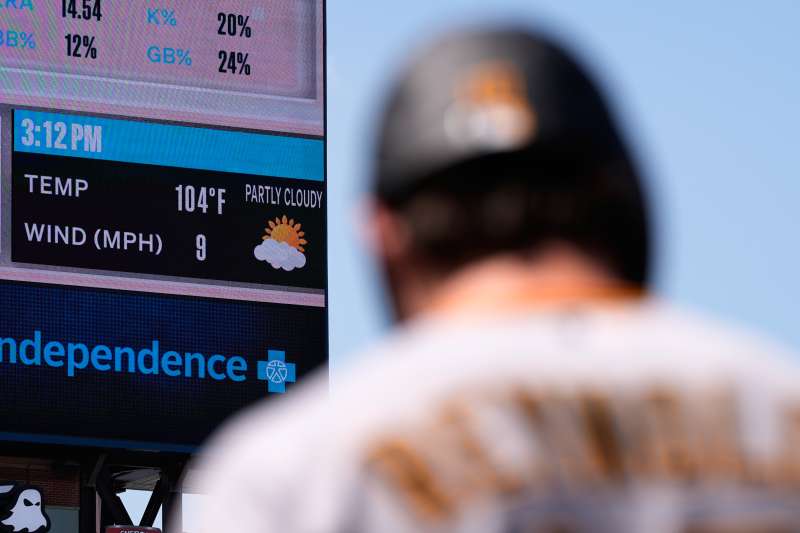
Pennsylvanians are braced for another round of dangerous heat this week—the second heat wave of the summer, just two weeks after an early-July stretch pushed temperatures to over 100 degrees in Philadelphia.
Forecasters flagged the middle of the week as when the heat will be at its worst, with highs in the mid-90s and humidity bringing the “feels-like” temperatures toward triple digits in south-central Pennsylvania.
The heat won’t be as punishing as early July, but forecasters warned it will still be dangerous, especially for those who are sensitive to extreme temperatures. When conditions are like this, the National Weather Service issues a heat advisory or extreme heat warning. Philadelphia is currently under an extreme heat warning.
Humid air carries a particularly unique danger. Your body cools itself mainly by sweating, and as sweat evaporates it carries the heat away. Humid air is already full of moisture, so sweat evaporates slowly and your internal cooling system falls behind. That’s why the “feels-like” temperature can go above what the thermostat says, and why a humid 95-degree day feels different than a dry 95-degree day.
Another critical number is the overnight low temperature. When air stays warm after dark, the body never recovers from the day’s heat, and the strain on your body increases. Nights that do not cool off are a big part of deadly heat waves.
Research shows that heat is the biggest weather-related danger in the US. Extreme heat kills more than tornadoes, hurricanes, and floods, according to the National Weather Service and NOAA. Heat often does not appear on a death certificate as a direct cause of death, and can therefore frequently go undercounted.
Federal CDC data attributed more than 2,000 deaths to heat in 2023, and researchers say that number may be an undercount, since heat deaths are often logged as heart attacks, kidney failure, or respiratory problems. The heat specifically isn’t what kills, but it directly leads to what does.
READ MORE: Climate change behind longer allergy season in many parts of Pennsylvania
Those most at risk are older adults, infants, pregnant people, outdoor workers, people without reliable air conditioning, and anyone with heart, lung, or kidney conditions. In cities, the “urban heat island” effect can leave some neighborhoods several degrees hotter than others nearby.
Why is this happening—and getting worse?
According to the EPA and the federal government’s national climate indicators, heat waves in major US cities have grown from roughly two per year in the 1960s to six per year today. Overnight lows are warming faster than daytime highs.
Federal agencies and Pennsylvania’s Department of Environmental Protection tie the heat to human activity, specifically the greenhouse gases from burning fossil fuels, which trap heat in the atmosphere.
The state’s 2024 climate impacts assessment projects average temperatures could climb roughly seven degrees by 2050 and 10 degrees by 2100.
The severity ahead isn’t necessarily set in stone, researchers say. Cutting emissions that cause warming will limit how bad future heat waves get. Much of that is up to elected officials, who help or hinder clean energy development through the bills they pass. Voters can start their search for which utility corporations are donating money to their local politicians here.
As for this week, health officials recommend drinking water before you feel thirsty and avoiding heavy exertion in the afternoon. Stay in air conditioning when you can or find a public cooling area. To find one near you, dial 211 or click here.
Never leave children, older adults, or pets in a parked car. Ensure pets also receive more water than usual, are in the sun less, and are given many opportunities to cool down.
Check on elderly relatives and neighbors who live alone, and learn the warning signs. People with heat exhaustion will sweat heavily, show weakness, nausea, and dizziness. If you notice those signs, get the person cooled down quickly. If someone displays confusion, fainting, hot skin, or a spiking body temperature, that’s a sign of heat stroke—call 911 immediately.