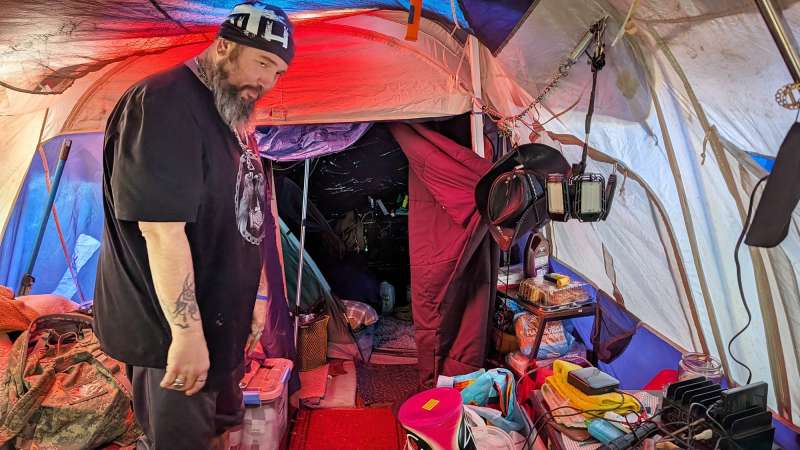
They call him The Mayor.
His name is Tink – just Tink – a large, burly guy, 50 years old, with a lengthy beard, speckled with gray, and his thick biceps and forearms covered in ink. He laughs when he says that they – and by they he meant the other denizens of the homeless encampment along the Codorus Creek near York City’s Bantz Park – call him The Mayor. He didn’t seek the office; it sought him.
“I definitely didn’t want the position at all,” he said, standing in the middle of his campsite, a sprawling, ramshackle compound atop the slope on the northern bank of the creek.
He’s been living in the encampment for nearly a year. He said he’s from “here and there,” originally from Clearfield County, northwest of State College. He had been living in Wrightsville, but the woman he was living with kicked him out. He lived in his truck for a couple of weeks while he was working odd jobs at the York Fairgrounds and cleaning out houses, which pretty much stopped because he needs a hernia operation. He makes about $480 a month donating plasma now, he said.
He stopped living in his truck, he said, because “the skunks got too friendly.”
And he found a spot in the encampment.
He spent three months clearing a spot, using an ax and pruners to clear brush and saplings. He cleared off the deer path that bisected the clearing and put up his tent. His complex has grown since then. His tent has a front porch – he calls it his “sunroom” – giving way to a living space and little kitchen. His bedroom is another tent that extends to the back. All of it is erected on shipping skids and old tires. The floors are covered with scraps of carpet and old rugs. The tent’s roof is covered with layers of tarps, some lashed to the trees on the perimeter of the clearing, for protection from the elements.
He has two generators and heavy yellow extension cords carry the power to his two-burner hotplate and to lamps inside his tent. He has a stone fire ring that he uses for cooking and heat, and a fire extinguisher in case the flames get out of hand. Adjacent to his tent, he dug a latrine and erected an outhouse. He was working on building a shower, fed by five-gallon jugs of water he carts to the site on a heavy-duty gardening wagon.
From his perch atop the slope that flows down to the creek, he can see a good bit of this section of the camp, the blue and green tents lining the trails through the woods. “I can hear everything up here,” he said. “I keep an eye on things.”
Nobody, he said, wants to live here. They have to. They have no place else to go.
“It is what it is,” he said, his laugh dripping in resignation.
The goal? ‘To help save lives’
The homeless have been living there for years, along the hiking trails in the woods between the park and the creek. In past years, there were a handful of campsites here and there, nestled in the woods.
Now, though, the encampment stretches for nearly a half-mile along the Codorus Creek, from Grantley Road to Richland Avenue. Dozens of tents line the main path and other, more elaborate sites occupy areas along the creek or, like Tink’s campsite, above the trail, closer to the park.
How many people live there is not exactly clear. People come and go. Some come and stay. It’s not like they have anywhere else to go.
The encampment has grown in past month or so, according to those who live there. Every day, one said, new people move in. “There were only three here before,” said James Mitchell, a 52-year-old York man who has lived in the encampment for about three months, gesturing toward the path near his tent. “Now, there are eight. Lots of people have moved in in the last week.”
Some of the recent growth can be attributed to the expiration of what’s known as Code Blue at homeless shelters in town. From November to March, the shelters expand their capacity to give homeless people a warm place to sleep during the winter. LifePath, which operates shelters in the city, uses its dining hall and chapel at its West Market Street shelter to expand its capacity during the winter, replacing dining tables and pews with cots to accommodate those seeking shelter from harsh weather, according to CEO Pat Ball. The shelter offered temporary housing to 509 people this winter, he said.
Another explanation is the decision by Springettsbury Township to clear out a small homeless encampment in the woods off Industrial Highway between Memory Lane and Northern Way. Some of the dozen or so people who had been living there when the township set a May 9 deadline for the homeless to clear the encampment have moved to the settlement by Bantz Park.
The encampment’s growth can also be attributed to the decision by former Mayor Michael Helfrich to permit the homeless to camp there. There were several reasons of the decision – to move the homeless from more high-profile locations downtown, to provide a place that can easily be policed and maintained, to accommodate the work of homeless advocacy groups in assisting people, to free up police to address crime rather than attending to the homeless. Homeless people were already living in the woods there, so it seemed like a natural location.
The city arranged to collect trash at three locations – at the head of the path into the encampment at the south end of Belvedere Avenue and at the bridges on Richland and Grantley.
Before new Mayor Sandie Walker took office, Helfrich accompanied her on a tour of the encampment. She knew some of the residents; they were people her father, Sandy Walker, served while operating Mr. Sandy’s Homeless Veterans Center in York. (Mr. Sandy, as everybody called him, passed away in May 2015.)
Staffers from Friends & Neighbors, a nonprofit that provides services to the homeless, visit the site twice a week to check on residents and make sure they have basic supplies. Medical staff from UPMC Memorial routinely join the staffers to attend to residents’ healthcare needs. The agency also provides them with tents – many of them Camel Crown two-person dome tents designed for use during winter months – sleeping bags and essential supplies.
The goal is simple, said Friends & Neighbors executive director Crystal Perry, “to help save lives.” The homeless population is growing, she said. On colder days, she said, perhaps as many as 100 people will stop by the agency’s North Duke Street drop-in center every day.
“We’re seeing brand new people, people we’ve never seen before, every week,” she said. “It’s a real struggle to see that everybody’s taken care of. There is not enough space, but so many people.”
There are the traditional causes of homelessness. Some suffer from mental health issues. Others are dealing with addictions, still drilling down to find rock bottom. Some just have had a streak of terrible luck.
Then there’s a lack of affordable housing. According to the U.S. Census, the median monthly rent in York County has increased by 47.35 percent since the COVID pandemic, from $916 in 2021 to $1,351 in 2026. And rents are continuing to rise, advocates for the homeless say. “A lot of people can’t afford rent,” Ball said. “We have to do everything we can to serve the population. We continue to see rising numbers.”
Perry said, “We’re doing whatever we can to help everybody. “It’s tough being (homeless) and it’s not anything that people want to go through. The general public just doesn’t know how desperate people are.”
‘It’s just circumstances’
Tammie Herbert, a slim, 56-year-old woman with sharp features, deep-set eyes and a staccato speaking voice, is originally from Newark, N.J. She moved from there to Williamsport and then to York to be closer to family.
She worked a lot of different jobs. “I did everything,” she said. “I worked as a printer, waitressed, drove a taxi. That’s when I had my license.” She is now on disability for a variety of ailments – “I have it all,” she said, from fibromyalgia and back issues to PTSD and bipolar disorder – collecting $894 a month from Social Security. “How they expect people to live on that, I don’t know,” she said.
She was living on the streets – she said her PTSD makes staying in a shelter uncomfortable – when she heard about the encampment from a friend. She moves in and out, one other resident said. “Most people here know each other,” she said one recent afternoon. “Once in a while, there are issues, of course, people stealing stuff. Most of the time, it’s pretty peaceful, like this.”
She would like to live in a house. “There are a lot of abandoned houses out there they could be turning into low-income housing. I guess they don’t want to.”
She said, “There really shouldn’t be this many people here. But they are.”
The encampment places some of the homeless out of sight. “A lot of people are ignorant of the homeless,” she said. She said a police officer once shared his solution for the homeless problem. “He said, ‘Stop feeding them,’” she said. “Wonderful, huh?”
She said, “We’re good people. It’s just circumstances. It could happen to anybody.”
‘A long story’
“It’s a long story,” James Mitchell said about his journey to the encampment.
The short version is that he had been working as a carpenter for a Realtor and wound up losing his job. “I couldn’t pay my rent and ended up homeless,” he said. “So this is it.”
For a while, he slept in Farquhar Park, but he had no shelter. He heard about the encampment and moved in. He’s looking for work, but it’s difficult, he said. “Not having a phone makes it hard,” he said. “The temp agencies want to be able to call you, but if you don’t have a phone, you can’t connect. I’m looking for work, trying to make that happen. Until it happens, this is what it is.”
Sitting in a folding camp chair outside his green Camel Crown tent, he said, “Living the dream, one nightmare at a time. I’d rather not be here, but it is what it is.”
One good thing has come from living in the encampment, he said. “I hear a lot of bird calls down here. Every one has its own unique song. “That’s what wakes me up.”
Paint roller covers?
One tent along the main trail is neatly kept. Outside the front flap were a half-dozen red roses. A less social member of the community lives across the trail. He scowled at visitors and retreated to his campsite, fashioned from several tarps lashed to saplings in a small clearing by the creek. He posted “No Trespassing” signs at the entry of the path to his home.
Outside of one makeshift tent, composed of blue tarps, was a package of three paint roller covers, as if the resident was planning to do some painting.
‘People pay good money to go camping’
Brendon Hopkins’ journey to living in the encampment began with a skateboarding accident 15 years ago.
A tall, thin 39-year-old man with a bush of brown hair poking out from a baseball cap and wearing a black T-shirt with the legend “I don’t run. I reload,” Hopkins is from Buffalo, N.Y. When he was 24, he was chasing after a friend’s car on his skateboard when he “got the speed wobbles” and put down his right foot to steady himself. His foot folded over, causing his ankle to snap, a compound fracture. “The bone was sticking out,” he said. His right ankle is bruised and swollen, more than twice the thickness of his left.
He had several surgeries to install metal plates and screws to hold his bones together. To ease his pain, he said, he was prescribed OxyContin. When that ran out, he said, he moved on to heroin and fentanyl and spiraled into addiction. He wound up in rehab. Wanting to get away from Buffalo, he went to a rehab in Williamsport and after that, to a recovery house in York.
He was evicted from the recovery house after he couldn’t pay the rent. He tried to work, getting a job as a flagger, but he was unable to stand on his bum ankle for hours at a time. The job lasted just a week. When he left that job, he said, he was in debt, owing the company money for his training and his reflective clothing and hard hat. “That was a bad week,” he said.
He found the encampment and moved into a large tent fashioned from tarps on the main trail. He tries to keep the place neat, picking up trash, and works to stay clean. “There are some drugs here,” he said. “But there’s no open market, you know what I mean.”
Life in the encampment is “like camping,” he said. “People pay good money to go camping.”
He said, “It’s a community down here,” composed of “different people, all different circumstances of life.”
He said he knows a lot of people in the encampment, but “they come and go.” For the most part, he said, “people look out for each other. I try to be respectful and help people out.”
The city, he said, “let us rock. They’re not coming down here are kicking everybody out.”
‘It is what it is’
Tink could be one of the longest tenured residents of the encampment. He is resigned to living there. “This is my reality right now,” he said, laughing.
His campsite is furnished with items people have thrown out. As he told his story, he was seated in a Queen Anne chair with ragged and stained striped upholstery, under a broken patio umbrella. His possessions are secured with chains and locks to thwart thieves.
“It’s home, for now,” he said. “I just want to make it a place to live.”
He said there are some difficult people living in the encampment, people who “make chaos.” He tries to keep that in check, he said.
He wears a blue, rubber wristband that says, “Strength.”
It’s a hard life, he said.
“I’m working all the time,” he said. “You have to hustle, you know?”
He laughs.
Echoing the sentiments of other residents, he said, “It is what it is.”