Three more police agencies in York County have signed onto a partnership program with U.S. Immigration and Customs Enforcement.
The Northern York County Regional, Hellam Township and Carroll Township police departments will join the federal 287(g) program after receiving approval to move forward with the agreements that deputize local law enforcement officers as immigration enforcers.
Northern York’s police commission voted 9-1 on April 21 to authorize the department’s 287(g) agreement, while Hellam Township received unanimous approval from the township’s board of supervisors April 16, according to members of the two governing bodies.
Carroll Township’s agreement was signed on April 17 following discussions by that township’s board since March.
The agencies join West York Borough and York County Regional police as local departments signing on to work with ICE through 287(g). West York signed its agreement in August, while YCRPD’s agreement was signed on March 21.
“We don’t anticipate any changes basically from anything they’re doing now,” said Loretta Wilhide, a member of Northern York County Regional’s police commission.
She and Corina Mann, Hellam Township’s manager, made similar assertions that the 287(g) partnerships are about providing their police agencies with additional resources in training and faster access to federal information for identifying subjects.
They don’t anticipate the agreements will culminate into ICE-led authoritarian raids or violence in local communities.
Hellam Township Police Chief Douglas Pollock and Northern York Regional Lt. Gregg Anderson, as a department spokesman, didn’t respond to messages seeking comment from the departments.
Mann argued that 287(g) would have Hellam Township officers either taking the lead in immigration enforcement situations or being involved in them rather than ICE acting on its own to go into places and serve warrants without local representation.
“Would you rather have our police enforce this, or have ICE come in and do this?” she asked hypothetically.
Their comments echoed those made by Carroll Township and West Manchester Township police during township board meetings last month — that the partnerships won’t change police operations and that they’re counting on the access to training and identity information data.
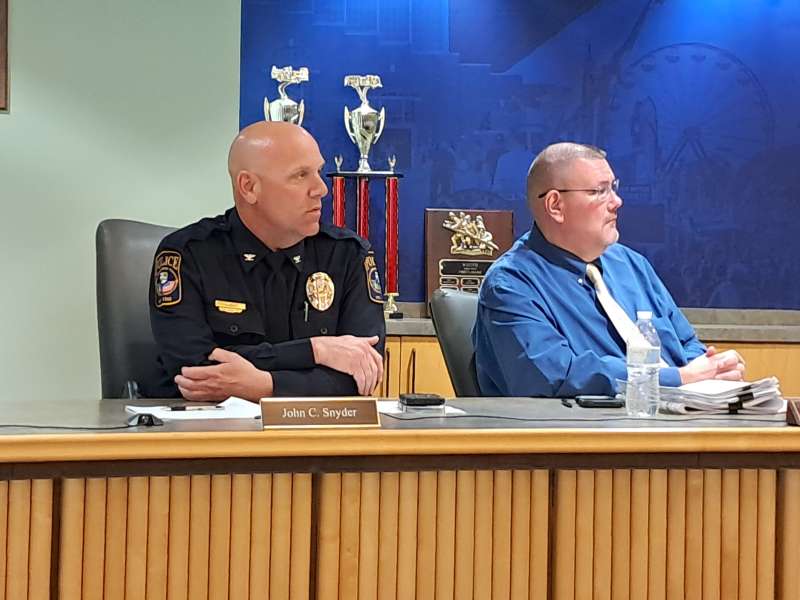
“This is not going to change anything or any way we operate here in West Manchester,” police Chief John Snyder told a crowd at the West Manchester Township board meeting on March 26.
Public opposition that night, as residents called on the board to vote no, led to Snyder deciding to withdraw his department’s proposal to join 287(g) and the board opting to table the issue indefinitely.
History of the 287(g) program
The 287(g) program gets its name from a section and subsection added to the U.S. Immigration and Nationality Act in 1996, now as federal immigration law as part of Title 8 of the U.S. Code.
Those sections authorize the government to enter into agreements with law enforcement agencies as a way to effectively deputize officers to perform federal immigration enforcement duties under ICE supervision.
The program expanded rapidly nationwide since President Donald Trump returned to office in January 2025 as part of his new administration’s aggressive immigration enforcement agenda.
ICE’s website describes 287(g), particularly one of its enforcement models as a “force multiplier” since it bolsters federal ranks by incorporating state and local officers into immigration enforcement.
The agency has 1,734 agreements for 287(g) partnerships in 39 states and two territories as of April 23, the site shows.
Of that figure, 85 agencies throughout Pennsylvania are participating in the program, with ICE’s data indicating that 10 departments joined in the month since the West Manchester Township meeting.
Northern York County Regional doesn’t appear in that data so far. But Wilhide confirmed the department’s agreement was approved and said the federal list probably hasn’t updated to include it yet.
Law enforcement agencies that join 287(g) opt to participate through three models: Task Force, Warrant Service and Jail Enforcement. Task Force is the most prominent as it grants designated officers authority to question, search and arrest people they suspect of violating immigration law, according to the agreements.
Civil rights advocates, pointing to high-profile errors in which U.S. citizens were detained and deported, said the program risks more mistakes while spreading fear and eroding trust in local law enforcement. Further, the 287(g) program may expose local police to increased legal liability for actions taken under ICE supervision.
The first 287(g) agreements were penned in 2002, according to U.S. Congress data, and slowly grew to include 72 departments by 2011. The number of agreements declined steadily after President Barack Obama shut down the task force model in 2012 amid controversy within the program. By the time Obama left office, just 35 agreements were still in effect.
Department of Justice investigations in the early 2010s found police in Arizona and North Carolina committed patterns of constitutional violations with arrests and stops as racial profiling of Latinos increased, according to the American Immigration Council.
During President Donald Trump’s first term, a renewed program saw the number of participating agencies grow to 150. But new agreements halted again under President Joe Biden.
In his second term, Trump revived a task force model that deputized local police to question, search and arrest people suspected of violating immigration law during their patrols. ICE describes the model as a “force multiplier” that can use local police to bolster its ranks, which under its Enforcement and Removal Operations wing includes about 6,100 deportation officers.
Police cite traffic stops for joining program
Hellam, Carroll, York County Regional and West York all adopted the Task Force model.
Mann said Hellam Township’s decision came after township leaders discussed the program with the director of ICE’s field office in York County and West York Borough Police Chief Matthew Millsaps, as well as with Hallam and Wrightsville borough officials.
Mann said she couldn’t remember the field office director’s name. Snyder told the West Manchester audience in March that he was part of a similar discussion with an ICE official a few weeks before seeking approval for his department to participate in 287(g).
Mann, like West Manchester and Carroll police, noted that officers have worked with ICE in the past, and that joining the program now will provide officers with additional training and quicker access to the agency’s identification information.
As an example, Mann said officers sometimes encounter traffic stop situations on Route 30 where passengers in vehicles don’t have identification and officers have to let them go. Partnering with ICE would allow faster access to the agency’s data for identifying whether or not such people are immigrants in the country illegally.
“So, it’s local police, not ICE enforcing stuff,” she said.
The example she gave was similar to one Carroll Township Sgt. Terry Williams described in March about traffic stops along Route 15 in northern York County as he spoke in support of joining the 287(g) program.
“We’re partnering for specific reasons, and it’s just the same as if we partnered with the FBI or ATF or other law enforcement agencies in the course of doing our jobs,” he told the York Daily Record on March 12.
He, like Snyder, like Mann, described the agreement as another resource for police rather than a federal agency usurping the department.
“Joining this partnership is just another tool in our toolbelt in doing our jobs,” he said then. “We’re still going to be the same police department we’ve always been.”
Mann believed 10 of Hellam Township’s 13 officers will receive training from ICE through the 287(g) program.
When asked whether the township is anticipating federal reimbursements, she said compensation was discussed at the April 16 meeting, but that she didn’t know what that was.
“And I don’t know that it really matters, because our police are already doing the job,” she said, adding the training, access to data and improved communications and cooperation were the important factors to her.
Questions about compensation came up through resident questions at the West Manchester meeting.
Officials eventually pointed to a FAQ sheet on ICE’s website that described a potential for agencies under the Task Force Model to receive $7,500 in equipment reimbursements per officer trained, $100,000 in new vehicles and overtime reimbursements of up to 25% of an officer’s salary.
West Manchester’s board hasn’t revisited its 287(g) proposal since the meeting.
ICE’s 287(g) data shows that of the 85 agencies in Pennsylvania with active agreements currently, about half were signed from March through December 2025. The other half were signed through the first four months of 2026.
West York was among the first York County agencies to join the program in 2025 with an agreement signed in August.