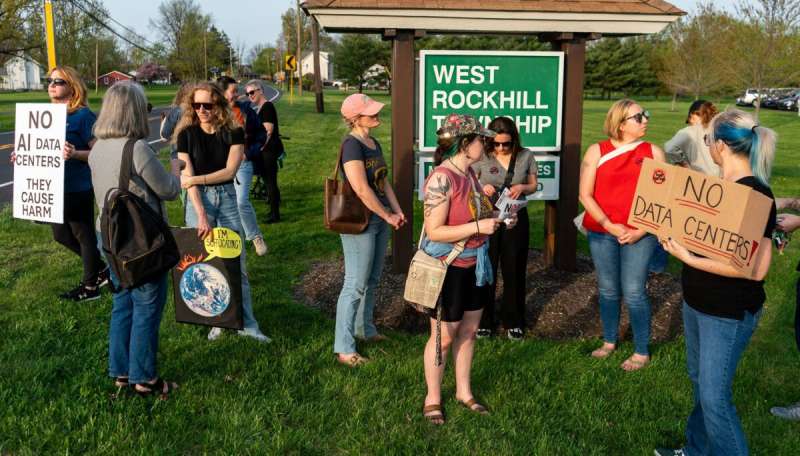
From her home in Indiana Township, Vanessa Lynch can already trace the invisible path of pollution.
She’s seen the maps. She knows where her son goes to school. And she knows what could be coming.
Lynch lives about six miles from the proposed Cheswick/Springdale AI Data Center site, a planned 565,000-square-foot facility on a 47-acre campus in Allegheny County. She said the project has opened her eyes to what these facilities can mean for nearby neighborhoods.
“As a mom, you look at something like this and think about your kids….and what they’re breathing,” said Lynch, who’s Pennsylvania’s campaign coordinator for Moms Clean Air Force.
That fear is at the center of a rapidly growing debate in Pennsylvania, where a surge in data center development is colliding with communities unprepared for its scale.
“These small communities get these enormous proposals and local officials feel boxed in by the fear of lawsuits if they deny them,” Lynch said. “Our communities need clear rules before projects arrive, not after, because once a proposal is on the table, residents are already trying to catch up.”
A boom happening at “light speed”
Pennsylvania has become one of the country’s fastest-growing hubs for data centers, with 52 active data centers in the state already and about 50 more proposed, according to the website Track Data Centers.
While data centers may bring billions of dollars into the commonwealth, Lynch said the speed of the expansion is part of the problem.
“The speed with which data centers have come to Pennsylvania definitely impacts the readiness of local communities,” she said. “Many don’t have data center ordinances at all, or they’re very weak.”
In places like Springdale, Lynch said, local officials were left weighing massive proposals without the tools to fully evaluate or stop them.
“If you go back through the recorded meetings you’ll see elected officials say, ‘I felt like I couldn’t say no,’ even though the community is really concerned.”
What’s at stake: Rising utility bills and fresh air
Data centers are warehouse-sized facilities that are used to store digital information and house the enormous computing power necessary for the development of technology such as artificial intelligence.
These facilities can bring tax revenue and infrastructure investments to local governments, to the tune of tens of millions of dollars. They also bring jobs.
But a growing number of Pennsylvania communities and residents are saying there are other factors to consider.
“Pennsylvania’s industrial history has trained us to prioritize economic development, even when it comes at a human price,” Lynch said. “We lean on the side of economics instead of considering the economics of health. It’s a complete misstep not to look at the whole picture.”
The proposed Cheswick/Springdale AI Data Center includes about 100 onsite diesel backup generators. This equipment, Lynch said, can release harmful pollution linked to asthma attacks, heart disease, neurological damage, and cancer.
“We know diesel pollution has huge impacts for the people living near it,” Lynch said. “These are fence-line communities paying the price.”
In southwestern Pennsylvania, the price is even steeper, as several developers are proposing pairing data centers with onsite power generation fueled by methane gas—a fossil fuel closely tied to fracking. Communities near sites in Homer City and Mansfield are now confronting not just server farms, but full-scale energy facilities in their backyards.
“We’re creating scenarios where power generation sites are embedded in our communities and they’re going to need more fracked gas to fuel them,” Lynch said.
Beyond local air pollution, Lynch said noise pollution from round-the-clock operations is another concern, turning quiet residential areas into industrial zones.
The biggest concern, though, is the massive energy demands of data centers raising electricity bills for residents and straining the grid.
The proposed Cheswick/Springdale AI Data Center site would draw up to 180 megawatts of energy at any one time, according to the project’s developers. An average American home draws about 1,200 watts of power, meaning the amount of energy the single data center uses could power about 150,000 homes.
The increase in energy use drives up infrastructure costs and requires utilities to invest billions in new substations, power lines, and power plants to support them, with these costs often passed on to consumers. High power consumption for data centers causes demand to exceed supply, raising wholesale energy prices.
Harrisburg steps in—slowly
As the data center boom continues across the state, Pennsylvania still does not have a statewide law regulating data center development. Democrats have pushed for more oversight to protect residents, but Republicans in the state government have largely held those proposals in limbo, never forcing a vote that would reveal their true allegiances.
Last month, the state House passed House Bill 1834, backed by Democrats, which would give the Public Utility Commission temporary and permanent authority to regulate data centers, require companies to pay more of the infrastructure and energy costs they create, and push projects toward cleaner energy use.
While the bill passed the House, Rep. Craig Williams (R-Delaware) said it “accomplishes nothing.” Another GOP lawmaker, Rep. David Rowe (R-Juniata), said “the solution to higher energy costs is more generation,” and the answer is “not more mandates, more fees and more regulations”.
Another Democratic proposal passed by the House, House Bill 2151, directs the Department of Community and Economic Development to create a model ordinance for municipalities, giving local officials a template for regulating data center development.
The Republican-controlled Senate has yet to advance either of the House bills, with Senate Majority Leader Joe Pittman (R-Armstrong) justifying the stall tactic by saying that data center legislation should balance “economic opportunity” with community impacts.
In fact, Republican lawmakers have responded over and over by proposing policies that would significantly reduce oversight. Sens. Camera Bartolotta (R-Beaver) and Patrick Stefano (R-Bedford) introduced a bill that would altogether eliminate the need for key state permits before construction begins on data centers and related power plants, while also removing opportunities for public review.
Critics say that approach would leave communities even more vulnerable, especially as projects grow larger and more energy-intensive.
They also note that the standoff in Harrisburg mirrors a broader pattern in Trump-era politics, where lawmakers talk about economic opportunity while leaving communities to shoulder the pollution and rising bills.
A turning point for Pennsylvania
Across the country, resistance to data centers is growing as communities struggle with their impacts, from rising power bills to environmental concerns.
For Lynch, the issue isn’t whether data centers should exist, it’s how they should exist, and at what cost to Pennsylvanians.
“We are not against data centers,” Lynch said. “We are about the cleanest and healthiest future for our children.”