President Donald Trump’s decision earlier this year to send Immigration and Customs Enforcement agents into crowded airports to ease wait times raised the specter he could deploy federal agents to polling places on Election Day.
Trump sent ICE to a dozen airports in March to help Transportation Security Administration agents with security checks and crowd control as the Department of Homeland Security remained shut down over a funding dispute in Congress.
And ahead of his trip to China in early May, Trump wrote on his Truth Social network that the GOP would send an “election integrity army” to every state for the midterms. When pressed on his plans by reporters, Trump would not rule out sending members of the National Guard or ICE to polling places Nov. 3.
“I’d do anything necessary to make sure we have honest elections,” Trump said.
Staunch Trump ally Steve Bannon, who served as Trump’s chief strategist during his first term, said earlier in 2026 on his “War Room” podcast that the move to send ICE to airports was being done as “a test run, as a test case, to really perfect ICE’s involvement in the 2026 midterms.” And during his confirmation hearing in March, DHS Secretary Markwayne Mullin didn’t rule out ICE being sent to polling places if there was a “specific threat,” but not to intimidate voters. Nine secretaries of state sent a letter to Mullin asking that he put in writing his official position that ICE agents will not be present at polling places.
Trump’s rhetoric and executive orders over unfounded allegations of widespread election fraud, coupled with his expansion of ICE to carry out mass deportation of immigrants, has alarmed Democrats and other critics that the president might use federal agents to suppress voter turnout in places with high concentrations of Democrats during the midterm elections.
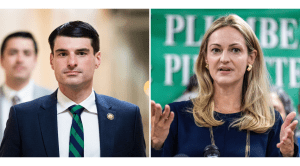
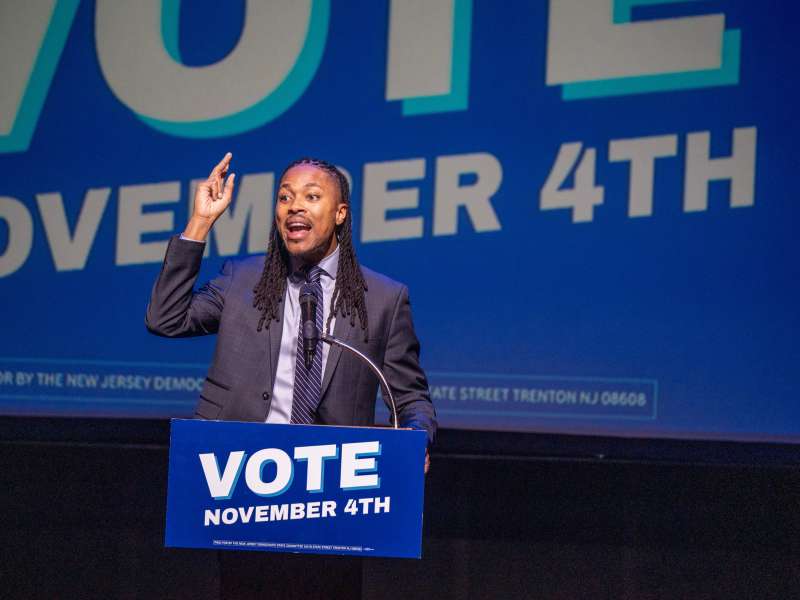
State Rep. Malcolm Kenyatta, a Philadelphia-area Democrat, in February announced he would introduce legislation that specifically bans these federal agents from entering polling places.
Pennsylvania already prohibits on-duty law enforcement officers from being within 100 feet on a polling place unless they are responding to a specific incident.
However, Kenyatta told the USA TODAY Network Pennsylvania that law says nothing about federal agents.
“We need to be as clear as possible under state law, in my view, to leave no doubt for people who may be afraid that — if they have the right to vote and if they are legally registered — they can exercise that right to vote without any threats from the federal government,” Kenyatta said April 13. “This is about us clarifying the statute, which is, right now, not as clear as it could be.”
State Sens. Nikil Saval and Lindsey Williams have introduced similar legislation in the Pennsylvania Senate. The Protecting Our Vote Act, S.B. 1357, was introduced May 8 and has been referred to the Senate State Government Committee.
“Currently, Pennsylvania law prohibits on-duty police officers from being within 100 feet of a polling place unless called upon to preserve the peace,” Saval wrote in a co-sponsorship memorandum. “However, with the increased presence and cooperation with federal officers and agents, the omission of other law enforcement officers leaves Pennsylvanians vulnerable to potential intimidation.”
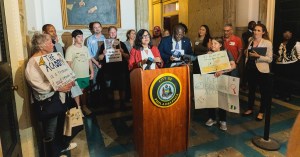
On June 9, Senate Democrats gathered on the steps of the Pennsylvania State Capitol Complex in Harrisburg for an “ICE out” event in which several lawmakers discussed a suite of bills aimed at keeping ICE agents out of schools, churches, hospitals and polling places.
“Voting is the cornerstone of our democracy, and your vote is incredibly powerful. If it weren’t powerful, Trump and Republicans in the federal government wouldn’t be working so hard to take it away from millions of Americans,” Williams said at the event, which also featured immigrant rights advocates, labor leaders and other community members. “But the federal government doesn’t administer elections. The state does. The federal government may try to enforce their will on Pennsylvania, but we have the final say on keeping voters safe, running smooth elections and making sure every vote counts.”
Guidance from the Pennsylvania Department of State issued in 2025 notes that police officers, whether uniformed or in plain clothes, must remain 100 feet or more from the entrance of a polling place unless they are personally voting, when the polling place is located in a building that also houses a police station, or when they are summoned to preserve peace.
Election officials or three voters in the precinct can request local officials, including constables, sheriffs or police officers, to clear a path to the door if it is obstructed and preventing people from voting, to maintain order or “quell any disturbance if it arises.”
There are also several guidelines about voter intimidation that could apply to ICE agents. For example, “Questioning voters about citizenship, criminal record or political choices,” is a form of voter intimidation. It’s also illegal for “any person or corporation (to) use abduction, duress, coercion or any forcible or fraudulent means to impede, prevent or otherwise interfere with a person’s right to vote,” according to Department of State guidelines.
Kenyatta said the Trump administration is trying to use “every single lever” to intimidate voters — from trying to federalize the administration of elections, to requiring people to present documented proof of citizenship in person to register, to drastically limiting those who can vote by mail.
“Almost all of it is using the completely flawed justification, also known as a lie, that there are massive amounts of illegal votes taking place with people who were either immigrants to the country who came here just with the intention of voting, or that people who are disqualified from voting for some other reason are somehow gaming the system and trying to vote,” Kenyatta said. “This administration is using every lever, and one of the levers that they’re using is to try to intimidate people from exercising their right to vote. And we have seen the president and his allies say in no uncertain terms that they want to use ICE to try to scare people at the polls.”
Critical midterm elections
Trump continues to repeat unfounded claims of a stolen 2020 presidential election despite the absence of evidence nearly six years later. Still, Trump has signed executive orders and has attempted to pass legislation, namely the SAVE Act, that critics argue would disenfranchise scores of eligible voters. He’s also moved Republican-controlled state legislatures in states, including Texas, Tennessee and Missouri, to gerrymander congressional districts, a process that has almost always occurred every decade following the U.S. Census.
California and other Democratic states have followed suit in an effort to counter the GOP gerrymandering.
The midterm elections are critical for Trump. All 435 members of the U.S. House and 33 of the 100 members of the U.S. Senate are on the ballot. Voters could shift control of one or both chambers of Congress, which would hamper the final two years of Trump’s presidency.
Philadelphia District Attorney Larry Krasner has joined a national coalition called the Project for the Fight Against Federal Overreach. It’s a group of prosecutors who want to hold federal officials accountable for violating constitutional rights when it comes to warrantless searches, unlawful detentions, and other issues.
‘Handcuffs and a jail cell’
Krasner told MSNOW host Chris Jansing that Trump wouldn’t be trying to ensure honest elections by sending federal agents to polling places.
“He’s totally in favor of dishonest elections and has been a serial election liar and denier,” Krasner said of Trump, noting the coalition of state prosecutors won’t hesitate to prosecute federal agents for violating the law.
To counter potential voter intimidation, Krasner said the public needs to thoroughly document, through photos and videos, and report any instances of overreach by federal agents at polling places.
“By being vocal, being prepared, by talking about this, anybody who might want to mess with the vote knows what’s coming,” he said. “And it is, in fact, handcuffs and a jail cell.”
And because such charges would be brought by state prosecutors, “Trump can’t pardon you,” he said.
Krasner said every vote needs to be counted, “no matter for whom.”