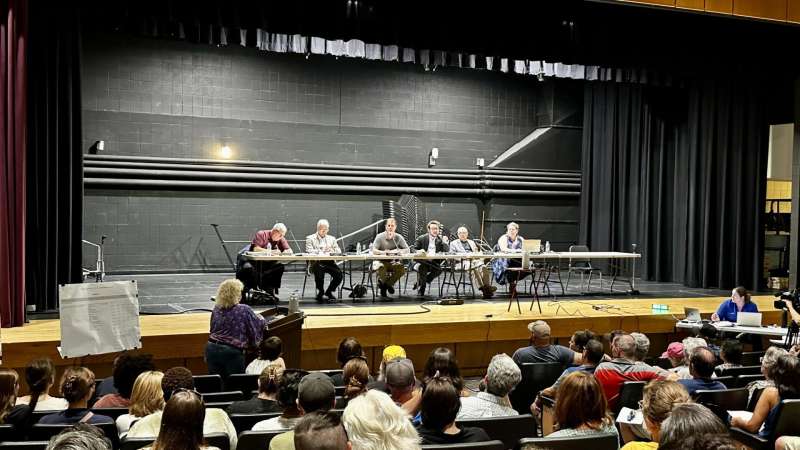
Smithfield Township’s amended data center ordinance was approved by the board of supervisors on Aug. 12, providing further regulation over the structures which have become something of a bane to communities across the country.
And while many celebrated what they considered to be a “win” in the ongoing discussion on data centers, many recognize that the battle is far from over.
The supervisors approved Draft Ordinance No. 268 following a public hearing at J.T. Lambert Intermediate School, setting in place more targeted regulations for data center projects and restricting them to a particular district.
Smithfield Township Board of Supervisors Chairman Jacob Pride provided a brief summary of the matter, clarifying that it would remove data centers as a by-right usage in the industrial zone and a conditional use in the economic development zone, leaving such projects to seek conditional use in the new heavy industrial zone, and limiting data centers to 50,000 square feet.
“It also adds additional setbacks, prevents clearcutting of woodlands, and also requires an energy usage plan, among other utility certifications, similar to what we have now, just with additional details being required,” Pride said.
“That also changes the assessment of sound and a stronger community impact statement, as well as a bonding requirement.”
While attendees at the meeting were informed that this meeting was dealing with the ordinance itself, and not the Smithfield Gateway data center project which is currently under consideration, plenty of speakers drifted toward that subject during the public hearing.
Others expressed general concerns over environmental impacts – including water and electricity usage, sound pollution and more – and an interest in fine-tuning the ordinance to be even more restrictive.
One resident floated the idea of making it so that a data center developer would be so constrained by the ordinance that it would simply be unprofitable to attempt to build in the township.
Solicitor Ronold J. Karasek said that would likely lead to legal challenges from developers.
“In fact, the ordinance that presently stands, I want everyone to know it may be challenged,” Karasek said.
“You’re making this in this H-1 zone. A court may say, ‘That’s not big enough. You were purposefully making this so small and so restrictive that a data center can’t go there,’ and that could occur.”
One of the most misconstrued issues about data center regulation is the idea that a local government can simply ban development. That would constitute exclusionary zoning, which is generally considered unconstitutional in Pennsylvania.
Several individuals did comment directly on the ordinance, with a few speakers, including Katie Calcaterra, suggesting the addition of a “green amendment,” which would essentially require even more scrutiny over projects’ impacts on the local environment.
“Every action taken by this municipality should include an appropriately thorough review of the impacts of its proposed actions on the environment, environmental rights, and natural resources in order to ensure environmental rights will not be infringed upon, and to ensure the municipality is fulfilling its natural resource trustee’s obligations,” Calcaterra said, with board members even suggesting this could be applied to the township’s entire code.
Jessica Delfino suggested a list of “non-negotiables” for the ordinance, such as further environmental protections for noise, water, and air pollution; standards for backup generators; specialized fire safety plans; protection of the power grid and residents; requiring decommissioning bonds for teardowns once the property is no longer used; and truly independent testing for sound and water quality annually.
Josephine Gingerich suggested a more relative approach to setback requirements for data centers.
“We need to put in our ordinance the definitions of the data centers, because if, say, a setback for a little data center that’s downtown that’s five megawatts, that wouldn’t hurt us with a small setback,” Gingerich said.
“But a hyperscale campus should not be held to the same 500-foot setback. That needs to be half a mile or more.”
State Rep. Tarah Probst (D-189th District) also spoke briefly, encouraging the board to get as restrictive as possible in the ordinance, and making a point that as state government works at a slower pace with legislation, it falls upon the municipalities to institute regulation and change now.
“[I]f you make it too restrictive, I keep hearing, ‘Well, they’re going to sue us. They’re going to sue us.’ Let me tell you, you’re going to say, ‘no,’ and you have every legal right to say ‘no,’ and they’re still going to try to sue you to get this. So you might as well go balls-to-the-wall…” Probst said as the crowd applauded and cheered.
Following a brief recess, the board returned for the vote. Before the vote, Supervisor Michael Albert stated he would be interested in several of the proposed ideas – namely, noise issues, a fire safety plan, diesel backup generator limits, and natural buffers – and he was comfortable adding them to the ordinance in the near future.
“I feel very strongly about passing this as soon as possible, and then incorporating these things,” Albert said.
“And I think the timeframe is ultimately the same. It just means that we’re more protected right now.”