Despite political rhetoric, data shows white people are the largest racial group receiving SNAP benefits. Many of the people hit hardest, though, are the ones who have to show up to school with empty bellies.
“I fell into a downward spiral.”
That’s how Enrique Fuentes described the feeling of being without the $250 he received each month in federal assistance to cover the cost of groceries.
In an interview with Times Leader, the 27-year-old Philadelphia resident said that he works three days a week as a technician assisting therapists who help autistic children and adults. However, that work schedule wasn’t enough to qualify for the Supplemental Nutrition Assistance Program (SNAP) under a law signed by President Donald Trump.
“I wasn’t even aware of that stipulation,” Fuentes said.
Fuentes is one of an estimated 3 million able-bodied Americans who do not work enough hours to qualify for SNAP benefits under Trump’s “Big Beautiful Bill.” Many of those adults are in low-wage jobs where employers control hours, so they struggle to hit the hourly threshold even when they want more work—and risk sanctions when shifts are cut. Others fall into gray areas the policy doesn’t account for, such as cycling in and out of short-term gigs, living with physical or mental health conditions, or caring for children or other family members while being treated as if they’re fully available for work.
A serious side effect of the cuts is the number of children losing benefits as collateral damage. A new analysis by ProPublica shows that a year after implementation, 46% of people who lost food assistance were children, and the fallout extends into their education.
In 2024, 47% of households with children who participated in SNAP were automatically eligible for free school meals through a process called direct certification, meaning kids in SNAP households received free meals without their families having to fill out a separate application. Without SNAP, many of those children lose automatic access—and lose the nutrition and full bellies necessary to learn.
In Pennsylvania, kids make up roughly 1 in 3 SNAP recipients, and their families’ SNAP status matters. That’s because schools use their family enrollment data to qualify for free meals for all students, no paperwork required. Because of Trump’s SNAP cuts, the state estimates that more than 144,000 Pennsylvanians will lose food assistance, which could push many schools below the threshold needed to keep the program going.
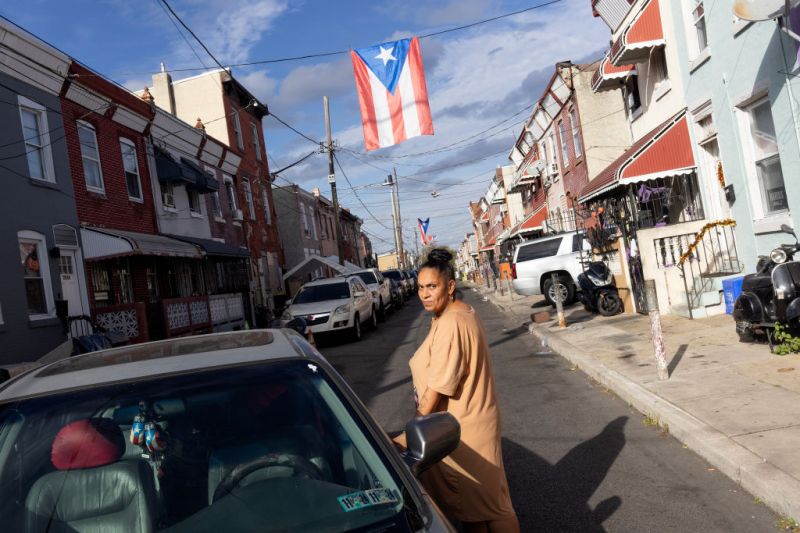
Compounding the problem: Trump eliminated SNAP-Ed, the federal program that taught families about nutrition and how to apply for SNAP. Spanish-language materials, along with all other non-English versions, were removed from the program’s website, leaving only English-language resources. That makes the application process harder to navigate for people with limited English proficiency—a significant barrier for the Latino community, who make up about 40,000 of those affected by SNAP cuts in Pennsylvania.
Republicans have a storied history of painting the Latino community as defrauding the government for using food assistance programs, whether they are American citizens or undocumented immigrants.
Last year, Trump issued an executive order to end “all taxpayer-funded benefits for illegal aliens.”
According to the most recent USDA data from 2023, white people are the largest racial group receiving SNAP benefits, at 35.4%, while African Americans make up 25.7%, Latinos 15.6%, Asian Americans 3.9%, and Native Americans 1.3%.
While the misconception is that undocumented immigrants are taking from taxpayers, research shows that the reality is quite the opposite.
According to the CATO institute, “the biggest myth in the debate over immigrant welfare use is that noncitizens—which includes illegal immigrants and those lawfully present on various temporary visas and green cards—disproportionately consume welfare. That is not the case. Noncitizen immigrants consumed 54% less welfare than native-born Americans.”
Meanwhile, a study by the Institute on Taxation and Economic Policy, a tax research group, found that those in the US without legal status have contributed billions of dollars to the Social Security system.
The current economic situation in Pennsylvania—and the nation—remains quite dire: grocery and gas prices are rising. However, an estimated 4 million Americans are expected to lose SNAP benefits this year under Trump’s cuts, including 144,000 in Pennsylvania, 45,000 in Philadelphia, and 12,000 in its collar counties, according to the Pennsylvania Department of Human Services.