Local governments are racing to write regulations for data centers.
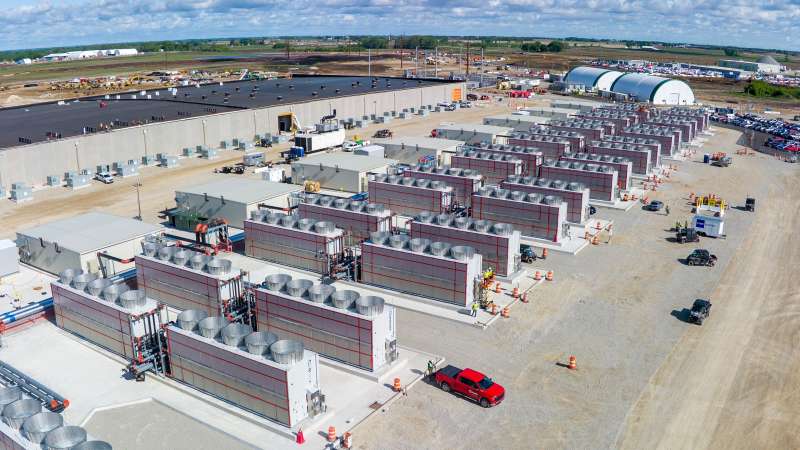
Data centers house hundreds or thousands of computers and associated technology needed to power the growing demand for artificial intelligence, cloud storage and other digital applications.
They’re criticized for gargantuan water and electrical use, noise emitted by generators and cooling systems, and other potential community impacts.
There currently are no data centers in northwestern Pennsylvania, according to the citizen-run Data Center Proposal Tracker.
And there are few or no rules to regulate them. Regulations being written by Erie County and local municipalities will change that.
“I would imagine everyone is trying to catch up,” said Harborcreek Township Supervisor Dean Pepicello. “We are trying to balance the legality of zoning regulations with limitations that protect the community.”
Work in progress
Harborcreek Township has drafted an amendment to the township zoning ordinance to address data centers. Supervisors are expected to vote on the proposal on June 17.
Summit and Millcreek townships are also finalizing data center regulations.
Summit Township Planning Commission will consider a draft zoning amendment on June 8. If recommended by planners, supervisors would vote on the regulations in July.
Millcreek’s draft regulations could be considered by township planners as early as July with action by township supervisors as early as August.
Girard, Venango and North East townships also are among local municipalities planning or preparing data center regulations.
All are expected to stir public interest.
When North East Township Planning Commission began reviewing a template ordinance on data centers provided by the Erie County Department of Planning and Community Development on June 1, the meeting had to be relocated to a larger room to accommodate the 40 people who attended.
What municipalities can and can’t regulate
By state law, local governments cannot prohibit data centers — or any legal land use — within their boundaries.
They can designate zoning districts where they are permitted.
“The bottom line is, if you don’t allow it somewhere, such as in an industrial district, it’s allowed to be anywhere,” said Millcreek planning and development director Matt Waldinger.
The draft Summit and Millcreek zoning amendments would limit data centers to industrial districts.
The proposed Harborcreek amendment would allow data centers by special exception only in the township’s public university district, basically in the Penn State Behrend/Knowledge Park area.
In North East Township, data centers will be allowed only in appropriate areas, planning commission member Matt Putnam said June 1.
“Any fears that anybody has about them being in residential or agricultural areas, it’s not going to happen,” he said. “And we don’t spot zone. That’s illegal. It would only be in a commercial (district) or something that’s zoned appropriately.”
Local governments additionally can require developers to show that sufficient water and electrical capacity is available for their needs.
They can require developers to address noise levels, environmental issues and other concerns prior to construction and also can set minimum requirements for setbacks from the road and neighboring properties, limit building heights, set maximum noise levels, and more.
Requiring a conditional use permit for data centers additionally allows local governments to set specific requirements for each proposed development, Putnam said.
“The thing that the conditional use allows us to do is set parameters based on the specific application. It doesn’t just give a broad set of rules that somebody can sidestep.”
County-level action
Rural municipalities with large tracts of land available for development are more likely than urban areas to be considered as locations for new data centers.
But not all of those municipalities regulate where a development might be located or impose any regulations.
A proposed amendment to the Erie County subdivision and land development ordinance would provide some ground rules for data centers in Platea, Cranesville, Mill Village and Elgin boroughs and Conneaut, Elk Creek, LeBoeuf, Amity, Wayne, Union and Concord townships — where there are no local land development rules.
“What the county is doing will get some rules on the books for data centers in communities that don’t have their own subdivision and land development ordinances,” Millcreek’s Waldinger said. Waldinger chairs the Erie County Planning Commission.
The proposed county amendment will be considered by the Erie County Planning Commission at the Girard Borough Municipal Building on June 11. If recommended for approval, Erie County Council would vote on the regulations this summer.
The goal: Balancing industry and community needs
The end goal should be each community determining where data centers can be located and how they will be built and operated, said Holly Fishel, policy and research director for the Pennsylvania State Association of Township Supervisors, in testimony before the Pennsylvania Senate Policy Committees in 2025.
“These centers will have long lasting impact on the communities that host them, which is why it is critical to preserve local decision making and avoid a one-size-fits-all design scheme,” Fishel said.