Artificial intelligence entrepreneur Sam Altman’s remarks envisioning a future when AI is as ubiquitous as running water have prompted legislation to make clear that data centers are not public utilities.
Sen. Katie Muth (D-Chester) published a memorandum Thursday seeking cosponsors for a bill that would amend the Public Utility Code to prohibit data centers from obtaining a Certificate of Public Convenience and becoming utilities.
The current law states the term public utility does not apply to “any person or corporation, not otherwise a public utility, who or which furnishes service only to himself or itself.”
“However, because of billionaire tech bros invading our Commonwealth with hyperscale AI data center proposals that include onsite methane gas power plants, enabled by our government fast-tracking permit approvals, the law must be more specific to ensure data centers are prohibited from obtaining the legal rights of a public utility,” Muth’s memo says.
She noted that if a data center company were to become a utility, local government decision making about their development would be severely limited.
Speaking at a summit hosted by asset manager BlackRock in March, Open AI co-founder and CEO Altman said he sees AI as a utility “like electricity or water, and people buy it from us on a meter and use it for whatever they want to use it for.” Muth included the quote in her memo.
“We want to flood the world with intelligence. We want people to just use it for everything. We want this to just be something that the future generation doesn’t think about,” he said.
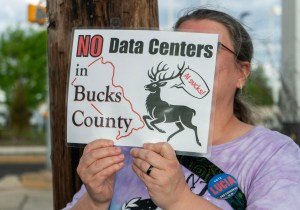
Muth notes that Pennsylvanians and local governments across the state have responded to data center proposals by fighting to ensure the impact on host communities is minimized. Many communities are scrambling to update zoning ordinances to place specific requirements on data center development.
If a data center developer was deemed a public utility, local government authority over zoning and onsite power generation would be eliminated, Muth noted in her memo. She also warned that public utilities are granted eminent domain powers – which allows them to take private property for a project benefiting the public.
“This would enable data center developers to acquire development rights, rights-of-way and property for building, maintaining, or expanding infrastructure for data center projects that only benefit private, for-profit corporations,” Muth said.
In Muth’s district last week, the East Vincent Township Board of Supervisors voted to deny a conditional use application for a 1.4 million square-foot data center complex on the grounds of the former Pennhurst State School and Hospital outside Pottstown. The site is zoned for light industrial. A conditional use is one that is considered on a case-by-case basis.
The property, within view of the Limerick nuclear generating station, would also be the site of a 550 megawatt natural gas-fired power plant and 160 backup generators. An attorney for the developer, Pennhurst Holdings DE, told WFMZ-TV that the company plans to appeal in Chester County Court.
The township supervisors have until July 5 to provide a written denial, at which time the developer will have 30 days to appeal.
Data centers are buildings that house computer servers. For decades, they’ve supported online streaming, e-commerce and other internet services.
With the advent of machine learning and large language models that power AI, developers are building hyperscale data centers that house thousands or millions of computers to develop better models and support commercial applications.
These facilities can consume as much power as a small city, require water for cooling and are competing for increasingly scarce energy resources. The peak demand for electricity is forecast to grow 66 gigawatts over the next decade, according to regional electricity grid operator PJM Interconnection.
Altman said at the summit in March the growing demand for AI doesn’t seem to be slowing. If computing capacity for AI doesn’t keep up, companies like Open AI will either lose business or the price will increase to a point where it becomes inaccessible to all but the wealthy, he said.
“So, the best thing to me throughout all the history of capitalism, innovation, whatever you want, is to just flood the market,” Altman said at the summit.