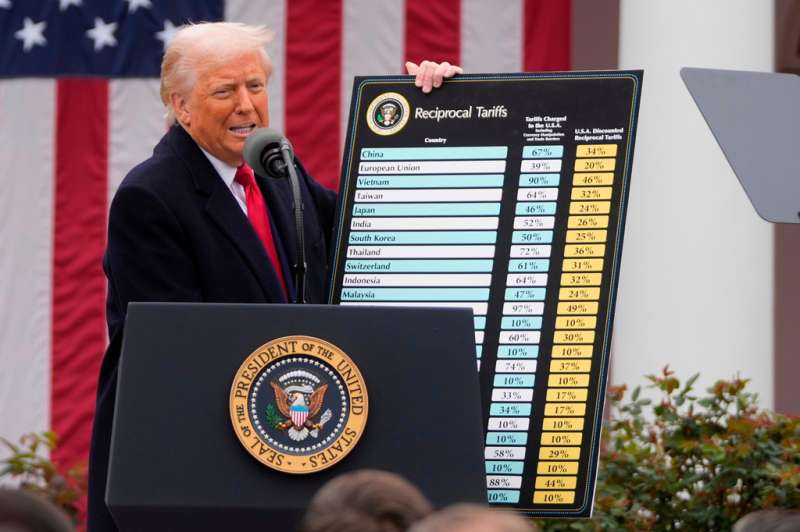
Since taking office in January 2025, President Donald Trump’s tariff policies have cost Pennsylvanians an additional $11 billion, ranking it the 11th most-affected state in the nation, according to a conservative-leaning taxpayer advocacy group.
The National Taxpayers Union Foundation’s State Tariffs Tracker found that the per-household equivalent of the additional executive tariffs on imports into the state amounts to $2,016 more for Pennsylvanians than what tariffs cost in 2024 before Trump took office.
Pennsylvania is one of 37 states or territories (the NTUF tracks all 50 states as well as Washington D.C. and Puerto Rico) that have experienced $1 billion or more in tariff costs since the start of Trump’s second, nonconsecutive term.
“About 57% of that fell on raw materials, parts, and equipment that Pennsylvania manufacturers buy, and the hardest-hit category is cars and trucks at $1.4 billion,” the group says.
Cars and trucks cost an additional $1.4 billion in tariffs for the state, with the average tariff on vehicles between July 2025 and June 2026 amounting to 16.9%, according to the NTUF. Twelve of the 52 jurisdictions tracked had cars and trucks atop their lists, the most of any category of imports.
That’s 135 times the 0.1% tariff rate that was being paid in 2024.
Food and beverages cost Pennsylvanians $1 billion more due to tariffs, with the tariff rate on imports increasing 3.7 times, from 2.2% in 2024 to an 8% average.
Next was steel, aluminum and other metals, which cost $946 million overall, followed by clothes and shoes at $690 million.
The NTUF’s estimates, prepared in conjunction with Trade Partnership Worldwide using U.S. Census data, show that California has seen the biggest impact from the Trump tariffs at a cost of $63 billion.
The tariffs have also cost Ohio and Tennessee $11 billion. However, both states have higher per-household equivalents of $2,274 and $3,770, respectively.
Here are the top 10 most-affected states:
- California: $63 billion, $4,552 per-household equivalent
- Texas: $37 billion, $3,269
- Michigan: $23 billion, $5,619
- Georgia, $20 billion, $4,771
- Illinois, $17 billion, $3,325
- New York, $15 billion, $1,856
- New Jersey, $14 billion, $4,031
- Florida, $12 billion, $1,279
- Ohio, $11 billion, $2,274
- Tennessee, $11 billion, $3,770
Different metrics
The website tarifftax.org uses a different metric to measure tariffs’ effect on states. In this case, the focus is on exports from states.
The site was developed by TheDataProject.ai, a data journalism and analysis group that is “focused on making complex policy data accessible to the public.” It assigns impact scores that measure the trade exposure caused by tariffs. That score includes things like export dependence, the number of at-risk manufacturing jobs and how vulnerable a state is to retaliatory tariffs.
In this case, Pennsylvania ranks 14th with an impact score of 71. Texas has the highest impact score of 90.
Tarifftax.org says 95,000 jobs and $14 billion worth of exports annually are at risk in the Keystone State due to tariffs, and that the cost to households averages $1,800 annually.
“Pennsylvania’s diverse industrial economy creates tariff exposure from the steel mills of Pittsburgh to the pharmaceutical labs of the Philadelphia suburbs,” it says. “U.S. Steel’s historic Mon Valley Works and Cleveland-Cliffs’ operations benefit from 25% steel tariffs, but these gains come at the expense of far larger downstream industries — auto parts, machinery, and construction — that pay more for steel inputs.”
Tarifftax,org also says of Pennsylvania that:
- Pharmaceutical companies like GSK, AstraZeneca, Merck and numerous biotech companies have been impacted because of disruptions at both ends of the global supply chain due to tariffs.
- Tariffs on imported feedstocks are raising costs for the state’s chemical industry, while retaliatory tariffs have threatened specialty chemicals exported from the state.
- Chester County, where 60% of the nation’s mushrooms are grown, has been hurt by retaliatory tariffs, as have other segments of the state’s agricultural industry, especially dairy, hay and soybean growers.
- Food manufacturers like Hershey are paying more for cocoa, sugar and other ingredients.
- And although Pennsylvania is a top producer of natural gas from the Marcellus Shale basin, tariffs on equipment are increasing extraction costs.