It was approaching midnight on Sept. 4, and Pastor Molis Augustave was delivering for DoorDash.
He had taken the gig when he was suddenly out of work in late July. It was expected.
Augustave, a Haitian immigrant, had been working under a permit issued by the federal government, and when U.S. Supreme Court allowed the Trump administration to terminate the temporary protective status for Haitian immigrants, their permission to work in the United States also disappeared. A loophole exists for self-employed contractors.
Augustave signed up for the delivery service when he was no longer able to work his day job as an organizer for We Are CASA, an organization that advocates for immigrant rights, among other things. His pastoral work with a local Pentecostal congregation is more an avocation than an income-generating job.
“He had to look at other means to bring in income to support his family,” said Ama Frimpong, chief of services and legal advocacy for CASA.
Augustave was near the intersection of Route 30 and Kenneth Road when a police car lit him up, the West Manchester Township officer pulling him over for having a burned-out headlight. He also had an expired registration, police reported.
The officer took his identification and, as is routine during traffic stops, checked to see whether he had any outstanding warrants. Since the township has an agreement with U.S. Immigration and Customs Enforcement, township police chief John Snyder said, one of those queries included a check of the agency’s database to whether ICE was seeking him.
The check determined that ICE was looking for Augustave and required the officer to take Augustave to ICE’s field office in an industrial park north of York and hand him over to authorities.
From there, Augustave – a pastor at a local church – was shipped to the ICE detention center in Moshannon, in Clearfield County, and then to the Central Louisiana ICE Processing Center, halfway between New Orleans and Shreveport, to await deportation proceedings.
His detention has sparked a community protest, questioning why Augustave, a gregarious family man described as a husband, father, friend and pastor, a man who has helped others in the Haitian community navigate the byzantine immigration system, was detained to be sent back to the unstable Caribbean nation.
‘It hasn’t been easy’
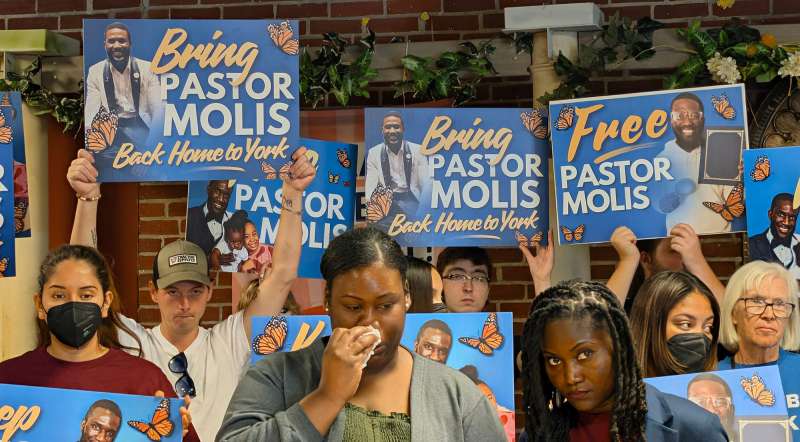
About 50 of Augustave’s supporters gathered Monday morning at CASA’s offices on Roosevelt Avenue in York to rally for Augustave’s release from ICE detention and show support for his wife, Omana, and his two children, a 9-year-old stepdaughter and a 2-year-old son.
They chanted “Bring Molis Home” and carried signs asking the same as they filed into the ballroom at CASA’s office building.
Olga Galati, CASA’s Pennsylvania deputy director, said, “This is personal for us. Molis is one of us so we do take this personal.”
She and other speakers during the news conference also defined Augustave’s detention in more general terms, that he is among the 15,000 Haitian immigrants in the state who face a similar fate now that they have lost protective status. Galati also spoke about the economic toll beyond Augustave’s family. She said the Haitian community contributes $235 million to the state’s economy every year, working mostly in agriculture, hospitality and healthcare. They pay taxes and support the state’s local businesses.
The speakers heaped vitriol on the Trump administration for its immigration policies, Frimpong calling them “hate-fueled, racist and white supremacist.” She described a social media meme that showed Haitian immigrants in shackles and they were loaded onto a plane at night, in the rain, to be returned to Haiti. “Picture that,” she said. “That is what they want this country to go back to.”
Terminating protective status is cruel, she said, noting that Augustave, like many other Haitian immigrants facing the same fate, “fear going back to Haiti, to return to a country we know is not safe. Deporting Molis to a country where he does not feel safe is cruel.”
Sherry Washington, president of the York County chapter of the NAACP, accused police of racial profiling, pulling over people of color for minor offenses, like a burned-out headlight. She said she recognizes that police have jobs to do, but that shouldn’t “abandon human rights or human dignity” to perform them.
“Where is the equity?” she asked. “This is not simply an immigration issue. It’s a civil rights issue.”
Pastor José López, who knows Augustave through his work with Iglesia de Dios Voz de Alerta, said, “We are not asking for anyone to be above the law, but we have to have something more humane.”
Other speakers called for an end to agreements between ICE and local police departments, called 287g agreements, that they say deputize local police as federal agents. If West Manchester Township did not have such an agreement, Mary Barnes of Indivisible York said, “Pastor Molis would not be in Louisiana.”
Michelle Hines of Solidarity, a Lancaster organization that advocates for ending 287g agreements, said the pacts “outsource” federal responsibilities to local police as “a force maximizer” to help ICE reach its quotas for detaining and deporting immigrants. Eighty-five percent of those detained by ICE in York County, she said, are initially taken into custody by local police.
Augustave’s wife, Omara, who works at WellSpan and is going to nursing school, spoke briefly during the press conference. “It hasn’t been easy,” she said, “but we will bring him home.
‘It makes absolutely no sense’
Augustave’s legal status is complicated.
Frimpong said Augustave entered the United States legally a decade ago and applied for asylum. His asylum claim was rejected and in 2020 an immigration judge issued an order to remove him from the country.
But Augustave was permitted to stay in the U.S. under the temporary protective status first granted to Haitian immigrants after a catastrophic earthquake in 2011. The status had been renewed several times since then in response to a series of natural and manmade disasters. Currently, Haiti remains in chaos. It doesn’t have a functional government, the capital city is mostly under the control of armed gangs and violence is commonplace. It is so bad that the U.S. State Department advises American citizens not to visit the country.
While he was under the protective status, Frimpong said, Augustave met all the requirements under the law, checking in with ICE every 18 months.
When the protective status was revoked, Augustave still had an application for a green card pending, eligible to apply for permanent residency because he is married to a U.S. citizen, Frimpong said.
Frimpong said lawyers representing Augustave hope to file a writ of habeas corpus demanding his release while his green card application is considered by the end of the week.
In short, Frimpong said, Augustave followed the law and was still detained by ICE and faces deportation. “He is someone who has done all the right things,” she said. “It makes absolutely no sense.”
She said, “He is afraid to return to Haiti. That fear has not gone away. It has only intensified as time has gone by.”
‘It’s been a lot to handle’
After the news conference, Omara, a native of Denver, Colorado, who moved to York with her family when she was a child and is a graduate of William Penn Senior High School, met with a gaggle of reporters. She was overcome with emotion during the press conference and had composed herself well enough to speak about Augustave without breaking down. Still, her voice quavered as she spoke about her husband and his plight.
Augustave, she said, is an outgoing, intelligent man. He speaks four languages and often volunteered as a translator for those in need. He often reached out to his fellow Haitians who feared leaving the homes, afraid that ICE agents would snatch them off the street, to help and run errands. “He’s such an extrovert,” she said.
They met six years ago, shortly after Augustave came to York, while working together at a York company that sold smokeless fire pits. For their first date, she said, they went to Bible study.
They live a quiet life, she said. Augustave liked outdoors activities, ice cream dates and soccer games with his children and movie nights.
Since his detention, she said, “It’s been a lot to handle.”
Her 9-year-old daughter is hopeful that Augustave will come home. Their 2-year-old son, Omara said, “can’t really express his feelings.” She said he waits by their front door “saying ‘daddy’ a lot,” waiting for his father to return home.
When it appeared the protective status would be revoked, she said they discussed what would happen if he were detained by ICE, something he feared. He kept a lot of those feelings to himself, she said. He has family in Haiti but feels he would be in danger if he returns.
She has spoken to Augustave while he is in custody – he has to call her, she can’t call him – and “he’s very optimistic.”
The conditions in the detention center are not good, she said. He has seen people being abused. He told her he has not received any treatment for a head injury he suffered when he was taken into custody. She did not know how he received the injury or its severity.
“Even now,” his wife said, “he’s looking out for other people.”
He started a Bible study group and ministers to others in detention center.
He tells his wife he misses her and loves her.
And, she said, he tells her “to stay strong.”