“It usually starts out fairly benign with yelling—‘No one’s going to love you like your baby loves you’—and then it will escalate and get nastier. They go after staff, calling them murderers.”
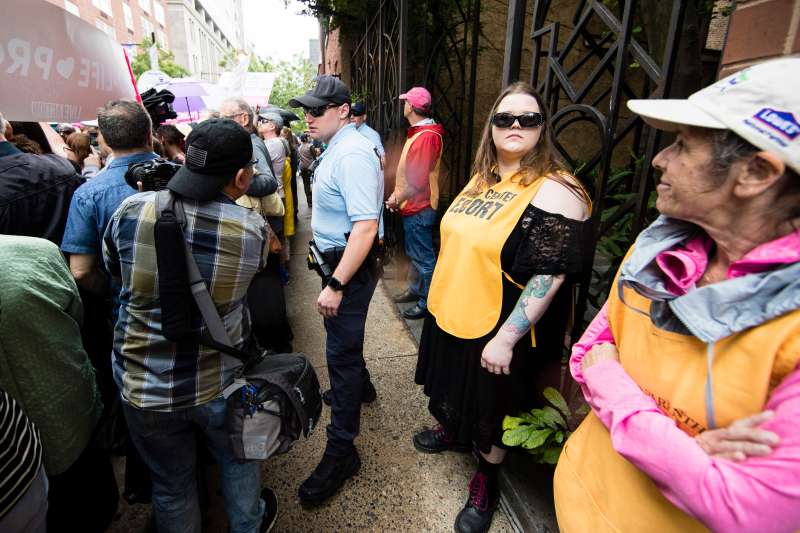
Connie Griffin is a volunteer patient escort at one of Pennsylvania’s Planned Parenthood clinics. She typically arrives at 8 a.m. and wades through the protesters already gathering for their daily routine. She grabs her apron, badge, and key to prepare for patients’ arrival.
“The protestors are fairly consistent,” she said. “There’s usually somebody there before me that is just praying. Then there’s a guy that comes with a big sign who’s really obnoxious, and just screams and shouts things.”
Though abortion is a protected right in Pennsylvania, Griffin said every morning without fail, anti-abortion protesters rally outside Planned Parenthood clinics where women are seeking reproductive care of all kinds. The protestors assume the patients are there for abortions—and some are—and try to convince them to walk away from their appointments.
This is where patient escorts come in. They’re trained volunteers who help patients safely enter and exit the clinic, offering support and a sense of calm.
“When I’m escorting a patient, I let them know that they don’t have to respond to those people, but they can if they want to,” Griffin said. “I just try to give them something else to talk about or focus on and get them inside.”
Planned Parenthood Keystone CEO and President Melissa Reed said escorts act as safeguards for patients.
“They are a physical shield and an emotional shield from what’s going on around them,” Reed said. “They shield them from the protesters that sometimes gather at our clinic sites, from protecting them from getting their pictures taken to talking to them to block out the harassment and vile statements that the protesters are making.”
While patient escorts work diligently to create a warm and welcoming environment for patients, the persistence of the protests can make it difficult. The demonstrations outside of the clinic are not limited to signs or peaceful prayers—they frequently include forms of confrontation.
“They will mob the cars as they turn into the driveway to give them brochures through the car window,” Griffin said.
Patient escorts are not permitted to interact with the protesters in any way. Their goal is to deescalate tension and deliver patients safely to the clinic and their cars.
“Something that I did not witness myself but one of the nurses informed me of was a couple of weeks ago, people came and set up speakers on the side of the fence playing a recording of a baby crying,” Griffin said. “They’ve got their right to be as committed as I am to the other point of view, but the ones that get nasty, I have to bite my tongue and that is the hardest part.”
Griffin detailed that the protests do not affect her motivation for helping patients. She explained that abortion is a big, emotional, and personal decision that should be a private affair.
“It is such a personal decision, that is not mine, not yours, and certainly not some politician’s in Washington,” Griffin said. “They are trying to get care and it’s an emotional day.”
Patients have to face the potential of being filmed and harassed while seeking reproductive care, with few legal protections to prevent it.
“The state of California has a law that prohibits filming people within 100 feet of clinics and recording people without their consent,” Reed said. “Laws like that are vital to protect patient privacy. I would really like to see things like that put into effect here in this state.”
Compounding the problem, the Trump administration has stated they will not uphold the Freedom of Access to Clinic Entrances (FACE) Act, which prohibits the use of force, physical obstruction, threats of force, and property damage to interfere with individuals seeking reproductive care. Reed said it seems to make people opposed to abortion feel more emboldened.
“They know the Trump administration will not prosecute them, and they feel like they have license to harass and target abortion providers and patients.
“Since the fall of Roe v. Wade, we have seen an uptick in the number of protesters outside of our health centers and the virulence of their actions.”
As a patient escort, Griffin believes the state should have the responsibility to prosecute protesters breaking those federal guidelines.
“It’s not enough just to have federal laws. We need Pennsylvania laws that are going to protect Pennsylvanians,” she said.
“I truly don’t want to infringe on their right to protest, just like I don’t want my right to protest smothered,” Griffin said. “But, you know, there’s better ways to do that.”
Protestors or no, Reed said Planned Parenthood Keystone remains committed to ensuring that patients can receive the care they are legally entitled to.
“As long as it’s legal, we’re going to make sure that our patients have safe access and compassionate care,” Reed said.
READ MORE: PA Republicans cut women’s healthcare—but Planned Parenthood is back