When Mike Stantzos opened his pizza shop in York, Crazy Tomato, he thought all he had to do was fire up the neon “open” sign and people would just stream in and life would be great.
He hadn’t realized that the business is highly competitive, with a lot of established mom-and-pop shops and national chains that had their loyal customers.
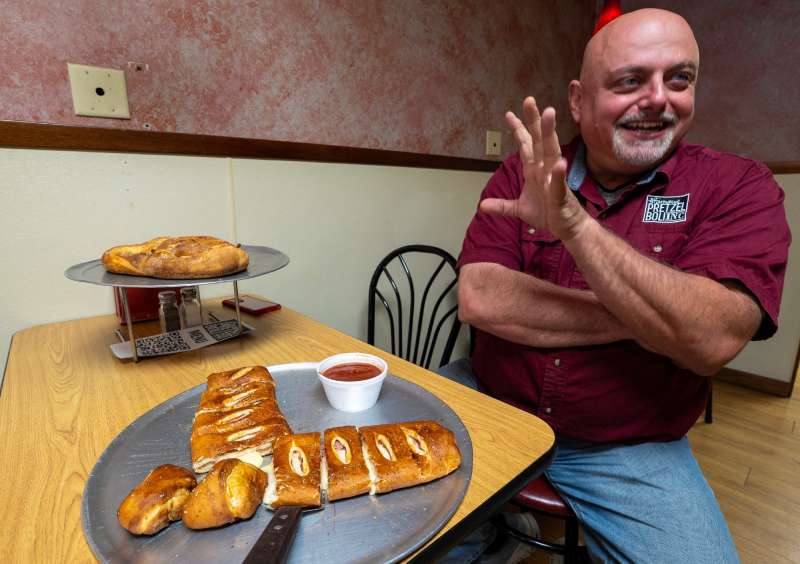
“I needed to do something to set myself apart,” Stantzos, a stocky man with a shaved head who speaks with a lot of enthusiasm, said as he sat at a table in his West York pizzeria. “I needed something different, something that hasn’t been done before.”
He thought: Pretzels.
“I grew up in York. Pretzels were everywhere,” he said. “Why not do something with pretzels?”
He came up with the notion of making a pretzel boli, substituting the pizza dough used to make strombolis with pretzel dough – allying Italian and German specialties, an axis of culinary traditions of countries that, in the past, caused the world a good bit of trouble – to create something new. “America is the only country in the world where you can have this mix of cultures,” he said.
His notion began a four-year obsession. His brother thought he was crazy. He enlisted his friends to serve as guinea pigs for his failed experiments. He went “down the rabbit hole,” he said, trying to perfect the recipe, researching bakery science and getting yelled at by pretzel makers who accepted his calls for help in revealing the secrets of pretzel dough.
Over those years, he said he ate “more pretzels than any other human being on earth, more bad pretzels than anyone on earth.”
Finally, he thought he had it. He asked his cousin Sammy, who owns Astoria Diner in West York, to try it.
“He was blown away,” Stantzos recalled, “and that’s when I knew we had something here.”
‘You can’t fake a pretzel in York’
Since that day, in 2005, Stantzos has been evangelizing for the pretzel boli.
He trademarked the name, eschewing a patent, which would have resulted in disclosure of the recipe that he had toiled over for four years. In addition to selling it at his shop in the 1700 block of West Filbert Street in West York he sells dough and licenses the method for making the bolis to independent pizza shops throughout Pennsylvania and from Connecticut to Florida to Tennessee to Texas and in between.
And he evangelizes for his hometown as the snack food capital of the world, the pretzel boli being among York County’s contributions to the nation’s appetite for salty snacks, citing Martin’s Potato Chips, Utz, Snyders of Hanover, Frito-Lay and others.
It’s in the county’s DNA. He cited York Pretzel Bakery, which was a pioneer in industrial-scale manufacturing of snack foods in the early 1900s. In 1921, the company produced one billion pretzels, enough, as a newspaper noted at the time, that linked together would encircle the planet one and a half times. “We should have a museum here,” he said.
York, with its German heritage, loves pretzels, Stantzos said, consuming twelve times more pretzels than any other county in the country, if not the world.
He knew, from the beginning, that he had to do it right. You can’t fake pretzels in York. “If people in York don’t like your pretzels, you don’t pass muster,” Stantzos said. “You can’t fake a pretzel in York. Who are you going to trick?”
Four years in the making
Here’s the problem Stantzos faced: Pizza dough and pretzel dough are two very different things.
Solving problems and an inventive spirit run in Stantzos’ family. His father, Kostas Stantzos, who died of COVID in June 2020, was a master carpenter and owner of Gus’s Place, a bar in York.
Kostas built the family home based on plans he drew up on the back of a Budweiser poster. “He was a genius,” Stantzos, who emigrated to America with his family when he was 11 months old, said.
Pizza dough is made with high-gluten flour, intended to make it very pliable and stretchable.
That’s what holds it together when the pizza maker pounds it and tosses it into the air to stretch a ball of dough into a circle. Pretzel dough is denser, often with less gluten to hold it together, a more granular dough. It doesn’t stretch like pizza dough.
As he began formulating his plans for a pretzel boli at his first pizza shop, at the entrance to the city on East Philadelphia Street, he didn’t have a clue. (The original Crazy Tomato, which is now a convenience store, was at the corner of East Philadelphia and North Harrison streets.)
He researched pretzels, learning about how they were invented by Italian monks in 612 A.D. and perfected by German bakers. (He points out that pretzels are often displayed upside down, that they were shaped to portray a person in prayer with the apex forming the head, the loops being the bent elbows and the twists being the entwined fingers of the supplicant.)
He conducted some experiments that didn’t turn out well. He contacted flour millers and asked about different kinds of flour. He tried contacting pretzel makers – from small to large – to learn the formula for making pretzel dough. He met a lot of resistance. “I got yelled at. I got cussed out,” he said. “It was like asking for nuclear secrets.”
He studied bakery science, how different flours create different textures and flavors. He tried using different varieties and different blends of flour, different levels of yeast, different amounts of sugar.
It took him two and a half years to develop a pretzel dough that stretched like pizza dough, he said.
“One day, I thought I nailed it,” he said. “It cooked right, but it didn’t taste right.”
He continued to experiment. Every Thursday, he would whip up a batch of the dough and invite his friends to his shop to sample his latest attempt. They were harsh and honest critics. If it was bad, he said, they told him.
He continued to work on it for another year and a half, trying to get the flavor right. In his mind, it should taste like pretzels but not be so overwhelming that it overpowers the ingredients, whether it’s ham and cheese, or cheesesteak, or whatever else he folded into the envelope of dough.
One of his experiments went off the rails, unintentionally. He had mixed up a 50-pound batch of dough and stashed it in the restaurant’s walk-in refrigerator to rise in a black plastic trash bag, figuring on baking it the next day. It was summer, and very hot. An employee of the restaurant thought it was trash and put it out in a trash can. The heat made it rise quickly, and it soon resembled the monster from the movie “The Blob,” taking over and expanding to engulf the front end of a nearby parked car. “I paid to have the car washed,” Stantzos said. “I was surprised we didn’t have the haz-mat team down here.”
While he was working on it, his brother George, who works with him, kept warning him about wasting time on the project. “We used to argue about it,” George Stantzos said. “I thought it was a waste of time.”
Finally, he thought he nailed it, a sentiment confirmed by his cousin Sammy.
“That’s the secret,” he said. “If it makes you go ‘yummy,’ you’ll be back for more.”
He started offering customers free samples when they would stop by to pick up pizzas. The orders started trickling in. As word spread, he said, it became more popular.
And his brother had to admit he was wrong. “We sell more pretzel bolis than pizza now,” he said.
How it’s made
To make a pretzel boli, the dough is stretched into a rectangle, layered with, in this instance, ham and mozzarella and American cheese and folded. After being brushed with a proprietary browning sauce, pretzel salt is sprinkled over the top. The ends, which are mostly dough, are sliced off and placed on the baking sheet to make pretzel knots, served with the boli.
It is then baked in a 525-degree pizza oven until golden brown. When it comes out of the oven, it is brushed with melted butter and served with a cup of a marinara-style sauce.
You can taste the mildly salty pretzel, but it doesn’t overwhelm the filling. It’s not as heavy as you might think.
It’s pretty good.
‘We’ve only just begun’
In December 2005, he applied for a trademark for the pretzel boli.
The trademark means that other businesses cannot market pretzel bolis without Stantzos’ permission. The process is fairly straightforward. According to the U.S. Patent and Trademark Office, the trademark has to be unique and not included in the government’s database of current trademarks. An attorney in the office examines the application and conducts a search for identical trademarks. If the attorney finds none and is satisfied that the application complies with the law, it is granted.
Stantzos’ trademark was granted on the day before Christmas in 2005. He renewed it last year.
Others have tried to replicate it, to no avail, he said. He said he has had competitors rummaging through his dumpster, believing they will find clues on how to make the dough. “People keep trying to make knock-off versions,” he said. “And there are people trying to claim it didn’t come from York. It did, right from 1270 East Philadelphia Street.”
The shops that sell original pretzel bolis are ones that get their dough from Stantzos. The dough – made, using his formula, by Amish bakers in Lancaster County – is distributed by restaurant suppliers, frozen. It keeps up to six months, he said. “Pretzel dough is durable,” Stantzos said. “That was the idea when it was invented in 612.”
He markets the dough and process to independent shops, also offering a deal with DoorDash that makes it easier to use e-commerce to market the product. “I want to help the little guy,” he said. “Independent shops are the backbone of their communities. They’re the ones that support Little League baseball teams and charities and the community.”
He said, “We’ve only just begun. We want to spread it across the country and put York on the map.”