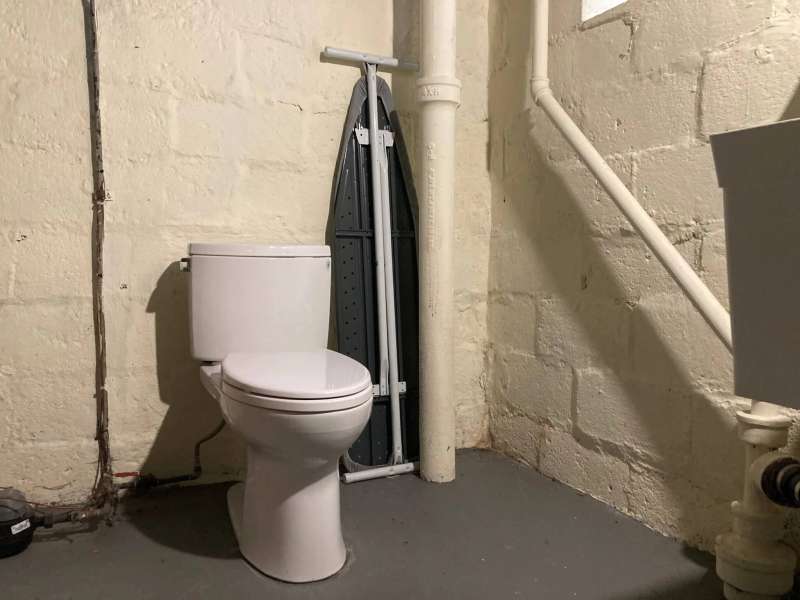
It’s a standalone toilet commonly found in Pittsburgh homes, but why? Here’s a brief history and a few theories.
If you’re searching for housing in Pittsburgh, you might come across a few distinct features of homes built in the area around a century ago. Many have lovely stained-glass or leaded glass windows that remain untouched since they were installed. A lot of the older houses are built in the American foursquare style, a type of budget house built from mail-order parts. And if you’re lucky—well, it’s actually quite probable—your basement will be home to a Pittsburgh potty.
In many Pittsburgh houses built before World War II, there is a toilet in the basement—but there’s not a full bathroom. With no walls surrounding it, the toilet is usually just sitting there against a wall in the middle of the room. It’s a toilet you can likely see as soon as you open the basement door and look down the stairs. A toilet that, like its namesake city, is a little strange.
READ MORE: 8 Pennsylvania Town Names That Will Make You Blush
Most people in Pittsburgh have a good explanation for the existence of the Pittsburgh potty. See, Pittsburgh has industrial roots—it’s well known as a city where hard-working men (and it was usually just men) got jobs at steel mills and blast furnaces to take care of their families. And when they came home to said families, they’d usually be pretty gross, covered in all sorts of gunk and soot. Instead of getting their grime all over the house, these workers could come into the basement through a separate entrance, get cleaned up, change, use the Pittsburgh potty, and then go upstairs to the rest of the house.
This makes a lot of sense, and the explanation makes me sort of proud of my very own Pittsburgh potty standing vigil in the basement. My toilet was installed to benefit the people who made the iron and steel that built the country’s cities and infrastructure.
Unfortunately, that history may not be all that correct. Pittsburgh is such a proud city with a strong cultural identity, it fits that we residents would tell this story to each other.
But a New Jersey architect, William Martin, tells a different tale. In 2017, he told WESA, Pittsburgh’s NPR station, that the usual explanation for the Pittsburgh potty was not quite right. He said that perhaps miners and steelworkers used the toilets before coming up the basement stairs to their families, but the real reason these toilets were installed was to help warn of a sewer backup and make the resulting cleanup easier.
As Martin explained, if there were a sewage backup, it would affect the lowest fixture in the house. If there were not a toilet in the basement, you could have an overflow in your second-floor bathroom, which would then drip down into your first floor. (Gross.) Or, if you had a basement toilet, it would overflow in the basement, with its concrete floor, and be less of a mess. These basement toilets were never even intended to be used — they’re simply there to alert of the sewage backup and contain it.
This is an extremely unromantic explanation.
Not only that, but Martin also told WESA that our weird basement toilets “are not unique to Pittsburgh,” and they’re found all over New England, northern New Jersey, Philadelphia, and in the suburbs of New York City. That’s a little puzzling, considering that ever so often someone posts a photo of a Pittsburgh potty on social media and hundreds of people respond to register their shock and delight at learning about our Steel City commodes. They do not usually share a photo of their New Jersey johns.
Pittsburgh real estate agent Stephen Cummings added to this explanation of the basement potty’s origins, published in a different WESA article. He told WESA, which has done a real public service covering the Pittsburgh Potty beat, that he thought the toilets could have been remnants of basements used as living quarters for servants of wealthier families. That, of course, is just a theory—one I’m inclined to doubt partly because a lot of older Pittsburgh homes were built as budget houses. The truth is that though these toilets exist in homes built just 100 years ago, no toilet historian has stepped forward to share evidence of the real, conclusive history behind the Pittsburgh potty.
It will never fail to amaze me how much information must have been common knowledge decades ago but is now knowledge that we have just completely lost. Will we ever know the truth about the Pittsburgh potty?
Maybe it’s actually best that we don’t know the truth. I much prefer sharing the story of the toilet in my basement as connected to the city’s industrial history — the reason Pittsburgh first prospered. My basement toilet: a potty for the people.
READ MORE: Do You Speak Pittsburghese? A Glossary of Unique Words and Phrases Used in Western PA