It’s that time of year when the temperatures are dropping, the leaves are falling, and political attack ads are running more frequently than those Liberty Biberty commercials.
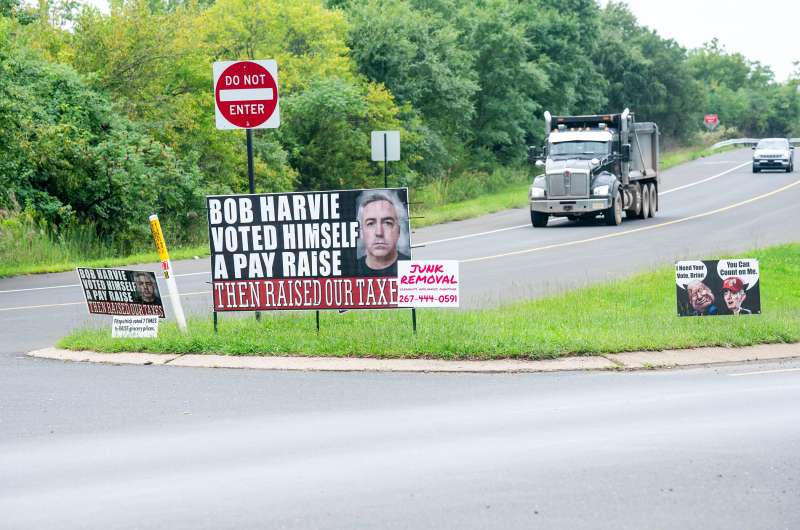
The last lap of each presidential and midterm election cycle features one 30-second spot after another where Republicans and Democrats are hurling accusations at one another.
Republican US Rep. Scott Perry took things to another level on Oct. 19 when his campaign released an attack ad seizing upon an unsubstantiated allegation of public nudity against his Democratic opponent in the Central Pennsylvania congressional race, former television news anchor Janelle Stelson.
According to PennLive.com, the accusation is uncorroborated. It relies on an alleged nude photo of Stelson in the backyard of her East Pennsboro home that Perry’s campaign does not have—and which the neighbor who claims to have taken it won’t share.
Ho-hum. Just another 30-second spot in the last lap of a hotly contested congressional race, aimed at showing voters… what now, exactly?
With campaign ads pretty much running on a loop until Election Day (Nov. 3), we asked Keystone newsletter readers: Are political ads actually influencing how you think about candidates?
Here’s what they had to say (answers have been edited for length and clarity):
“No, I do my research on the candidates as everyone should. I vote for who I think best reflects my ideals. The problem is that most people never question the candidates and just vote as their parents voted, Democrat or Republican. Most of them are actually voting against themselves and then are surprised when the candidates do not do what they think they should.” — Karen B., Luzerne County
“No. They all lie. For every attack ad there should be a fact check ad.” — Dave Kline, Luzerne County
“I don’t believe any of the political ads. I think they are all lies and they aggravate me more than help me decide.” — Lee, Chester County
“I’ve never much been influenced by political ads. I pay attention to what the elected officials that are in office are doing. By the time it’s Election Day, I already know who I want or don’t want to vote for. Ads are often misleading. However, if I do hear something that sounds interesting or worth consideration, I check to find out if it is, in fact, true. I check various online news and other sources to look for articles of what candidates’ qualifications are and what political actions/activities they may have participated in. But truly since the Republican party took over the 2009 absurd tea party movement, they have walked off the cliff of morality and abiding by our laws and taken half the country with them. I vote against them every chance I get.” — S. Sewell, Washington County
“The negativity is disgusting and makes me think less of the candidates. It is truly a case of lesser evil and there is little information about how they would actually work to represent us.” — Ginny Anton, South Whitehall
“I do my homework and vote for the candidate most likely to represent me and serve all Pennsylvanians with honesty and integrity. But when I see hate-filled ads, filled with half truths and outright lies, very often generated by A.I., I simply will not vote for the candidate these ads support. Period.” — Linda B., Erie
“There is nothing any ad can say that would make me vote for anyone who hasn’t condemned Donald Trump and the incompetent, unqualified, dangerous frauds and thieves around him, who are lining their pockets while we struggle.” — Joe Gee, Chester
“No, they are awful, a huge waste of resources and time. One of the biggest reasons why money and PAC’s need to be banned from elections in this country. Those funds could be used in actual beneficial ways such as supporting healthcare, housing for the un-homed, feeding the hungry, and education at every level. Just another of the many examples of the waste and callousness of the wealthy in the US.” — Mark P. Bogunovich, Allentown
“Positive, informative political ads may influence me slightly towards that candidate, or at least motivate me to find out more about them. But even some of them are weak on real information and are of limited value and oftentimes you can see right through them. Negative ads, attack ads in particular, will absolutely turn me against that candidate. They all have the same approach: ‘Our opposing candidate is very bad, will raise your taxes, subject your first born to forced labor, teach communism in our public schools, etc. etc. etc… ‘But, our candidate is good, very, very good… will lower your taxes substantially, provide free ice cream for your children, teach all American values in our schools… etc, etc, etc. Recent examples from the national political scene show just how low negative attack ads will go without shame or remorse no matter how well they are shown not to be based on facts and information. If you need to lie that horribly to try to gain political office, then you do not have the moral or ethical standards to be in office representing anyone. And no, this is not just a game, this shows just who you are.” — Dave Faunce, Chester Springs
“Ads that denigrate opponents turn me off. Tell me what you would like to achieve, don’t tell me lies.” — Pat Foley, Huntingdon Valley
“Containing so many ridiculous claims, half-truths, and outright falsehoods, political ads are nothing more than brain rot. They do not have any effect on my views about a candidate.” — Steve Rowland, Erie
“I have reached a point where I place little to no trust in the messaging of any politician or political party in the US. While I find the current administration and Congress to be particularly unreliable, this issue is widespread across the political spectrum. Consequently, political advertisements fail to capture my attention, as I prefer not to expend the time and energy required to parse their messaging for small kernels of truth. When deciding how to cast my vote, I rely instead on verified, objective metrics. I compare a candidate’s public statements directly against their voting record. Furthermore, I evaluate the actual time and effort the candidate devotes to fulfilling the duties of their elected office, and I weigh these factors carefully against their opposition.” — Edward Anderson, Hanover
“Political ads have taken the meaning of mudslinging to new heights (or maybe lows). Everything needs to be fact checked because of misrepresentation. As I research I find my opinions of some candidates can change. But I still think the money spent on all these ads could be put to better use for constituents and their communities.” — Ann Benasutti, Archbald