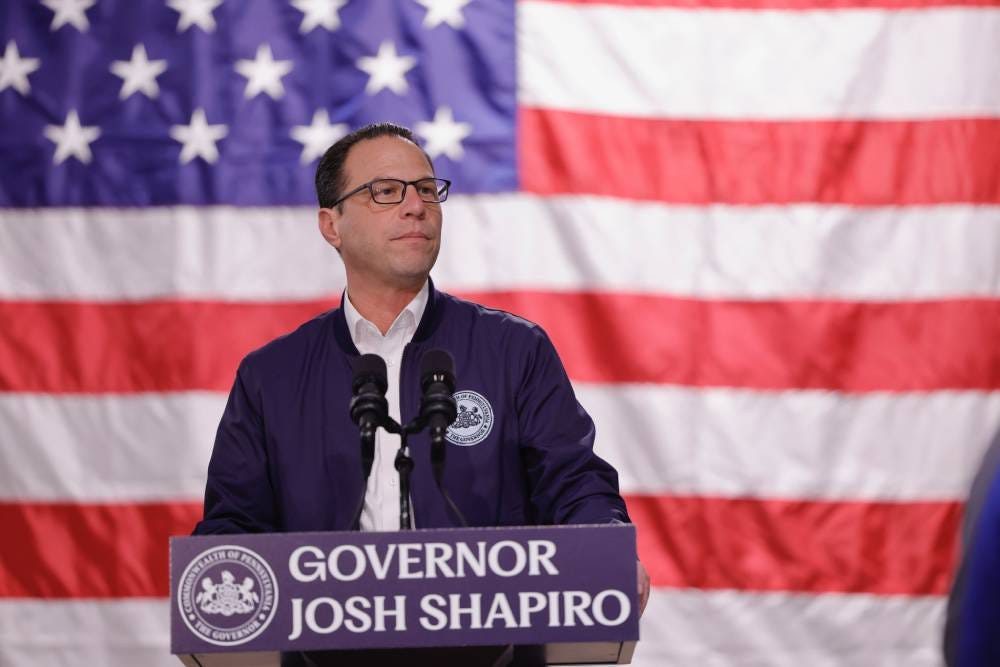
Gov. Josh Shapiro on Oct. 31 announces new state-led efforts to provide $5 million in funding to Pennsylvania's food banks and the 2 million Pennsylvanians who rely on the Supplemental Nutrition Assistance Program. (Photo: USA Today Network)
Pennsylvania has been an outlier, missing goals to reduce agricultural runoff in Susquehanna River and tributaries.
Gov. Josh Shapiro touted Pennsylvania’s achievements in reducing pollution, restoring streams and improving farming practices, as he was elected Tuesday to lead the multi-state program restoring the waters and ecology of the Chesapeake Bay.
Taking over from Maryland Gov. Wes Moore, Shapiro will serve as chairperson of the Chesapeake Bay Executive Council, which sets goals and strategies for the state and federal governments to repair the damage caused by decades of pollution.
“We are impatient. We want this to be the era of ‘yes’ and ‘now,’ and we want to be inclusive, to show that we are going to protect all those involved in our society,” Moore said, noting the council voted to develop formal channels for tribal nations to participate, among other revisions to its goals. “I’m thrilled to have somebody who exudes that and shows what that looks like in our next chair in Governor Josh Shapiro.”
The group, established in 1983, includes the governors of Delaware, Maryland, New York, Pennsylvania, Virginia and West Virginia, the six states in the bay’s 64,000 square mile watershed; the mayor of Washington, D.C.; and the administrator of the U.S. Environmental Protection Agency.
Shapiro, who was elected unanimously at the council’s annual meeting, noted the University of Maryland Center for Environmental Science gave the upper bay the second best grade in its 2025 Chesapeake Bay and Watershed Report Card. That’s the portion most affected by Pennsylvania.
Pennsylvania, historically, has failed to meet the commission’s goals. The commonwealth, and to a lesser extent, West Virginia are outliers with decades of shortfalls in reducing agricultural runoff. Experts say prior agreements have failed despite binding limits on nitrogen, phosphorus and sediment, which are released as a result of fertilizer use and erosion, because of the U.S. Environmental Protection Agency’s reluctance to penalize Pennsylvania and other states that fall short of goals.
The Susquehanna River, which supplies about half of the bay’s fresh water and is the bay’s largest tributary, flows through Pennsylvania and receives water from dozens of tributaries in the commonwealth. It empties into the north end of the bay near Havre de Grace, Maryland.
Shapiro credited Pennsylvania’s Agriculture Secretary Russell Redding, Environmental Protection Secretary Jess Shirley, Conservation and Natural Resources Secretary Cindy Dunn and Deputy Chief of Staff Sam Robinson, who oversees environmental policy, with carrying on the work started under former Gov. Tom Wolf.
“We have made progress, largely under their leadership, by giving local communities the tools and the funding to improve their local watersheds, plant forested stream buffers and to restore wetlands,” Shapiro said. “And we did it by working with landowners and with farmers, because when our waterways are healthy, they have more opportunity.”
Shapiro said Pennsylvania has reduced its run off of nitrogen, a component of fertilizer that is a major pollutant, ten fold compared to the previous decade. The state has also planted nearly 1,000 miles of forest buffers along streams and restored 139 miles of stream.
He also said the partnership with the other Chesapeake Bay states, the federal government and non-governmental organizations such as the Indigenous Conservation Council allowed Pennsylvania to achieve its progress.
“Now more than ever, there is an importance to multi state alliances, an importance to states working together to solve the big problems that we are facing in this nation,” Shapiro said. “And I think more than ever, states need to rally together to continue to make progress on the things that matter most.”
As chair, Shapiro said he would work to continue and accelerate collaboration between the states and organizations to put the revised Chesapeake Bay agreement into practice and create a sustainable and streamlined program.
“We live by three letters in Pennsylvania. We focus on GSD, since this is a high brow crowd, I’ll just say that stands for ‘get stuff done,’” Shapiro said. “That is our motto, and that is our mantra, and that is the way I intend to lead this organization forward.”
Author


A light from above: How one Pennsylvania church put its faith in solar energy
In a town known more for Bucknell University and its rustic charm than clean energy innovation, St. Andrew’s is leading a quiet but significant...

Villanova study reveals the hidden dangers of using road salt
Villanova's Dr. Steven Goldsmith reveals road salt's extensive environmental impacts, stressing the need for alternatives to mitigate harm. As...
Pennsylvania is going through an energy boom, thanks to the Inflation Reduction Act
Pennsylvania has received over $1.08 billion in clean energy investments made possible by the Biden-Harris administration’s Inflation Reduction Act....

Electric vehicles more popular than ever in Pennsylvania thanks to Biden/Harris’ Inflation Reduction Act
Electric vehicle ownership is continuing to grow in Pennsylvania due to the Biden-Harris administration’s Inflation Reduction Act. Residents are...
Biden’s Inflation Reduction Act helped boost two PA Dairy farmers’ yogurt business. Now its funding is at risk.
The Inflation Reduction Act helped two Northern Pennsylvania sisters expand their dairy farm and Icelandic yogurt business through the Farm Bill....