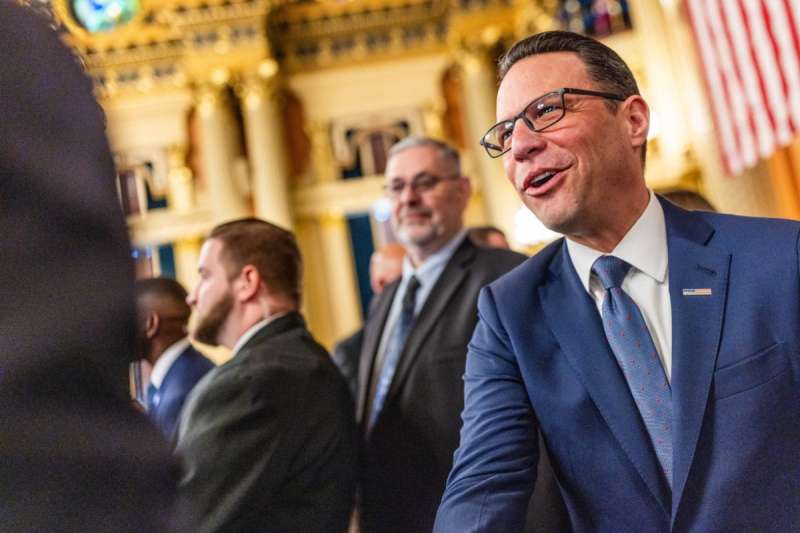
Gov. Josh Shapiro introduced his fourth budget in Harrisburg on Tuesday.
Gov. Josh Shapiro delivered a budget address in front of the Pennsylvania General Assembly earlier this week, where he laid out his vision for the 2026-27 fiscal year.
This presentation can be seen as a continuation of Shapiro’s previous budget, which was signed into law late last year.
“ We remember what we’ve been able to accomplish together, and we recognize what our governor laid out here in Harrisburg, on the floor of the Pennsylvania House in joint session, that we’ve got our sleeves rolled up and we’ve got more work to do,” Pennsylvania House Speaker Joanna McClinton said following Shapiro’s budget presentation.
She added, “ while we’ve been able to accomplish a few different things, we know that there are still things left on the to-do list. We still have to finally raise the minimum wage. We still got to make sure that this budget invests and fully funds our transits all across the Commonwealth of Pennsylvania.”
Here’s a run down of Shapiro’s fourth budget address.
Dusting off the greatest hits
Shapiro once again called upon the Pennsylvania House and Senate to raise the minimum wage to $15 per hour, legalize adult-use cannabis for residents over the age of 21, and regulate skilled games, which are the slot machine-like games and gaming terminals proliferating in gas stations, convenience stores, and gaming halls across the commonwealth.
Democrats in the Pennsylvania House passed legislation addressing these issues over the previous year, but all attempts were thwarted in the Republican-controlled Pennsylvania Senate.
Even though there are no new taxes in the budget, Shapiro is hoping to raise $2 billion in revenue in order to cover the projected $53.2 billion budget proposal.
Continuing to invest in Education
Education advocates praised Shapiro’s proposed budget as it continues to close the funding gap between poorer and wealthier school districts with an additional $565 million in adequacy funding, which is the money school districts need to close funding gap.
The budget also includes $50 million in basic education funding, an additional $5 million for the Pennsylvania Student Teacher Support Program, which offers stipends to college students going through the student teaching program and looking to teach in the commonwealth, $125 million to clean toxic school buildings, and another $125 million for the Solar for Schools program.
“Governor Shapiro’s proposed budget is more than a spending plan; it is a vision for what Pennsylvanians should aspire to achieve,” Arthur Steinberg, President of the Philadelphia Federation of Teachers, said in a statement.
“This budget deepens investments in long-underfunded schools, frees districts from wasteful cyber charter obligations, empowers administrators to enact smart phone bans to enhance learning, and grows the child care and educator workforce – without raising taxes on working people.”
Responding to federal cuts
Shapiro’s budget includes $100 million to create a Federal Response Fund to protect Pennsylvania residents from President Donald Trump’s administration and its efforts to withhold congressionally approved funds.
“Pennsylvanians pay $158 billion in federal taxes every year — and we expect to get something for that money,” Shapiro said during his address.
“And the federal government hasn’t just tried to unlawfully withhold funding for public safety — they’ve also tried to do that with dollars for plugging abandoned wells, providing health care for rural communities, improving school infrastructure, and even providing food benefits through SNAP. They’re breaking the compact they made with the people of Pennsylvania.”
Regulating Data Centers
During his speech, Shapiro tried to ease concerns Pennsylvanians have about the expansion of data centers throughout the commonwealth. He unveiled a four-point plan to regulate data center growth through the Governor’s Responsible Infrastructure Development (GRID) standards.
According to the governor, developments must come with their own power generation or pay for new generation to keep utility costs down for businesses and homeowners. Developers need to commit to transparency and community engagement, train a local workforce, and commit to environmental protection and water conservation.
“If companies adhere to these principles, they will unlock benefits from the Commonwealth, including speed and certainty in permitting and available tax credits,” Shapiro said. “I know everyone in this room wants to see our economy grow and create more jobs and more opportunity.”
Now that Shapiro presented his budget, members of the Pennsylvania House and Senate Appropriations Committees will return to Harrisburg at the end of the month and hold three weeks of hearings with administration officials, probing every aspect of the budget, which is due on June 30th.