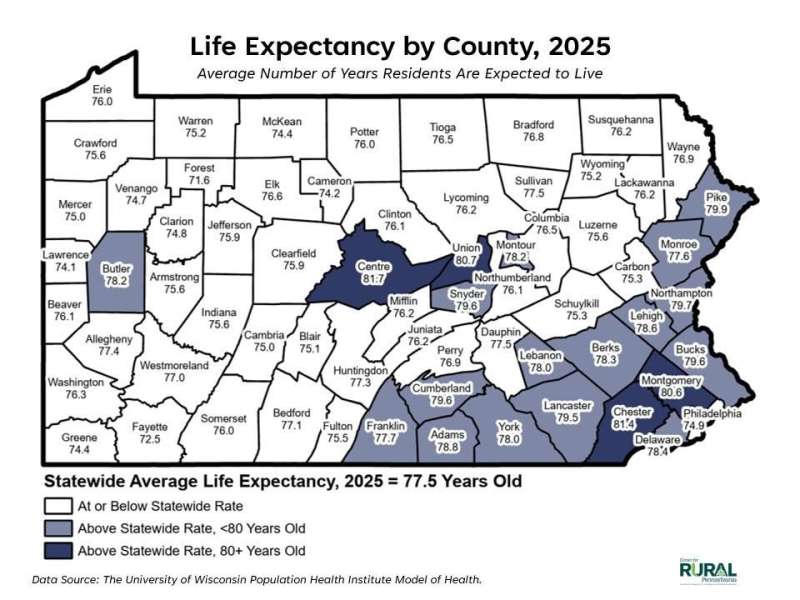
The average Pennsylvanian lives to about 77½, but typical lifespans tend to be years longer or shorter than that in certain parts of the commonwealth.
Centre County tops the list with a life expectancy of 81.7 years, according to an analysis released by the Center for Rural Pennsylvania in July 2026.
But across most of the commonwealth, particularly in many rural communities, the average lifespan is much shorter — and the center says policymakers should pay attention to these statistics.
“These differences can reflect many factors, including access to health care, economic conditions, health behaviors, and the social determinants of health,” the center posted on its Facebook page.
Where are Pennsylvania lifespans shortest?
Life expectancies are shorter in the western and northern parts of the state, according to the center’s data. Philadelphia is also below average, at 74.9 years.
At the bottom of the list are Fayette and Forest counties, with average lifespans of 72.5 and 71.6 years respectively.
Where are Pennsylvania lifespans longest?
Outside of Philadelphia, southeastern Pennsylvania’s residents are living relatively long compared to the rest of the state. A few counties in the Poconos and central Pennsylvania are also beating the averages, according to the rural center.
Chester (81.4 years) and Centre (81.7 years) counties have the highest average lifespans.
Health factors in these counties
Though many factors affect a person’s lifespan, the community where they live can make a difference, experts say.
Places that offer secure employment, high-quality medical care and healthy food can help people live longer, according to the University of Wisconsin Population Health Institute. Conversely, areas with higher levels of pollution, lack of healthcare access and unstable housing can take a toll on residents’ lifespans.
Chester and Centre counties rank high among Pennsylvania communities with strong health outcomes in a list produced through a collaboration between the university and the Robert Wood Johnson Foundation.
The foundation also placed the two counties high on a ranking based on social determinants of health, including access to clinical care, education, employment, housing options and access to clean air and water, as well as lifestyle factors like alcohol and tobacco use, activity levels and diet.
Fayette and Forest counties appear near the bottom of the list for these health determinants.