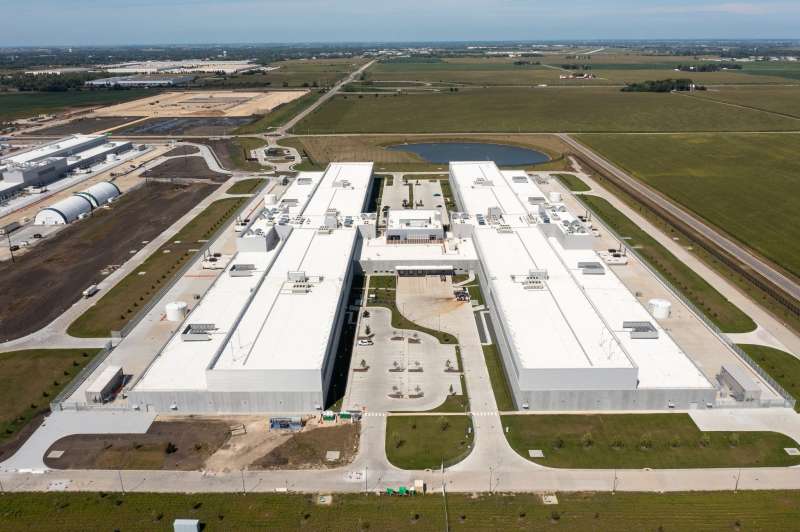
The Franklin County commissioners voted unanimously May 20 to adopt an ordinance to help municipalities regulate data centers that companies might seek to develop in the area.
The amendment to the county’s subdivision and land develop ordinances, or SALDO, has been a long time coming. It was late January when Commissioner Chairman Dean Horst first asked county staff to look into the issue, and there have since been multiple discussions and two public hearings.
The data center ordinance is not typical legislation for the county. In Pennsylvania, municipalities have authority over land use and zoning. About half of communities in the county — all are in the west half and represent about 20% of the population — do not have zoning to limit where different types of developments can build, leaving them vulnerable to a tech company coming in, buying up land and building a sprawling data center with heavy needs for power and water.
Commissioner John Flannery said that even though he believes zoning should remain a municipal-level decision, it was important for the commissioners to step out of their lane for the data center ordinance. While no data centers have been proposed in Franklin County yet, datacenters.com shows there are approximately 65 data center campuses in Pennsylvania, a number of which are in Central Pennsylvania.
“If we do not pass this ordinance this evening … we face the potential of tomorrow one of these data centers could plop down on one of these municipalities,” he said. “So, I’m very appreciative of the fact that, thank God, we’re getting something in place now.”
The ordinance is not the law of the land just because the county commissioners approved it; it is up to municipalities to adopt it or a version of it.
All three commissioners, Horst, Flannery and Bob Ziobrowski, acknowledged that the document is not perfect, but there is no reason why towns can’t make their own changes or the county can’t amend it in the future.
Horst directed county staff to watch out for news affecting the data center industry and keep the commissioners apprised of information that could improve the ordinance.
“I think this is starting in the right direction. We have to have something on the books,” Horst said.
As part of two public hearings held in April, about 150 people shared comments in writing or in person about their concerns on how data centers would impact the local water supply, power grid, environment, landscape, noise, health and more. While the ordinance addresses those issues and more, some people pushed for more limits.
The county amended the ordinance early in the process to remove a rule requiring data centers to generate solar power equal to 25% of the power they use. Flannery and Horst approved the revision over concerns about how much land would need to become a solar farm to generate the amount of power needed.