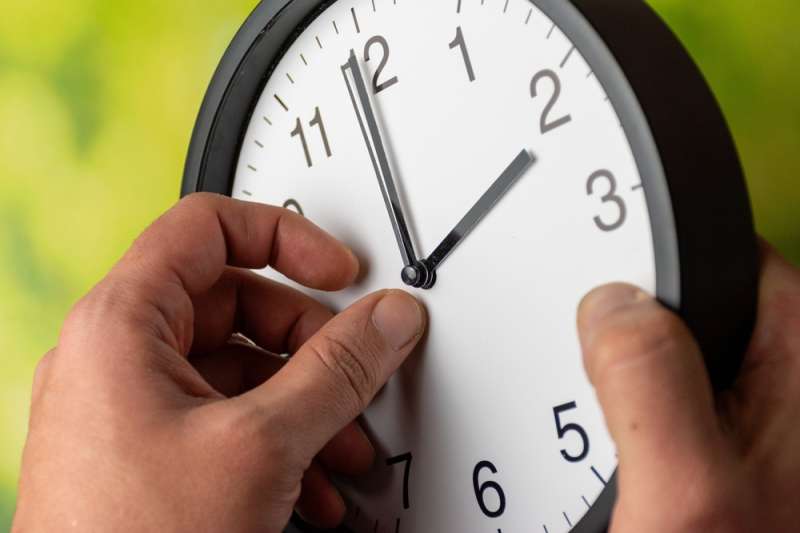
Tired of changing your clocks twice a year? A new House bill would end daylight saving time and keep the country on permanent standard time.
H.R. 9638, dubbed the “Sunshine for Our Kids Act of 2026,” introduced July 9 by Democratic Pennsylvania Rep. Mary Gay Scanlon and Republican North Carolina Rep. Pat Harrigan, would end the automatic time change that happens every spring and fall.
Permanent standard time would mean earlier sunrises and sunsets, which some argue increases safety in the mornings for schoolchildren and commuters and is more in line with our biological circadian rhythms. The American Academy of Sleep Medicine, the American Medical Association and the National Sleep Foundation have all urged for a change to yearround standard time.
“For decades, scientists and medical professionals have highlighted the detrimental mental and physical health impacts of twice-a-year clock changes, particularly on children and teens,” Scanlon said in a release. “The Sunshine for Our Kids Act will not only help children and teens during the most important years for mental and physical development, but will also promote public health and safety in our communities.”
The bipartisan bill would repeal the section of the Uniform Time Act, also known as the Calder Act, that makes daylight saving time the default practice. States that wished to keep daylight saving time would still be able to, but would have to pass their own laws to do it.
“It’s hard to find anyone who enjoys changing the clocks twice a year, yet Americans have been stuck with the same outdated policy for decades,” Harrigan said. “The Sunshine for Our Kids Act replaces that one-size-fits-all mandate with a smarter approach by making standard time the default while allowing states to decide what works best for their own communities.”
Most polls show a majority of Americans want to end the practice of changing time, but opinions differ on which one to stick with.
What’s the difference between daylight saving time and standard time?
Since 1966, most Americans have changed their clocks twice a year to align our man-made schedules to the longer summer daylight hours and shorter nights. Under daylight saving time, we see later sunrises and sunsets, which means more time for outdoor activities after work or in the evenings, and more light for evening traffic.
It also means potentially darker mornings for commuters and schoolchildren as daylight hours begin to shrink again.
Many business and tourism interests have lobbied to keep daylight saving time permanent to maximize shopping and recreation hours.
Florida legislators have tried to end time change for years
The charge to end daylight saving time changes has been led by Florida politicians, but in the other direction. Their bills sought to make daylight saving time, the change made from spring to fall, the permanent one.
In 2018, Florida became the first state to pass legislation “locking the clock” to stick with daylight saving time yearround, but it requires an act of Congress before it can go into effect. Annual bills to do that since have failed to move.
Florida (or any state) could simply decide to stick to standard time all year without anyone else’s approval, but so far lawmakers and lobbyists in the Sunshine State have pushed for permanent DST (although one Florida lawmaker wants to split the difference).
When does daylight saving time end in 2026?
Daylight saving time, by federal mandate, begins on the second Sunday in March and ends the first Sunday in November.
This year, daylight saving time started on Sunday, March 8, at 2 a.m. local time. It will end on Sunday, Nov. 1, at 2 a.m. local time, when clocks will be moved back one hour.
Has the United States ever tried yearround daylight saving time?
Yes, in 1974, under President Richard Nixon, during the fuel crisis. It didn’t last long.
By the end of January, eight Florida schoolchildren had been killed in accidents compared to two in the same time period the year before, among multiple accidents reported around the country. According to The New York Times, a spokesman for Florida’s education department said that “six of the deaths were clearly attributable to the fact that children were going off to school in darkness.”
Responding to the deaths and many angry parents, then-Gov. Reubin Askew called a special session of the Florida Legislature to consider a return to standard time, the Times reported. Then-Senator Lawton Chiles, later Florida’s governor, joined in the call to repeal the two-year measure right away.
Less than half a year into the change, Congress voted to repeal permanent daylight saving time.