Twenty-four years.
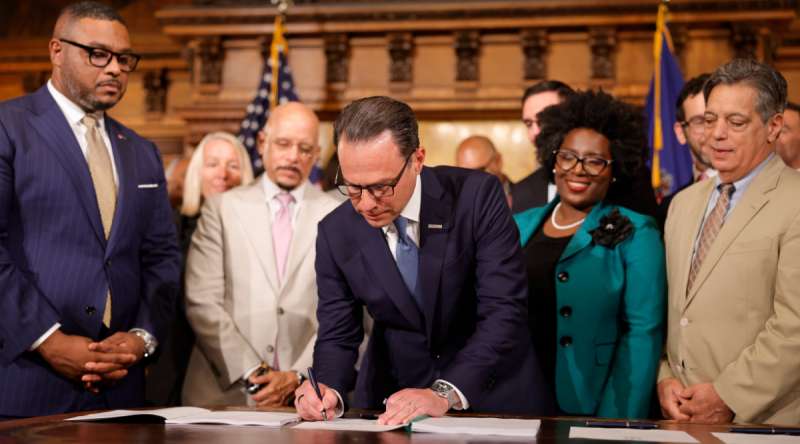
That’s how long retired public-sector employees who left the state workforce prior to the 2001 Act 9 pension overhaul have been living without a cost of living adjustment (COLA), but that changed after Gov. Josh Shapiro signed the 2026-27 state budget into law.
“ I got to tell you, this is a problem I heard about when I was knocking on doors running for state rep in 2004 back in Abington,” Shapiro said at a press conference Sunday celebrating the passage of the budget.
“ This is the year when we finally came together to give them a cost of living adjustment for the first time in over two decades. This is real money back in people’s pockets.”
Pennsylvania lawmakers returned to Harrisburg on Friday to hash out the remaining details of the budget, which was due at the end of June, and with its completion, retirees can expect an additional $75 to $300 per month based on how long they’ve been retired, according to the Pennsylvania Capital-Star.
Roughly 54,000 retirees—most of whom are in their 80s and 90s—have not received pension increases since 2002 and have been surviving on under $20,000 a year since then.
In 2001, the Pennsylvania General Assembly passed Act 9, which increased pensions for active educators, support professionals, and state employees by 25%. However, the law did not include those who retired before its passage.
Before Act 9, Pennsylvania lawmakers approved COLA increases for retirees every four to five years.
“We are grateful for the bipartisan work of the members of the General Assembly who worked tirelessly to ensure that our pre-Act 9 retirees weren’t forgotten—again,” Aaron Chapin, president of the Pennsylvania State Education Association, said in a statement.
According to the Bureau of Labor Statistics, inflation has increased by 85%, the cost of food has increased by 97%, and the cost of medical care has increased by 111% since 2001.
“For too long, these dedicated Pennsylvanians, many now in their 80s and 90s, have struggled to make ends meet amid the skyrocketing costs of housing, gas, groceries, and medicine. Now, after decades of waiting, they will finally receive the modest increases they deserve,” Chapin added