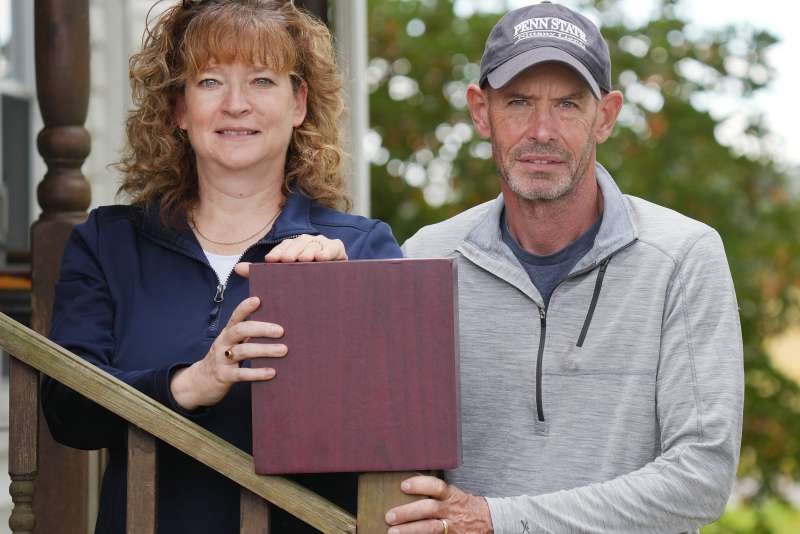
The seeds of a new business were sown during a marathon card-playing weekend at John and Amy Bridger’s Crawford County farm.
At one point, the discussion turned to the cremated remains that they held in storage, waiting to be scattered.
“When you have a family farm, you have a responsibility,” Amy Bridger said. “You have all these different requests and you try to make sure everyone is taken care of.”
That topic led the couple to ask a question: Were other people out there looking for a suitable place to scatter ashes?
Amy Bridger, assistant dean for innovation and corporate strategy at Penn State Behrend, saw an opportunity for her and her husband, who raise beef cattle, horses, dogs and two teenagers on their 185-acre farm.
The Bridgers, whose family has been farming for four generations, launched Farmstead Scattering Garden LLC in 2024.
The venture is still in its fledgling stages, but it’s gaining traction. So far, they have spread the cremated remains of people and pets for customers from 19 states.
The Bridgers see plenty of room for growth. Today, just 150 years after the nation’s first crematorium was built, more than 63% of all bodies are cremated, according to the National Funeral Directors Association.
Amy Bridger said statistics show 21 million people have ashes in their homes.
“A lot of people don’t know what to do with them,” she said. “There’s a pretty solid need.”
How the process works
Customers, who pay $200 for the basic service, ship ashes to the farm, where they are spread in a location of their choice. Options include wooded areas, ferns, cattle or horse pastures and hayfields.
Farmstead Scattering Garden doesn’t offer the option for people to be on hand while the ashes of their pet or loved one are spread.
It’s a hard-and-fast rule.
“We are a working farm,” she said. “From a safety perspective, my husband’s worst nightmare is to come around the corner on a tractor and see someone randomly standing there. If someone got in with the cattle, it could go wrong.”
In short, she said, they don’t want to disappoint a customer who arrives to have the moment interrupted by a cow giving birth or hay that needs to be baled.
Ashes are typically scattered within seven days of receipt. John Bridger said he and his wife always travel together, often driving an all-terrain vehicle to remote locations on their land.
The process relies on a certain amount of trust. Who would know, after all, whether the ashes weren’t handled respectfully?
“We would know,” Amy Bridger said. “It matters to us and I think people can sense that through the phone.”
The couple try to pick a nice day. Some families have something different in mind, asking that ashes be scattered in the rain or during a snowfall.
Some of those requests will raise the price, but even then there are limits. The Bridgers are happy to scatter ashes from a horse or in the rain, as some customers have requested. They would prefer, however, not to spread ashes from horseback during a thunderstorm.
“That wouldn’t be safe,” Amy Bridger said.
Whatever the client requests, the Bridgers aim to be respectful.
“We tend to talk about the person or the animal we are scattering,” Amy Bridger said. “I will say they loved to fish or really liked to read books. I will tell a little bit about the person. It becomes our own tradition of welcoming them to the farm.”
Clients can put their own touches on the committal.
“We are agnostic in terms of anything you want us to read from different religions,” she said. “We can play music,” John Bridger added.
The moment is documented with photos. Customers are also provided with a map that marks the spot where the remains of their pet or loved one were spread.
John Bridger said he takes the process seriously.
“I wouldn’t want a family or friend being sent somewhere and people just tossed them out.”
Small farms diversify as their numbers decline
The number of U.S. farms has been falling steadily since it peaked at 6.8 million in 1935, falling recently to 1.86 million, according to the USDA National Agricultural Statistics Service.
That decline has continued locally. The USDA reports Erie County lost 231 farms between 2002 and 2022.
Some of the farms that remain have worked to reinvent themselves by establishing farm markets or selling meat or other goods direct to consumers.
Others have followed a less conventional route by transforming their farms into concert, entertainment and wedding venues. Others have ventured into the world of goat yoga, and cow cuddling, Amy Bridger said.
“There are a whole bunch of ways to diversify farming,” she said. “This just happened to be our way.”
At least for now, however, very few U.S. farms are offering ash-scattering services.
Plenty of places, including many state parks, allow ashes to be scattered with permission. Ashes can also be spread in the ocean as long as they are spread at least three nautical miles from the nearest shoreline.
But the Bridgers say they are aware of only one other private landowner that offers a service like theirs.
She is hoping their family farm will offer clients a sense of permanence, allowing them to track online photos of the changing seasons at their loved one’s resting place.
They explain their thinking on the farm’s website:
“The farm is home to more than just crops—it’s a haven for animals and a testament to generations of agricultural dedication. We honor the past by caring for our land, animals, and the memories families entrust to us.”
The Bridgers are clear on one point. Their land is a farm and they want it to remain that way.
To Amy Bridger’s thinking, the two ventures complement one another.
“On a farm, you are very much in the cycle of life,” she said. “If you have 60 cows and four horses and however many dogs and cats, something is always being born and something is always dying. It makes for a nice dovetail that people might not always see.”