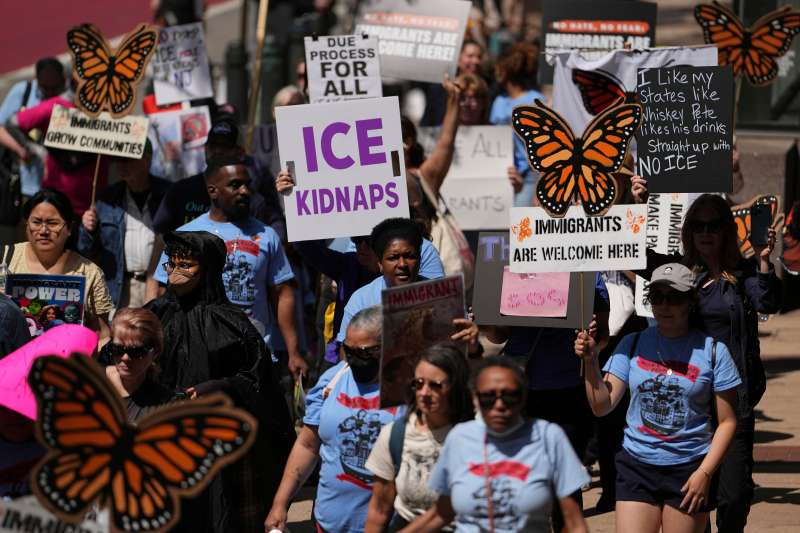
The basketball courts in Hazleton are mostly empty now. The young men who used to meet up for pickup basketball games at community centers and neighborhood courts in Hazleton don’t show up anymore. Regardless of status, the increase in mass deportations in the area has them too afraid to leave home, said Luz Zapata, a field coordinator in Luzerne County for Make the Road Pennsylvania, a community organization of Latino, immigrant, and Black working-class members in Hazleton, Allentown, Reading, and Philadelphia.
“They are terrified because they know that having a paper is no longer safe, because people who have had documentation have been kidnapped before,” she said.
Zapata works in Hazleton, home to one of Pennsylvania’s largest Dominican communities. She said fear now shapes nearly every part of daily life for immigrant families there, from going to work to seeing a doctor to taking kids to school. And taxpayers across Northeastern Pennsylvania are helping pay for the federal enforcement push behind it.
Taxpayers in nine NEPA counties are covering about $524 million of federal spending on mass deportations, according to the Economic Policy Institute’s new Cost of Deportations Calculator. Over the rest of President Donald Trump’s term, that same money could instead cover Medicaid for roughly 16,500 people or food benefits for about 238,000 people under the Supplemental Nutrition Assistance Program (SNAP).
Luzerne County carries the largest share in the region at about $143 million, or $1,316 per taxpayer. That alone could cover Medicaid for 4,497 people, SNAP for 64,865 people, or the salaries of 475 elementary school teachers.
Statewide, Pennsylvania taxpayers are covering about $9.4 billion of the federal deportation push, or $2,064 per taxpayer. Over the rest of Trump’s term, that money could instead cover Medicaid for 295,520 people or SNAP for nearly 4.3 million.
The calculator starts with the National Priorities Project’s estimate that the federal government plans to spend $268.9 billion on mass deportations during Trump’s second term. It then assigns each county a share based on how much federal income tax its residents pay.
“It is baffling. I do not understand how anybody can support this,” Zapata said when she heard the Luzerne County numbers. “Our misery and our fear and being cruel towards us doesn’t make other people better. It doesn’t improve upon their life.”
She said that many of the same neighbors who support the crackdown are losing their help too. “Their own benefits are being cut as well. So it doesn’t help anybody,” she said. “I think that cruelty is the purpose.”
What it costs your county
Here’s each NEPA county’s share and what it could fund instead over the rest of Trump’s term:
- Luzerne County taxpayers will pay $143 million, or $1,316 each. That could cover Medicaid for 4,497 people or SNAP for 64,865.
- Lackawanna County taxpayers will pay $108.2 million, or $1,501 each. That could cover Medicaid for 3,405 people or SNAP for 49,108.
- Monroe County taxpayers will pay $76.1 million, or $1,339 each. That could cover Medicaid for 2,393 people or SNAP for 34,523.
- Schuylkill County taxpayers will pay $63.3 million, or $1,331 each. That could cover Medicaid for 1,991 people or SNAP for 28,723.
- Pike County taxpayers will pay $33.4 million, or $1,569 each. That could cover Medicaid for 1,051 people or SNAP for 15,161.
- Susquehanna County taxpayers will pay $32.2 million, or $2,268 each, the highest per-taxpayer cost in the region and above the statewide average of $2,064. That could cover Medicaid for 1,014 people or SNAP for 14,622.
- Carbon County taxpayers will pay $25.6 million, or $1,113 each. That could cover Medicaid for 804 people or SNAP for 11,595.
- Wayne County taxpayers will pay $25.5 million, or $1,428 each. That could cover Medicaid for 803 people or SNAP for 11,576.
- Wyoming County taxpayers will pay $16.9 million, or $1,780 each. That could cover Medicaid for 532 people or SNAP for 7,674.
The cost of staying home
Those numbers land at a tough moment for NEPA families. The same 2025 federal law that poured billions into immigration enforcement, the One Big Beautiful Bill Act, also cut Medicaid and SNAP—programs that thousands of families across the region rely on to see a doctor and put food on the table.
For immigrant families, the threat of deportation is already keeping people from that kind of help. Zapata said many legal immigrants in Hazleton live in mixed-status households and avoid anything that might draw attention to a relative or roommate.
“People are afraid to access basic needs, rather healthcare or food assistance,” she said. “They are even scared to take their kids to school.”
Diana Robinson, co-executive director of Make the Road Pennsylvania, said she has not heard directly from families dropping benefits, but she expects the threat of enforcement is keeping people from care.
“People probably forgo going to a doctor or going to a hospital because of fear that they might be detained there,” Robinson said.
Robinson said Pennsylvanians are often stunned when they see what that money could buy instead. Statewide, it could pay for 27,013 registered nurses or medical care for 180,901 veterans at a time when hospitals across the state are closing and short on staff.
“It’s real things that they feel impact their daily lives,” Robinson said.
When someone is detained, the fallout spreads fast. “Oftentimes the main breadwinner is detained, and families are then in crisis, can’t pay their rent, are afraid to send their kids to school, or even go back to work,” Robinson said.
Make the Road has set up mutual aid funds to help families through those crises, but Robinson said community support isn’t a long-term solution. Many of the people being targeted have spent years trying to do everything right.
“People who’ve been here for decades have been working, have been showing up to their court appointments, and have been trying to fix their status. But because our system doesn’t allow it, they haven’t been able to,” she said. “They’ve been paying taxes.”
Zapata described one Hazleton woman with a pending asylum case whose husband was arrested and sent to New Orleans. Left alone with her child, she relied on neighbors for meals. When her court date came, volunteers split up so some could go with her to the hearing while others watched her child.
“It was just chaos, and this is just one of the many cases,” Zapata said. “It is just so very cruel.”
Workers NEPA depends on
Enforcement has already reached NEPA businesses. In May 2025, ICE agents arrested three employees at Elegante Restaurant & Pizzeria in Honesdale, and the owners publicly questioned why. Robinson said the owners described those workers as family and part of the fabric of the community.
Restaurants, food processing plants, and farms across the region depend on immigrant workers, Robinson said. Most of the people being detained are taken while working.
“It’s people who are working, who are doing their part, and then are being punished for that,” she said.
Zapata said that money could be doing far more good in Hazleton. She pointed to the city’s roads, its health care needs, and its schools, where many students come from Spanish-speaking homes but bilingual teachers are scarce.
“That money could be going towards ensuring that all kids who attend public schools are set up for success,” Zapata said. “Our success doesn’t mean somebody else’s failure. The fact that immigrant communities prosper is a benefit for everyone. It doesn’t mean that we are taking something from someone else.”
Robinson said that’s especially true now, when families across NEPA, immigrant or not, are already stretched thin.
“Our communities are suffering. In Pennsylvania, the minimum wage hasn’t gone up in over 20 years,” she said. “People are working multiple jobs to be able to pay rent, to be able to buy groceries.”
Pennsylvania’s minimum wage has been stuck at $7.25 an hour since 2009, and state lawmakers haven’t raised it since 2006.
What advocates want
Make the Road Pennsylvania is pushing state leaders to end collaboration between Pennsylvania law enforcement and ICE, including sharing information or data with the agency. The group also backs Drive PA Forward, a campaign to let undocumented residents earn a driver’s license by passing the same tests as everyone else.
Robinson said most Pennsylvanians already know the immigrants in their communities as neighbors, coworkers, and friends.
“Oftentimes we create these divisions that really don’t exist,” she said. “Immigrant families are part of our communities. They’re part of the working class. They care about the same issues that we all do.”
“We all care about affordability. We all care about having good schools for our kids,” she said.
Zapata came to the US from Cali, Colombia in 1999, fleeing violence. She has spent the years since watching one immigrant group after another get blamed and stereotyped. She thinks those stereotypes are what drive the support for mass deportations.
“They are afraid of us. They think that we are different, that we are other, that we are not human—and we are just the same as everyone else,” she said referring to Pennsylvanians who support the mass deportations push.
NEPA taxpayers are covering $524 million for the current administration to carry out that mass deportations push, money that Zapata said could go toward the same things her neighbors want for their own families.
“We want to work. We want to raise our families. We want to have peace and quiet,” Zapata said. “Our enemy is not the immigrant next door.”
READ MORE: How to take action for immigrant rights in Pennsylvania