From covered bridges to rolling farmland, the pastoral landscapes of Upper Bucks County come to life in Dot Bunn’s oil paintings. Her award-winning work illuminates the beauty of Southeastern Pennsylvania’s four seasons with expert technical skill.
“I love it when people say to me, you know, ‘I can hear the crunch of the snow in the field,” Bunn said.
The lifelong Bucks County resident has always enjoyed art, but it wasn’t until later in life that she committed to her creative practice full-time.
“I went through the usual — you get married, you have a couple kids, you work with your husband,” Bunn explained. “I’m painting then, but I’m not serious. I’m not really working.”
“Once the kids got old enough, I started really bearing down and trying to get better.”
Now approaching her 80th birthday, Bunn jokes that she no longer climbs onto scaffolding to paint, as she did when contributing a panoramic mural to the historic Strawberry Mansion in Philadelphia. But from leading multiple art classes at her studio every week to appearing in acclaimed art shows, including the 2026 Oil Painters of America National Small Work Exhibition, her enthusiasm hasn’t faltered.
“I like to keep my hands busy,” she said. “I’ve always got a project going.”
Classes at Red Stone Farm Studio are focused and fun
Bunn lives and works at an old farmhouse down a long driveway off a wooded Doylestown street. She bought the “fixer-upper” with her husband, Tom, about 40 years ago.
Even as the surrounding countryside has grown more suburban, the Bunns have preserved the character of their Red Stone Farm Studio. They keep ducks, chickens, four cats and a garden of vibrant flowers on the property, with the latter providing a convenient supply of props for Bunn’s still-life paintings.
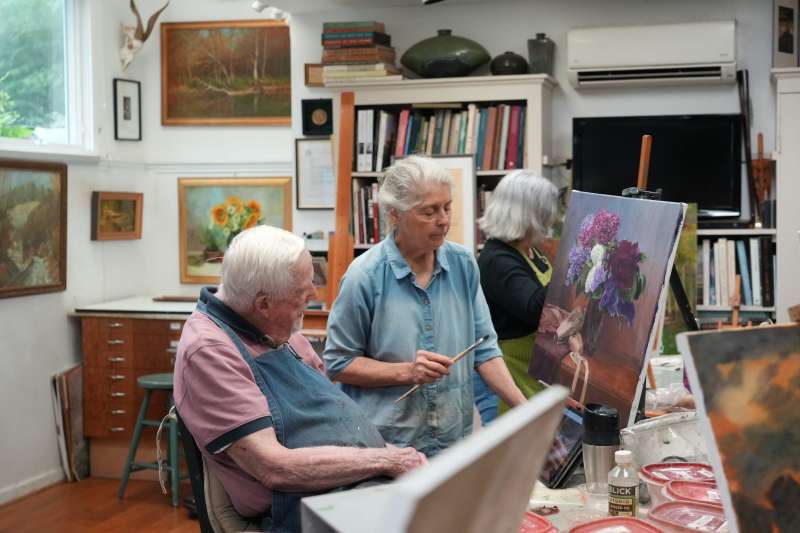
She paints and teaches in an addition at the front of the house. Large windows allow ample natural light, while a rainbow of books, vases and ribbon awards line the shelves.
Bunn opened up this studio to students 18 years ago. Now, she hosts classes every Monday and Tuesday morning, as well as one Saturday a month. She charges $40 per session and caps attendance to eight students.
At the weekly gatherings, the class enjoys dedicated time to work on their paintings along with personalized advice from Bunn. There’s plenty of camaraderie and laughter among the close-knit group — one playful gift from a longtime student, a poster listing Bunn’s most common sayings, hangs on the studio wall — but class is no laidback “paint and sip” hangout.
“Once in a while, I have to say to them, OK, OK, nobody’s painting here,” Bunn said. “… They’re all working hard. I’m kind of rigid about that.”
The group varies in experience: some are lifelong artists with extensive training, while others are exploring a new passion in retirement. But they share a few commonalities, including their age.
“All of my students are seniors,” Bunn explained. “It keeps them mentally alert and keeps them going.”
During class, Bunn walks around the room and offers tips.
“That is a beautiful color in there… now I want you to match that value… get a slightly cleaner, purer color in there.”
She doesn’t sugarcoat her thoughts. Honesty and direct communication are traits she valued in her own artistic mentors, especially the late Myron Barnstone. The legendary Lehigh Valley artist could be “gruff” and even “insulting,” Bunn said, but that tough love worked wonders on his students’ abilities.
“You did something wrong, he told you… ‘this looks like roadkill,’” Bunn remembered. “And then he would tell you what’s wrong with it [and] how to fix it, and you learned.”
Bunn’s students said they appreciate her approach.
“Dot’s the best,” said Ray Albergotti. “She’s a really good teacher. Sometimes, great artists are not great teachers, but she has talent in both areas.”
“She’s amazing,” added Mary Weber. “She shares all her tricks of the trade.”
Weber, who studied art at Kutztown University and has exhibited her paintings throughout the region, has attended Bunn’s sessions for over a decade. She said Bunn’s excellent instruction, as well as her friendships with the other students, have kept her coming back all these years.
In fact, many of Bunn’s students remain enrolled in the weekly classes long after they have mastered specific artistic techniques.
“I have two students that have been with me since the beginning,” Bunn laughed. “I keep telling them — I have given you everything.”
A meticulous painting process
Bunn’s high standards for her students are reflected in her own rigorous creative process. Without a clear structure for her work, she said, her projects devolve into “chaos.”
But after several decades of professional oil painting, she’s developed a system that delivers consistent results.
“I don’t make bad paintings anymore,” Bunn said. “Some paintings are much better than others, but there are no disasters.”
Her foundation is a solid grasp of color theory. Bunn draws from the strict less-is-more philosophy of English artist Frank Morley Fletcher. For each project, she identifies two dominant colors and a secondary color, then uses these hues to mix a unique color palette.
“You must start with those three colors that control the harmony, which means in the end, every color in your palette has a little bit of every other color that was chosen,” Bunn explained. “And it’s in that harmony that true beauty comes out.”
She views this step as so vital to realistic oil painting that she’s instituted a prerequisite color workshop for anyone interested in her weekly classes.
“I teach a very unusual, specific form of color management,” the artist said. “When [students] come into classes… they come with a lot of preconceived ideas that they bring, and it’s really hard to get them switched over.”
“The less colors they use, the more harmony this painting will have.”
When selecting subjects, Bunn seeks inspiration everywhere. For landscape paintings, her husband Tom drives her around Bucks County in search of bucolic vistas. As the region’s countryside gradually disappears to development, she finds herself relying more and more on her stash of reference photos from decades past.
“It used to be easy to go out and find incredible older structures,” she said.
For still-life paintings, Bunn purchases or borrows props that are meaningful and visually striking. She carefully constructs her reference pictures. One painting of morning glories in a vase, for example, began with about 60 photographs as she tweaked the lighting and positioning again and again.
“I don’t work from life,” she explained. “I find that my process requires too many sessions.”
In the time she would need to complete a traditional oil painting “en plain air,” Bunn noted, the sunlight would change dramatically, flowers would wilt and cars would disrupt. But when her inspiration is preserved first in a digital photograph, she can paint confidently from the convenience of her studio.
Next is composition: with careful attention to the “golden ratio,” she sketches an outline of her scene. Then she completes a monochrome “underpainting,” which helps unify the finished product. Lastly, she introduces the full palette of colors to the painting, gradually adding detail. Because the painting must fully dry in between each layer, this last step in the process takes several days.
But her patience pays dividends, rewarding her with a beautiful rendition of her subject.
And even within such a strict process, Bunn finds room for imagination.
“I like playing, mixing certain colors, laying them on top of one another, seeing what happens,” she explained.
Rooted in Bucks County’s rich artistic heritage, Bunn is excited to continue capturing the region’s charm.
“There’s a lot of emphasis on creativity and expression in this area,” Bunn said. “I think artists should really paint what they know.”