A Pittsburgh ministry pursuing “trauma-informed community development” is one of many small groups across the US working to restore community connections amid an epidemic of loneliness and isolation.
On a recent weekday at the Neighborhood Resilience Project in Pittsburgh, some residents were upstairs, training for a project to get more people qualified to perform CPR in marginalized neighborhoods.
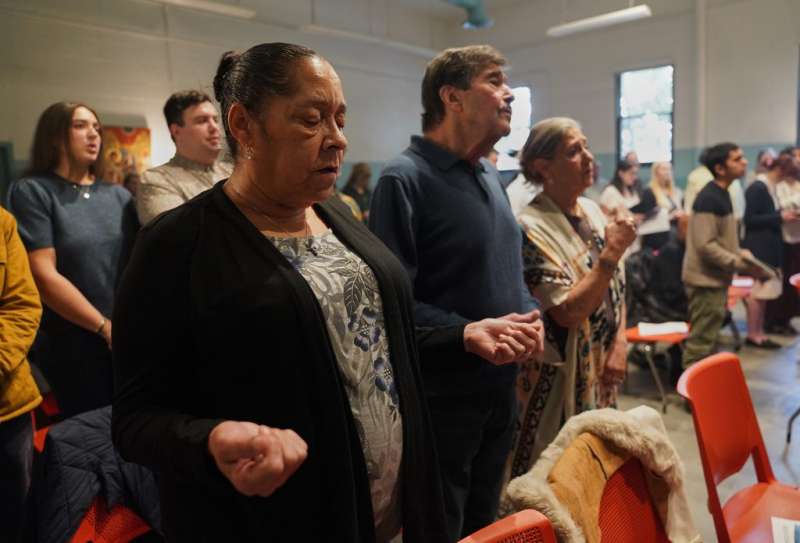
Downstairs amid the fragrant incense of St. Moses the Black Orthodox Church, worshippers were concluding a prayer liturgy. Afterward, they set out folding tables for a light meal of soup, hummus and conversation.
The parish is closely fused with the Neighborhood Resilience Project, an Orthodox social service agency.
They share a modest brick building in Pittsburgh’s Hill District, a historically Black neighborhood just blocks from downtown but a world away—long suffering from crime, gun violence, racism and displacement.
The project’s mission is “trauma-informed community development.” It hosts a food pantry and free health clinic. It deploys community health deputies and provides emotional support at violent crime scenes.
“In our work, community building is absolutely the core intervention,” said the Rev. Paul Abernathy, its founder and CEO.
Social isolation “is no longer simply the experience of marginalized communities,” he observed. “Now it seems as though the infection of isolation has spread across society.”
The center serves people regardless of faith. Not everyone on staff belongs to the church, though the church is attracting members.
Healing ‘block by block’
Across the country, small groups are working to rebuild social connection amid rising loneliness in their own modest ways.
It sounds simple—building relationships. But they’re up against powerful cultural forces.
By many measures, Americans are socially disconnected at historic levels.
They’re joining civic groups, clubs and unions at lower rates than in generations. Recent polling shows that membership rates in religious congregations are around the lowest in nearly a century. Americans have fewer close friends than they used to. They trust each other less. They’re hanging out less in shared public places like coffee shops and parks.
About one in six adults feels lonely all or most of the time. It’s the same for about one in four young adults.
No one has a simple solution. But small groups with diverse missions and makeups like the Neighborhood Resilience Project are recognizing that social disconnection is a big part of the problems they’re trying to address, and reconnection is part of the solution.
“It felt like a real community, and people my age who want to actually do some things and not just talk about doing something,” said Cecelia Olson, a recent college graduate. “We’re going to feed people because they’re hungry, and it’s not that complicated.”
Fidelia Gaba, a University of Pittsburgh medical student who grew up in another church tradition, recently was confirmed at St. Moses.
One Sunday, she felt emotionally distanced and couldn’t even sing. “I remember being carried by the church,” she said. “What was broken in me was healed.”
Project workers are reaching the isolated. Kim Lowe, a community health deputy, helps residents get to a food bank, address a child’s conflict at school, “whatever the need is,” she said.
One recent afternoon, Lowe visited Tricia Berger in the small apartment she shares with her daughter and grandson. Berger said she has multiple sclerosis and struggles with depression and anxiety. Lowe provides practical help, and the two enjoy conversing and watching comedy routines.
“We connect well, with common interests, as well as her helping me get beyond my loneliness and conquering my fear,” Berger said.
For Abernathy, such efforts exemplify community healing.
“It has to be healed person by person, relationship by relationship, block by block,” he said. “Honestly, neighborhood by neighborhood, it can be healed.”